
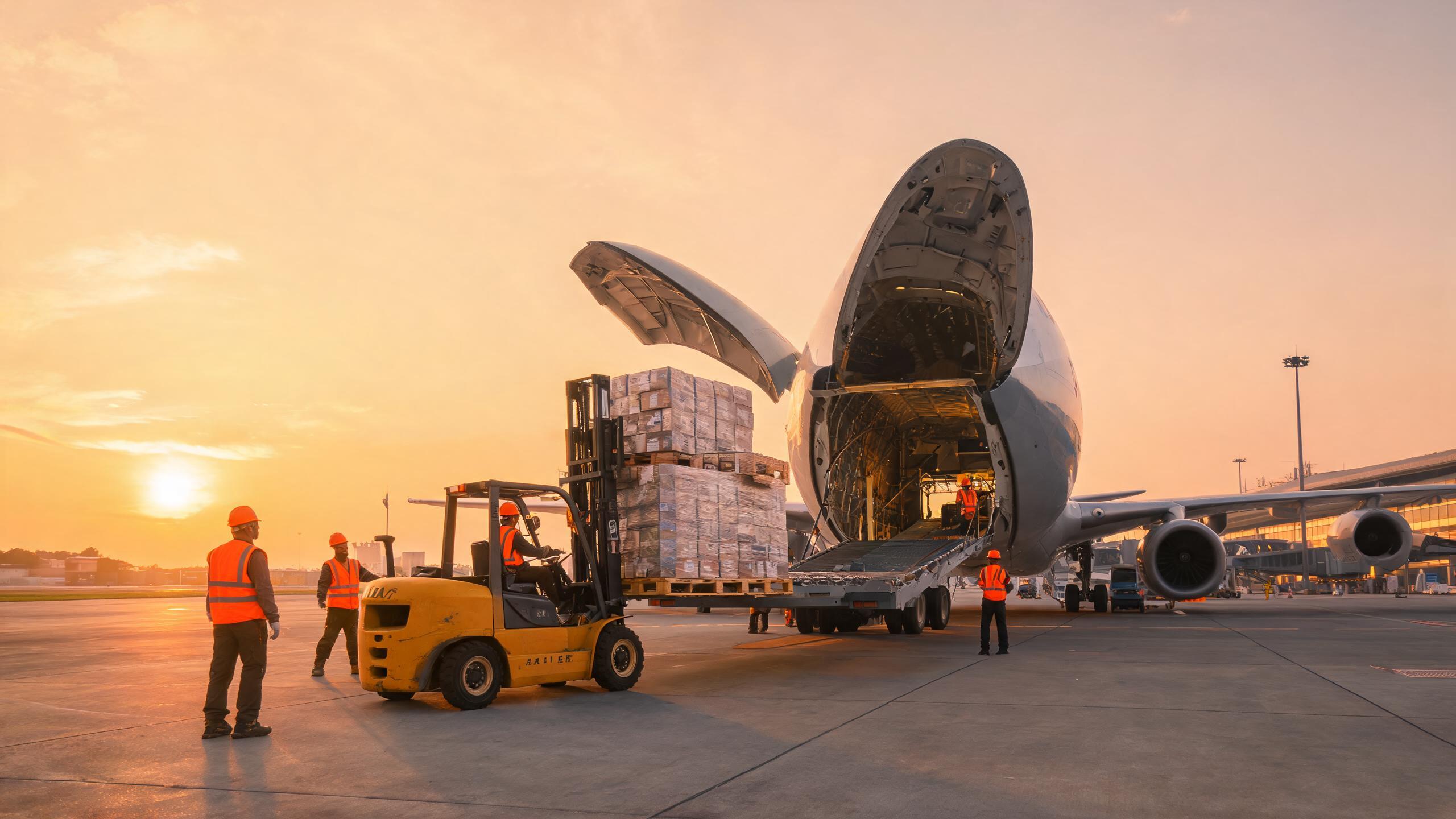
A practical guide for B2B buyers on air freight from China to Europe. Covers real transit times for different service levels (express, standard, economy), the key factors that influence cost (weight, volume, fuel, peak season), and actionable steps to optimize your shipping budget. Includes a comparison table of service options and a checklist for choosing a freight forwarder.
INTERNATIONAL LOGISTICS GUIDE
Air Freight from China to Europe: Complete Guide to Transit Times, Service Options, and Cost Optimization
• Express air freight (door-to-door) takes 3–5 days; standard airport-to-airport takes 5–8 days; economy/consolidated takes 8–12 days.
• Cost is driven by chargeable weight (actual vs. volumetric), fuel surcharges, and peak-season demand. Density matters: heavy, compact goods get better rates per kg.
• You can reduce costs by 15–30% by consolidating shipments, booking during off-peak windows, and using deferred or sea-air hybrid services.
If you are sourcing products from China and selling into Europe, air freight is often the fastest way to get inventory to your warehouse or customer. But the trade-off between speed and cost is real. A wrong service choice can eat your margin; a delayed shipment can lose a retail window.
This guide covers the actual transit times you can expect for air freight from China to Europe, the service options available, and the concrete steps you can take to optimize your shipping budget. We focus on facts, not generalities.
Why Air Freight from China to Europe?
For many B2B buyers, air freight is not the default—sea freight is cheaper per unit. But air freight becomes the right choice when:
- Time-sensitive goods: Fashion, electronics, seasonal products, or promotional items with a fixed launch date.
- High-value, low-volume items: Precision instruments, medical devices, spare parts, luxury goods.
- Inventory replenishment: When stock runs low and sea freight lead times are too long.
- Prototype or sample shipments: Small quantities that need fast delivery for testing or approval.
The key metric is cost per kg vs. cost of delay. If a delayed shipment costs you more in lost sales or penalties than the air freight premium, air is the better option.
Real Transit Times: Air Freight from China to Europe
Transit time depends on the service level you choose. Below are typical ranges for shipments from major Chinese airports (Shanghai PVG, Shenzhen SZX, Guangzhou CAN, Hong Kong HKG) to major European hubs (Frankfurt FRA, Amsterdam AMS, London LHR, Paris CDG, Milan MXP).
| Service Level | Typical Transit Time | Best For |
|---|---|---|
| Express / Door-to-Door (DHL, FedEx, UPS) | 3–5 business days | Urgent, small shipments (under 150 kg); samples; e-commerce fulfillment |
| Standard Air Freight (airport-to-airport) | 5–8 business days | Most commercial cargo; 150–500 kg shipments; regular inventory replenishment |
| Economy / Consolidated Air Freight | 8–12 business days | Non-urgent cargo; shipments that can wait for space on a shared pallet |
| Sea-Air Hybrid | 15–20 days | Cost-sensitive shipments that need faster delivery than sea (30–40 days) but cheaper than pure air |
Note: These are door-to-door or airport-to-airport times excluding customs clearance. Customs delays at either end can add 1–3 days depending on documentation accuracy and commodity type.
Service Options Explained
1. Express Air Freight (Door-to-Door)
This is the premium option. The carrier handles pickup from your supplier's factory in China, export customs, air transport, import customs, and final delivery to your European address. You get a single tracking number from origin to destination.
Typical cost: USD 5–9 per kg (varies by weight, destination, and fuel surcharge).
Best for: Urgent samples, small orders, e-commerce, or when you need a single point of contact.
2. Standard Air Freight (Airport-to-Airport)
You or your freight forwarder arranges pickup and delivery separately. The airline only moves the cargo from the departure airport to the arrival airport. This is the most common B2B option.
Typical cost: USD 3–6 per kg.
Best for: Regular commercial shipments of 100–1,000 kg. You need a reliable freight forwarder on both ends.
3. Consolidated / Deferred Air Freight
Your cargo is consolidated with other shipments onto a single pallet or container. The airline waits until the consolidated unit is full, so departure is not guaranteed on a specific day. This lowers the per-kg rate but increases transit time.
Typical cost: USD 2.50–4.50 per kg.
Best for: Non-urgent cargo; shipments that are flexible on timing.
4. Sea-Air Hybrid
Cargo goes by sea from China to a hub (e.g., Dubai, Singapore, or Colombo), then transfers to air freight for the final leg to Europe. This cuts the sea-only transit time roughly in half while keeping costs lower than pure air.
Typical cost: USD 2–4 per kg.
Best for: Mid-urgency shipments; goods that are too heavy for air but too time-sensitive for sea.
Cost Optimization: How to Reduce Your Air Freight from China to Europe
The single biggest lever you control is chargeable weight. Air freight rates are based on the greater of actual weight and volumetric weight (dim weight).
1. Understand Volumetric Weight
Volumetric weight formula (for air freight):
Formula Length (cm) × Width (cm) × Height (cm) ÷ 6000 = Volumetric weight (kg)
If your shipment is light but bulky, you pay for the space it occupies, not its actual weight.
Example: A carton of 50 kg actual weight but measuring 80×60×60 cm = 80×60×60 ÷ 6000 = 48 kg volumetric weight. In this case, actual weight (50 kg) is higher, so you pay for 50 kg. But if the same carton weighed only 30 kg, you would pay for 48 kg (the volumetric weight).
Action: Reduce packaging size. Use vacuum packing for soft goods. Remove unnecessary void fill. Every cubic centimeter saved reduces your bill.
2. Consolidate Shipments
If you have multiple small orders from different suppliers, consolidate them into one larger shipment. A single 300 kg shipment will have a lower per-kg rate than three 100 kg shipments. Use a freight forwarder with a consolidation service in China.
3. Book During Off-Peak Periods
Air freight rates spike during:
- Chinese New Year (January–February): Factory closures create a rush before and after.
- Golden Week (October): Similar effect.
- Pre-Christmas peak (October–November): High demand for retail inventory.
- Black Friday / Cyber Monday (November): E-commerce surge.
Booking 2–3 weeks before or after these peaks can save 10–20% on the rate. If your shipment is not urgent, schedule it for a Tuesday or Wednesday departure (mid-week flights often have more available space than Monday or Friday).
4. Choose the Right Incoterm
The Incoterm you agree with your supplier affects who pays for air freight and when. Common options:
| Incoterm | Who Pays Air Freight | Who Handles Export/Import Customs |
|---|---|---|
| EXW (Ex Works) | Buyer | Buyer arranges everything |
| FOB (Free on Board) | Buyer | Supplier handles export; buyer handles import |
| CIF (Cost, Insurance, Freight) | Supplier (to destination port) | Supplier handles export; buyer handles import |
| DDP (Delivered Duty Paid) | Supplier (all-in to buyer's door) | Supplier handles both customs |
For air freight from China to Europe, FOB is common for airport-to-airport. DDP is popular for door-to-door express shipments because it simplifies the buyer's process. The cost of DDP is typically higher because the supplier includes risk and handling fees, but it eliminates customs surprises.
5. Use a Freight Forwarder, Not Direct Airlines
Unless you ship 500+ kg regularly, a freight forwarder will get you better rates than booking directly with an airline. Forwarders buy space in bulk and pass on the discount. They also handle documentation, customs, and last-mile delivery.
What to ask a freight forwarder:
- What is the all-in rate per kg (including fuel surcharge, security fee, and terminal handling)?
- What is the transit time guarantee?
- Do you offer consolidation services?
- What is the process for customs clearance at the destination?
- Can you provide a tracking number?
Documentation Checklist for Air Freight from China to Europe
Missing or incorrect documents cause customs delays and demurrage charges. Ensure your shipment includes:
- Air Waybill (AWB) – The contract of carriage. Can be issued by the airline or the forwarder.
- Commercial Invoice – Must include HS code, unit price, total value, and country of origin.
- Packing List – Detailed weight, dimensions, and number of cartons.
- Certificate of Origin – Required for some EU trade agreements (e.g., for preferential duty rates under the EU-China agreement).
- Import License / Permits – For regulated goods (electronics, chemicals, food, medical devices). Check with your customs broker.
Tip: For DDP shipments, the supplier should provide a complete customs declaration. For FOB shipments, you or your customs broker will handle the EU import declaration.
Common Mistakes B2B Buyers Make
- Underestimating volumetric weight – A light, bulky shipment can cost more than a heavy, compact one. Always calculate dim weight before quoting.
- Choosing the cheapest option without checking transit time – Economy air freight may take 10–12 days, which might be too slow for a time-sensitive order.
- Not factoring in customs clearance time – Even with express air freight, customs can take 1–3 days if documents are incomplete.
- Ignoring fuel surcharges – These fluctuate monthly. A quote from one month may be 10% higher the next. Ask for a rate that includes the current fuel surcharge.
- Booking during peak season without a confirmed space – During Chinese New Year or pre-Christmas, airlines may bump cargo if space is tight. Get a confirmed booking (not just a quote).
FAQ: Air Freight from China to Europe
Q: What is the cheapest way to send air cargo from China to Europe?
A: Economy/consolidated air freight, typically USD 2.50–4.50 per kg. For even lower cost, consider sea-air hybrid (USD 2–4 per kg) if you can accept 15–20 days transit.
Q: How long does customs clearance take in Europe?
A: Typically 1–2 business days for standard shipments. For regulated goods (electronics, chemicals, food), it can take 3–5 days. Using a customs broker with a pre-arrival filing can speed this up.
Q: Can I ship dangerous goods by air freight from China to Europe?
A: Yes, but you need a compliant shipper's declaration, MSDS, and packaging that meets IATA DGR regulations. Not all airlines accept all classes of dangerous goods. Confirm with your forwarder first.
Q: What is the minimum weight for air freight?
A: There is no strict minimum, but express couriers (DHL, FedEx) accept shipments as low as 0.5 kg. For standard air freight, most forwarders have a minimum charge of 45–100 kg, even if your shipment weighs less.
Q: How do I track my air freight shipment?
A: For express, you get a tracking number (e.g., DHL 12-digit number). For standard air freight, you get the AWB number, which can be tracked on the airline's website or your forwarder's portal.
Final Advice for Buyers
Air freight from China to Europe is a mature, reliable service, but the cost is not fixed. The rate you pay depends on weight, density, season, and service level. The best approach is:
- Plan ahead – If you can give your forwarder 2–3 weeks' notice, you can book space at a better rate.
- Optimize packaging – Reduce dim weight. Every cm counts.
- Compare at least three forwarders – Rates vary by 10–20% for the same route and service.
- Use a consolidation service – If you have multiple small orders, combine them into one shipment.
For a specific shipment quote, contact your freight forwarder with the exact weight, dimensions, origin city, destination city, and commodity description. They can give you a real-time rate for air cargo from China to Europe based on current space and fuel conditions.