
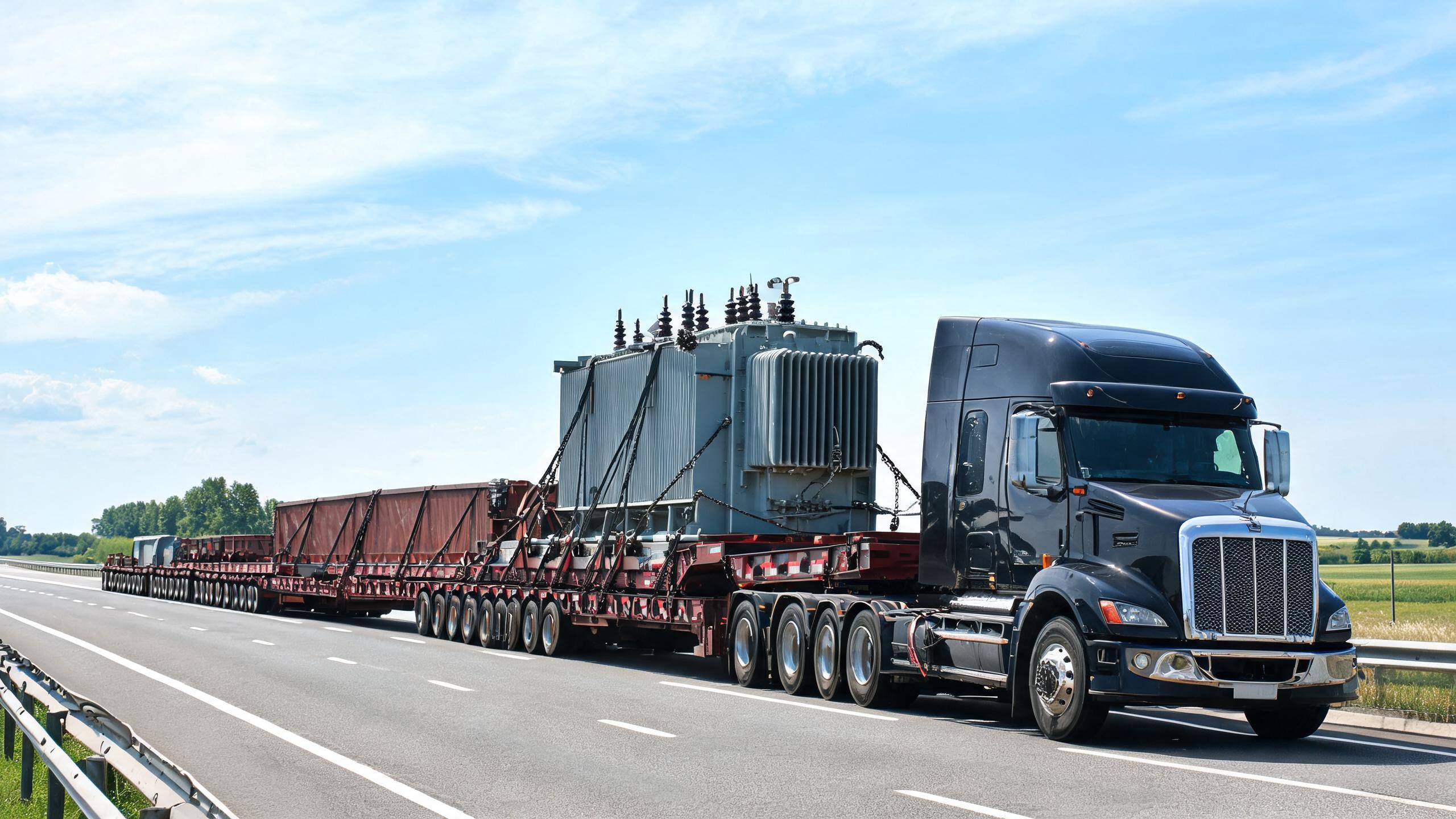
A practical buyer's guide to shipping heavy-haul and oversized cargo from China. Compare flat rack vs collapsible flat rack containers, learn correct flat rack container loading and lashing procedures, and understand route planning for breakbulk and project cargo.
BUYER GUIDE — HEAVY-HAUL & OVERSIZED CARGO TRANSPORT
Flat Rack and Collapsible Flat Rack Containers for Oversized Cargo from China
If you are importing machinery, steel structures, pipes, boats, or prefab components from China, you have probably hit the same wall: the cargo is too wide, too tall, or too heavy for a standard 40’ dry container. The door opening is 2.34 m wide. The internal height is 2.69 m. Anything beyond that will not fit.
This article covers the two practical alternatives — the flat rack container and the collapsible flat rack container — and walks through flat rack container loading, lashing, and route planning for heavy-haul and oversized cargo transport from Chinese ports.
- Flat racks remove the roof and side walls, so cargo can overhang width and height beyond standard container limits.
- Collapsible flat rack containers fold their end walls flat, saving roughly 70–75% of return storage space — important when the box must come back empty.
- Lashing is done to the corner castings and lashing rings on the container floor; the shipper is responsible for the securing plan, not the carrier.
- Route planning starts with port equipment: not every terminal can lift a 40-ton flat rack with cargo.
What Is a Flat Rack Container?
A flat rack container is a shipping container without side walls and without a roof. It has a heavy-duty steel floor and two end walls (head and tail). The end walls can be fixed or collapsible. Cargo is loaded from the side or from the top, and it is secured directly to the container floor.
Flat racks are built to the same ISO footprint as standard containers: 20’ and 40’ lengths, 8’ wide, with corner castings at the same positions. That means they fit on the same ship cells, chassis, and terminal equipment as ordinary boxes.
What changes is the payload and the open structure. A 40’ flat rack typically has a payload of around 40 metric tons, depending on the manufacturer and the shipping line’s rating. The floor is reinforced to take point loads from machinery feet or steel beams without buckling.
Flat Rack vs. Collapsible Flat Rack: What Is the Difference?
The collapsible flat rack container has end walls that fold down onto the floor. When collapsed, the container is a flat steel platform about 40’ long and 8’ wide, with a stack height of roughly 400–500 mm instead of the full 2.6 m.
| Feature | Standard Flat Rack | Collapsible Flat Rack |
|---|---|---|
| End walls | Fixed (vertical) | Fold down flat onto the floor |
| Empty return volume | Full container space (2.6 m high) | About 25–30% of full height |
| Best for | One-way shipment, cargo that needs end-wall support | Shippers who must return the box empty or reposition it |
| Loading access | Side and top | Side and top; end walls can be lowered for end loading |
| Typical extra cost | Base flat rack rate | Higher equipment rate + possible demurrage on the box |
Which one should you choose? If you are shipping one-way from China and the buyer keeps the cargo, a standard flat rack is usually enough. If the container must come back to China empty — for example, on a project with multiple shipments — the collapsible version reduces the return freight because several collapsed units can be stacked and shipped as one load.
What Cargo Goes on a Flat Rack?
Flat racks are the workhorse for heavy-haul and oversized cargo transport. Typical cargo from Chinese factories includes:
- CNC machines, presses, and injection molding machines (often 20–35 tons each)
- Steel beams, pipes, and structural sections longer than 12 m
- Boats, yachts, and hull sections
- Transformers, generators, and wind turbine components
- Prefabricated building modules and concrete panels
- Vehicles, tractors, and construction equipment that exceed standard container width
The rule of thumb: if the cargo is wider than 2.4 m, taller than 2.6 m, or heavier than 25 tons, a flat rack is likely the right choice. If it is merely long (over 12 m), you may also consider an open-top container or a 45’ pallet-wide box — but those have their own limits.
Flat Rack Container Loading: What the Shipper Must Know
Loading a flat rack is not like stuffing a dry container. There is no wall to brace against, and no roof to hold the load down. The securing plan is entirely on the shipper. The carrier provides the container; the shipper provides the lashing.
1. Weight Distribution
Machinery feet or steel beams must be placed over the container’s main longitudinal beams, not in the middle of the floor panels. A point load of several tons on a thin floor section can punch through. Use steel spreader beams or hardwood dunnage to distribute the load across at least two floor cross-members.
2. Lashing Points
Flat racks have lashing rings or D-rings along the floor edges and at the corner castings. The number of lashing points varies by container manufacturer — typically 8 to 16 points on a 40’ unit. Each point has a rated capacity (usually 2 to 5 tons). Ask the shipping line or container owner for the exact lashing diagram and load ratings before you plan the securing.
3. Lashing Materials
Use steel strapping, chain binders, or heavy-duty webbing lashings with ratchet tensioners. For cargo over 20 tons, chain lashings are standard. The lashing angle matters: the flatter the angle to the floor, the less vertical force it provides. A lashing at 30 degrees to the floor is far less effective than one at 60 degrees.
4. Blocking and Dunnage
Wooden dunnage under machinery feet prevents sliding. Wedges and blocking against the end walls stop longitudinal movement. For round cargo like pipes or rollers, use chocks and steel straps around the bundle. Do not rely on friction alone — the ship will roll and pitch, and the forces are much higher than road transport.
5. Overhang Rules
Cargo can overhang the flat rack width and length, but overhang beyond the corner castings requires special approval from the shipping line. Overwidth cargo may force the container to be loaded on deck only, and it may restrict which ports can handle it. Always confirm the overhang limits with the carrier before booking.
Route Planning for Oversized Cargo from China
Route planning for flat rack cargo is different from standard container routing. You cannot simply book any service and assume it will work. Three factors decide the route:
1. Port Equipment at Origin and Destination
Flat racks with cargo are lifted by the same quay cranes as standard containers, but the spreader must be adjustable for flat rack width. Some smaller terminals use mobile harbor cranes that may not handle a 40-ton flat rack with overwidth cargo. Confirm with the local agent that the origin port (e.g., Shanghai, Ningbo, Shenzhen, Qingdao) and the destination port can physically handle the unit.
2. Vessel Type and Stowage
Flat racks are usually stowed on deck, in the top tier of the bay. Overwidth cargo may block the view from the bridge or interfere with lashing of adjacent containers. The carrier’s stowage planner decides whether the cargo can go on a particular vessel. Heavy cargo (over 30 tons) may be restricted to specific vessels with reinforced deck structures.
3. Transshipment Hubs
If your cargo transships through a hub like Singapore, Busan, or Rotterdam, the flat rack must be discharged and re-lashed at the hub. Not all hubs accept flat racks on all services. Book a direct service if possible, or confirm with the carrier that the transshipment port has the equipment and the space.
Cost Considerations
Flat rack freight is typically quoted per unit, not per container like a standard box. The rate depends on:
- Route and distance
- Whether the cargo is overwidth or overheight (this may add a surcharge)
- Whether the container returns empty (one-way vs. round-trip)
- Equipment availability at origin
Collapsible flat racks usually carry a higher equipment rate than standard flat racks, but they can save money on the return leg. If you are shipping multiple batches on a project, ask the freight forwarder to compare the total cost of standard flat racks (one-way) versus collapsible units (with return repositioning).
Documentation and Compliance
Oversized cargo from China requires a few extra documents beyond the standard commercial invoice and packing list:
- Packing list with dimensions and weights — per piece, not per shipment
- Lashing plan — a drawing or sketch showing how the cargo is secured
- DG declaration — if the cargo includes batteries, fuel, or other dangerous goods
- OOG (out of gauge) notification — to the carrier, stating the overwidth/overheight dimensions
Chinese customs may require a pre-shipment inspection for certain machinery categories. Check with your supplier or freight forwarder whether the cargo needs an export license or a CCC certificate before it leaves the factory.
FAQ
Can a flat rack container be loaded with a standard forklift?
Yes, if the forklift can reach the cargo from the side and the cargo is within the forklift’s capacity. For heavy machinery, a crane or reach stacker is usually required.
What is the maximum weight for a 40’ flat rack?
Typically around 40 metric tons payload, but the exact figure depends on the container manufacturer and the shipping line’s rating. Confirm with the carrier before booking.
How many collapsible flat racks can be stacked when empty?
Usually 4 to 6 units, depending on the collapsed height and the stacking strength of the bottom unit. This is the main cost advantage when returning empty containers.
Do I need to provide my own lashing materials?
Yes. The shipper is responsible for the securing plan and materials. Some carriers can supply lashing at a fee, but it is cheaper and more reliable to bring your own.
Can a flat rack go on a standard container ship?
Yes, flat racks are ISO-standard and fit the same cell guides as regular containers. The limitation is the vessel’s deck space and the port’s lifting equipment, not the ship’s structure.
Final Advice for Buyers
When you get a quote for oversized cargo from China, ask the freight forwarder three questions:
- What is the exact payload rating and lashing diagram for the flat rack you will use?
- Which port will the cargo discharge at, and does that port handle overwidth flat racks?
- Is the rate one-way, or does it include the return of the empty container?
Flat rack container loading is a skill. If you are not experienced with lashing heavy cargo, use a freight forwarder that has handled similar project cargo. The cost of a poorly secured load — cargo shifting at sea, container damage, or a port rejection — is far higher than the fee of a professional forwarder.
For specific equipment availability, current freight rates, and route options from Chinese ports, contact our logistics team with your cargo dimensions and weight. We will confirm the flat rack option that fits your shipment.