
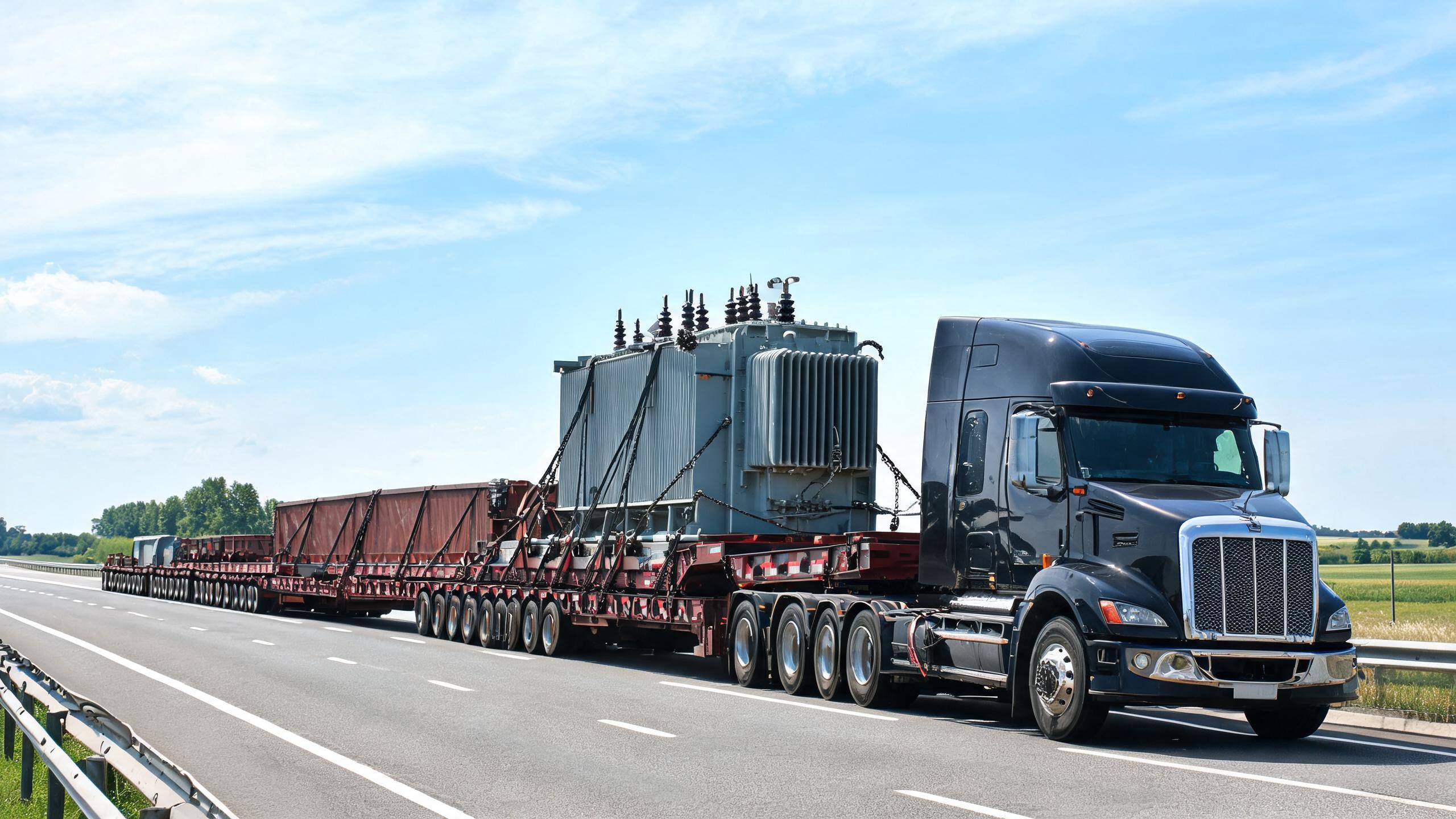
A practical guide for importers moving oversized and heavy-lift cargo out of China. Learn how route surveys work, what specialized equipment is actually used, how permits are coordinated, and what questions to ask a freight forwarder before you book.
BUYER GUIDE — PROJECT CARGO
If your cargo exceeds standard container dimensions — a 40-ton press, a 6-meter-wide processing line, a transformer skid too tall for a flat rack — the transport decision stops being "which forwarder" and becomes a logistics engineering problem. Oversized cargo transport in China involves route surveys, specialized heavy-haul equipment, and provincial permit coordination that most general freight forwarders cannot handle. This guide explains what actually happens on the ground, so you can evaluate a supplier's capability before you commit.
- Route surveys are non-negotiable. They verify bridge clearances, axle-load limits, and turning radii before a single truck moves.
- Heavy-haul trucking China uses specific equipment — lowbed, flatbed, SPMT — matched to weight and dimensions, not "whatever truck is available."
- Permits are issued by provincial transport authorities, and transit provinces each issue their own. Coordination takes days, not hours.
- Ask your forwarder for a written transport plan with axle loads, escort requirements, and permit lead time. If they cannot provide it, they are not a heavy-lift operator.
What Counts as Oversized or Heavy-Lift Cargo
In China, the threshold for "oversized" is defined by the national standard for road transport dimensions. As a practical rule for buyers, cargo is considered oversized or heavy-lift when it exceeds one of the following:
| Parameter | Standard Limit | What Exceeding It Means |
|---|---|---|
| Length | Approx. 18.1 m (for a standard tractor-trailer combination) | Requires a special route survey and possibly a pilot escort vehicle |
| Width | 2.55 m | Wider loads need lane-closure planning and police escort on highways |
| Height | 4.0 m from ground level | Over-height loads must be checked against bridge and overhead line clearances |
| Weight | 49 t gross for a standard 6-axle combination | Heavier loads require multi-axle trailers or SPMT and reinforced route planning |
If your cargo falls outside these figures, you are in the domain of heavy-lift transport China specialists. Standard container trucking companies will either refuse the job or quote a price that reflects their inexperience.
Phase 1: Route Survey — The Foundation of the Whole Move
Before any permit application, a competent operator conducts a physical route survey. This is not a desk exercise using a map. A survey team drives the proposed route and records specific data points:
- Bridge and viaduct clearances — measured height and load rating, not assumed from road signs.
- Axle-load limits — many provincial roads and county bridges have lower limits than the national standard.
- Turning radii at roundabouts and intersections — a 30-meter-long trailer cannot make the same turn as a standard truck.
- Overhead obstacles — power lines, toll gantries, traffic signals, and trees that may need temporary removal or rerouting.
- Road width and shoulder condition — for wide loads, the surveyor checks whether opposing traffic can pass safely.
- Toll station dimensions — some toll plazas physically cannot accommodate an oversized load, forcing a detour.
The survey output is a route dossier with marked waypoints, identified risk points, and a recommended alternative route. This dossier becomes the technical basis for the permit application. A forwarder who skips the survey and applies for permits directly is guessing — and that guess usually surfaces later as a stopped truck, a bridge inspection, or a fine.
Phase 2: Specialized Equipment Selection
Heavy-haul trucking China relies on a specific fleet of trailers, each designed for a weight and dimension envelope. The choice of equipment determines the axle configuration, which in turn determines the permit requirements.
| Equipment Type | Typical Capacity | Best For |
|---|---|---|
| Lowbed trailer (2- to 4-axle) | 30–80 t | Construction machinery, generators, medium transformers |
| Extendable lowbed | 40–100 t, length up to 30 m+ | Long items: steel beams, wind turbine blades, precast concrete elements |
| Multi-axle modular trailer (hydraulic) | 100–300 t | Heavy presses, large molds, industrial equipment |
| SPMT (Self-Propelled Modular Transporter) | Up to several thousand tons (combined) | Extreme loads: ship sections, large chemical reactors, bridge segments |
Two points matter for buyers. First, the equipment must match the cargo's weight distribution, not just its total weight. A 60-ton machine with a concentrated point load requires different axle spacing than a 60-ton evenly distributed load. Second, the trailer configuration affects the number of axles, which directly determines the permit fee and the route restrictions. Ask your supplier for the proposed axle configuration in writing.
Phase 3: Permit Coordination — The Administrative Layer
Oversized cargo permits in China are issued by the provincial transport authority for each province the vehicle passes through. A move from Shanghai to a project site in Sichuan may cross four or five provinces, each requiring its own permit application. This is the part of the process that most often delays shipments.
The permit application typically requires:
- The route survey dossier and proposed route map
- Vehicle and trailer registration documents
- Axle configuration and load distribution calculations
- Proof of insurance for the cargo and the vehicle
- Escort vehicle details (if required)
- Transport schedule and expected transit times
Permit lead times vary. A straightforward single-province permit for a moderately oversized load may be issued in 3–5 working days. A multi-province move with an over-height or over-width load can take 2–3 weeks, especially if any province requests additional engineering review. Police escorts for highway travel are arranged separately and add another layer of scheduling.
The single most common cause of delay in oversized cargo transport from China is not the truck or the route — it is the permit. Buyers who assume "the forwarder handles it" without asking for the permit schedule often discover the issue only when the cargo is already at the loading dock.
Cost Drivers: What You Are Actually Paying For
Heavy-lift transport pricing looks high compared to standard container freight, but the cost components are different. Understanding them helps you evaluate quotes and avoid surprises:
- Route survey fees — covers the physical inspection team, travel, and documentation.
- Permit fees — provincial fees vary; multi-province moves accumulate charges.
- Escort vehicle costs — required for wide or long loads on highways; police escorts are billed separately.
- Specialized trailer rental — lowbeds and modular trailers are not standard fleet equipment; they are rented per move.
- Loading and securing — cranes, rigging, lashing materials, and skilled labor at origin.
- Road closures or temporary infrastructure work — in rare cases, overhead lines are lifted or road barriers removed, with associated costs.
A reputable operator will break these out in the quotation. If a quote arrives as a single lump sum with no breakdown, ask for the components in writing. The breakdown is also your first signal of whether the supplier has actually done the route survey — a surveyed route produces itemized costs, not a round number.
Port and Terminal Considerations
The transport does not end at the port. Oversized cargo must be loaded onto a vessel using either a ship's own cranes, a mobile harbor crane, or a floating crane, depending on weight. The port's equipment capability and the vessel's loading plan are part of the overall logistics chain. For very heavy items, the choice of port matters — not all Chinese ports have the crane capacity or the draft for heavy-lift vessels.
This is why experienced heavy-lift forwarders coordinate the inland transport and the port loading as one operation, not two separate steps. The inland route is chosen not only for road conditions but also for the port's ability to receive the cargo.
Questions to Ask a Supplier Before Booking
Use this checklist when evaluating a heavy-haul transport provider for cargo from China:
- Can you provide the route survey report for my origin-destination pair?
- Which trailer configuration do you propose, and what is the axle load per axle?
- Which provinces will the route cross, and what is the permit lead time for each?
- Do you arrange police escorts, or is that a separate vendor?
- What is your contingency plan if a bridge or road is closed on the planned date?
- Can you coordinate the port loading crane and vessel schedule in the same contract?
If the supplier hesitates on any of these questions, treat it as a red flag. Heavy-lift transport is an engineering discipline, not a forwarding sideline. The right operator will have answers — and documentation — ready.
Bottom Line
Oversized cargo transport from China is manageable when the fundamentals are in place: a physical route survey, matched specialized equipment, and a realistic permit schedule. These three elements determine whether your cargo arrives on time or sits at a provincial border waiting for paperwork. For project cargo, the transport plan is as important as the cargo itself — and it deserves the same level of scrutiny.
If you are planning a heavy or oversized shipment from China, request a transport feasibility assessment from your forwarder before you finalize the purchase contract. The transport cost and lead time should be known inputs to your buying decision, not surprises discovered afterward.