
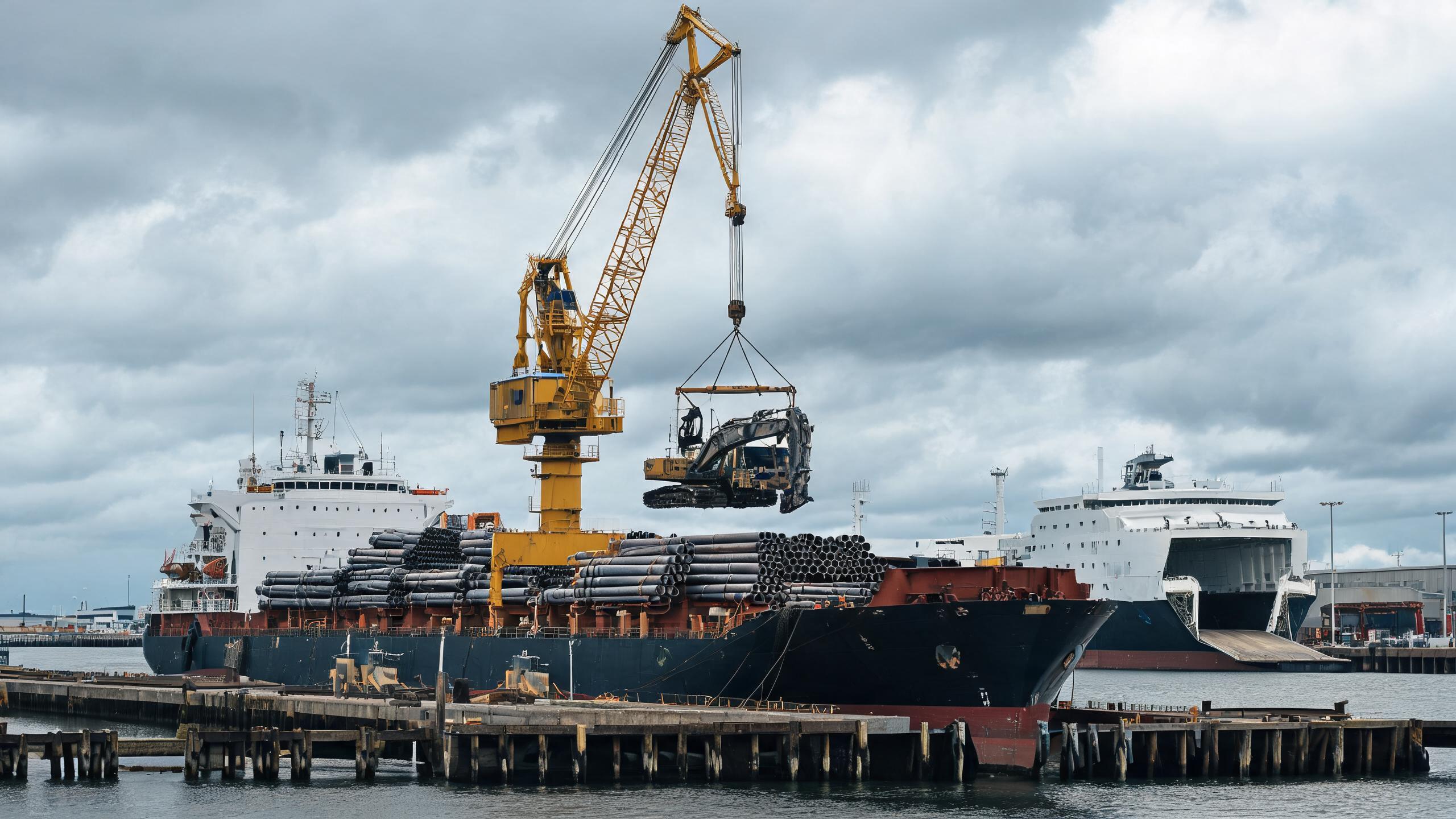
Container shipping doesn't work for everything. When your cargo is too tall, too wide, too heavy, or simply not box-shaped, breakbulk and Ro-Ro shipping from China are the practical alternatives. This guide explains how these two methods work, when to choose each one, what they cost, and what to prepare before your cargo leaves the Chinese port.
FREIGHT BUYER'S GUIDE
Breakbulk and Ro-Ro Shipping from China: Transporting What Containers Can't
If you've ever tried to book a standard 40-foot container for a 12-meter excavator, a 30-ton transformer, or a fleet of new trucks, you already know the problem: it doesn't fit. Container shipping has transformed global trade, but a large share of cargo—machinery, vehicles, steel structures, wind turbine components, industrial equipment—simply cannot be boxed.
For these shipments, two specialized methods carry the load: breakbulk shipping and Ro-Ro (roll-on/roll-off) shipping. Both are routine from Chinese ports, but they work differently, cost differently, and suit different cargo types. This guide explains how to choose between them, what to prepare, and where the costs and risks actually sit.
- Ro-Ro is for self-propelled cargo: cars, trucks, buses, tractors, heavy equipment that can drive on and off the vessel.
- Breakbulk is for anything lifted on and off by crane: oversized machinery, project cargo, steel, crates, and equipment that cannot roll.
- Both methods bypass container size limits, but each has its own packing, lashing, and port-survey requirements.
- Cost is calculated per freight ton or per unit, not per container—so cargo dimensions and weight directly drive your quote.
- Plan for port surveys, lashing materials, and possible out-of-gauge (OOG) surcharges before you book.
Why Container Shipping Fails for Oversized Cargo
A standard 20-foot container has a usable internal height of about 2.39 meters and a payload limit of roughly 28 tons. A 40-foot high cube offers more length but the same width and only slightly more height. Anything wider than 2.35 meters, taller than 2.7 meters, longer than 12 meters, or heavier than the payload limit cannot be containerized.
Even when cargo technically fits, loading can be impractical. A machine that must be lifted, tilted, and threaded through a container door—then chocked and lashed inside—adds handling time, risk of damage, and labor cost. For many shippers, breakbulk or Ro-Ro is simply the more rational choice.
Ro-Ro Shipping from China: When Cargo Can Drive
Ro-Ro vessels are built with ramps. Cargo is driven or towed on board at the port of loading and driven off at discharge. This makes Ro-Ro the fastest and most cost-effective method for anything that moves on wheels or tracks.
What Ships Well by Ro-Ro
- New and used passenger cars, SUVs, and vans
- Trucks, tractor heads, and trailers
- Buses and coaches
- Agricultural machinery: tractors, harvesters, sprayers
- Construction equipment: wheel loaders, excavators (if track-driven or loaded via ramp), forklifts
- Military and special-purpose vehicles
- Self-propelled industrial equipment
Key Advantages of Ro-Ro
- No crane lifting required—reduces damage risk during loading and discharge
- Fast turnaround—a vessel can load hundreds of vehicles in a single day
- Lower handling cost per unit compared to breakbulk for wheeled cargo
- Drive-on, drive-off convenience—your cargo doesn't need to be lifted onto a trailer at the destination
What to Prepare for Ro-Ro
Before your vehicle or machine is accepted at a Chinese port, the carrier will require:
- A clean, drained unit—fuel levels are typically capped (often below a quarter tank), and batteries must be secured or disconnected
- Documentation—commercial invoice, packing list, and a certificate of origin; used vehicles may require additional export documentation depending on the destination country
- Lashing points—the carrier will lash the unit to the deck; you are responsible for ensuring the machine has secure tie-down points
- Pre-shipment inspection—many Ro-Ro lines require a survey report confirming the unit's condition before loading
| Cargo Type | Ro-Ro Suitability | Breakbulk Suitability |
|---|---|---|
| Cars, SUVs, vans | Excellent—drive-on, drive-off | Possible but rare; requires lifting each unit |
| Trucks, buses | Excellent | Possible, but Ro-Ro is faster and cheaper |
| Excavators, bulldozers (tracked) | Good—many load via ramp or low-loader | Good—crane lifting is standard |
| Large transformers, generators | Not suitable—cannot roll | Excellent—crane lifting required |
| Steel coils, pipes, structural steel | Not suitable | Excellent—standard breakbulk cargo |
| Yachts, boats | Possible on specialized Ro-Ro or semi-submersible | Possible via crane lift |
| Wind turbine blades, tower sections | Not suitable | Excellent—project cargo handling |
Breakbulk Shipping from China: For What Can't Roll
Breakbulk cargo is loaded piece by piece using ship cranes or port cranes. There are no containers, no ramps—just cargo secured to the vessel's hold or deck. This is the workhorse method for project cargo and heavy-lift shipments.
What Ships Well by Breakbulk
- Heavy machinery: presses, generators, turbines, compressors
- Transformers and electrical equipment
- Steel products: coils, plates, beams, pipes
- Construction materials: cement plants, crushers, conveyor systems
- Wind energy components: blades, nacelles, towers
- Complete plant modules and prefabricated structures
- Oversized crates and industrial equipment of any shape
Key Advantages of Breakbulk
- No size limits—cargo can be as long, wide, or heavy as the vessel's cranes and holds allow
- Flexible loading—cargo can be lifted, slid, or rolled onto the vessel as needed
- Ideal for mixed project cargo—multiple types of equipment can ship together on one vessel
- Deck and hold options—heavy or oversized items can be stowed on deck; sensitive cargo goes below
Breakbulk Costs: How It's Calculated
Unlike containers, breakbulk freight is quoted per freight ton—the larger of the cargo's weight (in metric tons) or its volumetric measurement (in cubic meters, typically divided by a factor such as 1:1 or 1:2, depending on the carrier). This means your cargo's dimensions directly affect the price. A light but bulky machine can cost more than a heavy, compact one.
Additional charges often include:
- Port handling fees at both loading and discharge
- Lashing and securing materials—chains, wire ropes, dunnage
- Oversize surcharges if the cargo exceeds the vessel's standard crane reach or deck capacity
- Surveyor fees for pre-loading inspection
- Heavy-lift surcharges for individual pieces above a certain weight threshold
Project Cargo Shipping from China: When Breakbulk Meets Planning
Project cargo is the term for large, complex, often multi-piece shipments—a cement plant, a power substation, a mining operation. These shipments usually combine breakbulk with containerized components, and they require coordinated planning across multiple suppliers, ports, and transport modes.
For project cargo shipping from China, the key steps are:
- Cargo list and dimensions—compile a complete list of every piece, with weight, dimensions, and handling requirements
- Vessel selection—match the vessel's crane capacity, hold size, and deck space to your cargo
- Stowage planning—determine which items go in the hold, which on deck, and how to sequence loading
- Lashing design—engineer the securing arrangement for heavy or irregular items
- Port coordination—arrange crane availability, berth scheduling, and any special handling equipment
- Destination planning—arrange discharge, customs clearance, and onward transport to the final site
A freight forwarder experienced in project cargo can handle all of this. If you're shipping a complete plant or a multi-unit consignment, ask your forwarder for a detailed stowage plan before you book the vessel.
Breakbulk vs. Ro-Ro: Which One Do You Need?
The decision is mostly straightforward:
| Factor | Ro-Ro | Breakbulk |
|---|---|---|
| Best for | Self-propelled wheeled or tracked vehicles | Anything lifted by crane |
| Loading method | Drive-on via ramp | Crane lift into hold or onto deck |
| Speed | Fast—hundreds of units per day | Slower—piece-by-piece handling |
| Cost basis | Per unit or per lane meter | Per freight ton (weight or volume) |
| Damage risk | Lower—no lifting of the unit | Moderate—requires careful rigging |
| Typical cargo | Cars, trucks, buses, tractors | Machinery, steel, project cargo |
| Mixed cargo | Limited—mostly vehicles | Excellent—many cargo types on one vessel |
There is some overlap. A tracked excavator can go by Ro-Ro if the vessel has a suitable ramp, or by breakbulk if it's lifted. The choice often comes down to port facilities, vessel availability, and total cost. Ask your forwarder for quotes on both options if you're uncertain.
Practical Tips Before You Ship
1. Get accurate dimensions and weights. Every quote, every vessel selection, and every port plan depends on these numbers. Weigh the cargo, measure it at its widest and tallest points, and include any protrusions like mirrors, exhausts, or attachments.
2. Confirm the destination port's capabilities. Not every port has Ro-Ro ramps or heavy-lift cranes. If your cargo needs special handling at discharge, confirm this before you book.
3. Plan for lashing and securing. Both Ro-Ro and breakbulk require the cargo to be secured to the vessel. The carrier will provide lashing, but you may be charged for it. For heavy or irregular items, a lashing plan may be required in advance.
4. Check export documentation. China's export procedures for used vehicles and machinery can be specific. Confirm whether your cargo requires a pre-shipment inspection, a certificate of origin, or any destination-country import permits.
5. Work with a forwarder who knows project cargo. Breakbulk and Ro-Ro are not like booking a container. The vessel selection, stowage planning, and port coordination require experience. A forwarder with a track record in these shipments will save you time, money, and headaches.
Frequently Asked Questions
Q: Is Ro-Ro cheaper than breakbulk? A: For self-propelled vehicles, Ro-Ro is almost always cheaper and faster. For non-wheeled cargo, breakbulk is the only option. Compare quotes for both when your cargo could go either way.
Q: Can I ship a used excavator by Ro-Ro? A: Yes, if the vessel has a suitable ramp and the excavator can be driven or towed on board. Tracked machines may require a low-loader or skid. Confirm with the carrier before booking.
Q: How far in advance should I book breakbulk or Ro-Ro space? A: Unlike container shipping, these vessels sail on fixed schedules with limited space. Book 2–4 weeks ahead for standard cargo, and 4–8 weeks for project cargo or heavy lifts.
Q: What is an out-of-gauge (OOG) surcharge? A: It's an additional fee charged when cargo exceeds the standard dimensions or weight that a vessel or port can handle without special equipment. It covers extra crane capacity, extended lashing, or deck-space allocation.
Q: Do I need a surveyor? A: Many carriers require a pre-loading survey for used vehicles and heavy machinery to document the cargo's condition. This protects both you and the carrier in case of damage claims.
Final Thoughts
Breakbulk and Ro-Ro shipping from China are mature, well-established services. They move everything from a single used car to a complete cement plant. The key is matching the method to your cargo, preparing accurate documentation and dimensions, and working with a forwarder who knows how to plan and execute these shipments.
If you're shipping vehicles, machinery, or oversized cargo from China and need a freight partner who handles breakbulk, Ro-Ro, and project cargo, contact us with your cargo list and dimensions. We'll help you choose the right vessel and provide a clear, itemized quote.