
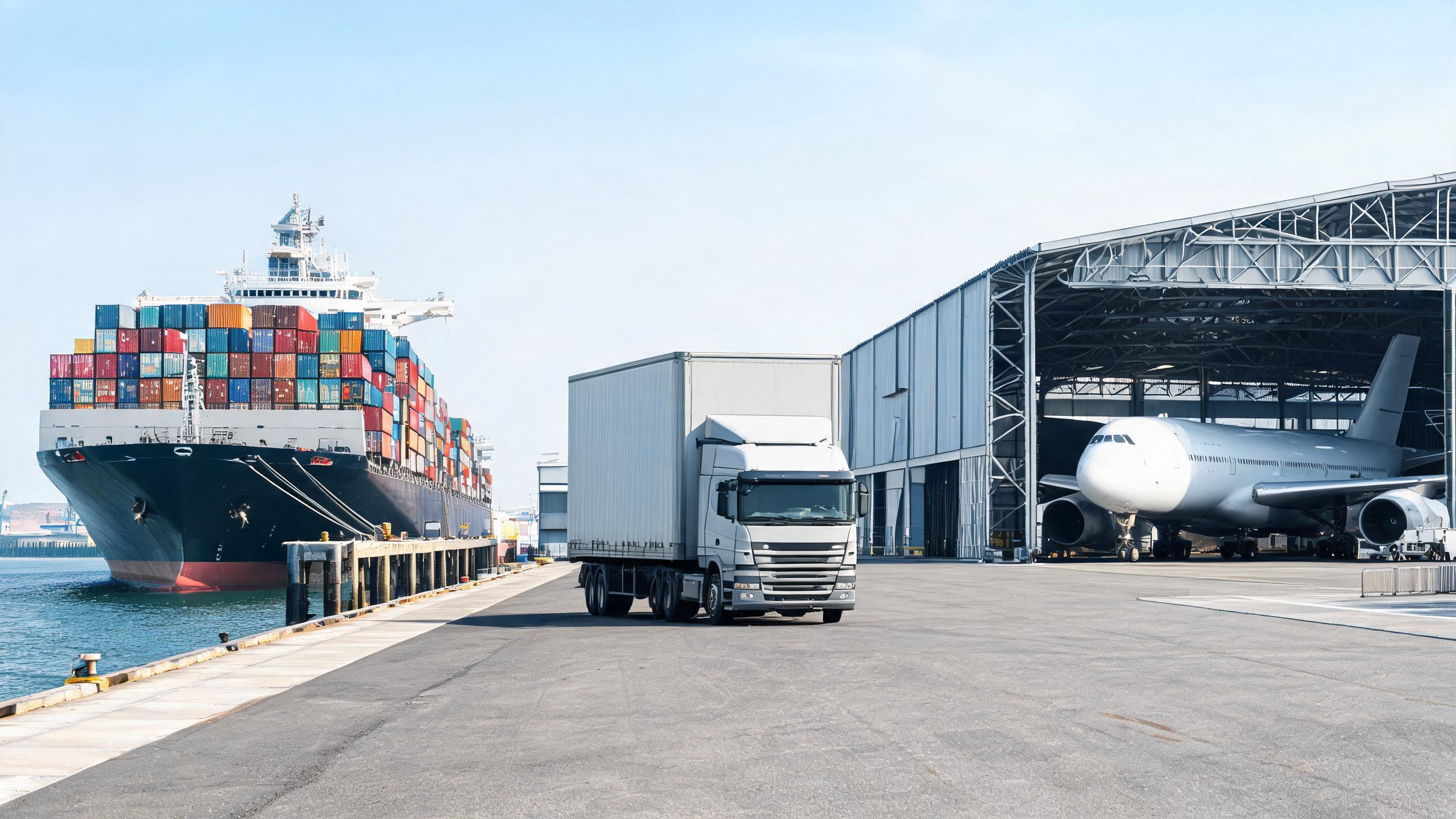
A practical guide to DDP shipping from China for B2B buyers and e-commerce sellers. Compare DDP vs FOB, CIF, and DAP; understand who pays duty and VAT at destination; learn how a China-based forwarder coordinates export customs, main carriage, import clearance, and last-mile delivery; and review the risks of under-declared value and tax liability.
BUYER GUIDE — INCOTERMS 2020
DDP Shipping from China Explained: What Delivered Duty Paid Covers vs FOB, CIF, and DAP
You found a supplier in China. The price is right, the samples passed. Then comes the question every buyer faces: which Incoterm should we use?
If you have ever received a quote that says "FOB Shenzhen" or "CIF Hamburg" and wondered who actually pays the import duty and VAT at the destination — this article is for you. We explain DDP shipping from China in plain terms: what it covers, how it compares to FOB, CIF, and DAP, who pays what at destination, and where the real risks hide.
- DDP means the seller bears all costs and risks until the goods are delivered and cleared at the buyer's door — including import duty and VAT.
- DAP is similar to DDP but without import clearance and duty payment; the buyer handles those.
- FOB and CIF are "named port" terms; the buyer handles import clearance and all destination costs.
- DDP is the default choice for e-commerce parcels and many B2B buyers who want one fixed landed cost.
- DDP carries real risks: under-declared value, incorrect HS codes, and unexpected tax liability. Choose a forwarder with in-house export customs and partner agents at destination.
What DDP Actually Means
DDP stands for Delivered Duty Paid. Under Incoterms 2020, it is the only term where the seller takes maximum responsibility. The seller:
- Handles export customs declaration in China
- Pays for the main carriage (ocean freight or air freight)
- Arranges destination import clearance
- Pays import duty and VAT at the destination country
- Delivers the goods to the buyer's specified address
In short: the buyer receives the goods at their door, and the price quoted is the final price. No surprise charges at customs, no unexpected VAT invoice from a courier, no delay because the buyer's customs broker is on holiday.
For a buyer, DDP shipping from China to USA (or to any EU country) means one number on the invoice is the number you pay. That certainty is the main reason DDP is so popular.
DDP vs FOB vs CIF vs DAP: A Side-by-Side Comparison
The four terms buyers ask about most are FOB, CIF, DAP, and DDP. Here is how they differ in who does what.
| Obligation | FOB | CIF | DAP | DDP |
|---|---|---|---|---|
| Export customs declaration (China) | Seller | Seller | Seller | Seller |
| Main carriage (ocean/air) | Buyer | Seller | Seller | Seller |
| Destination import clearance | Buyer | Buyer | Buyer | Seller |
| Import duty & VAT at destination | Buyer | Buyer | Buyer | Seller |
| Last-mile delivery to buyer's door | Buyer | Buyer | Seller (but not cleared) | Seller |
| Risk transfer point | On board vessel at origin port | On board vessel at origin port | At destination, before clearance | At destination, after clearance |
FOB (Free On Board)
FOB is the most common term in Chinese export trade. The seller delivers the goods on board the vessel at the origin port. From that point, the buyer owns the risk and pays for freight, insurance, import clearance, duty, VAT, and inland delivery.
FOB is fine for experienced importers who have their own customs broker and freight forwarder. It gives the buyer control over the shipping cost. But it also means the buyer must handle everything after the goods leave the Chinese port — including the often confusing import clearance process at destination.
CIF (Cost, Insurance, and Freight)
CIF is FOB plus the seller pays for freight and insurance to the destination port. But that is where the seller's responsibility ends. The buyer still handles import clearance, duty, VAT, and inland transport.
A common mistake: buyers assume CIF means "delivered to my door." It does not. CIF only covers the main carriage to the destination port. The buyer must still arrange customs clearance and pay all import taxes.
DAP (Delivered at Place)
DAP means the seller delivers the goods to the buyer's named place — but without import clearance and without paying duty or VAT. The seller pays for export customs, main carriage, and last-mile delivery to the buyer's address. The buyer handles import clearance and pays the import taxes.
DAP is a good middle ground when the buyer wants the seller to handle logistics but prefers to manage customs themselves — for example, when the buyer has a bonded warehouse or a customs broker who can reduce the declared value legally.
DDP (Delivered Duty Paid)
DDP is DAP plus import clearance and payment of duty and VAT by the seller. The seller is responsible for everything, door to door. The buyer's only obligation is to unload the goods at the destination.
The practical difference between DAP and DDP is simple: under DAP the buyer receives a customs bill; under DDP the buyer does not.
Who Pays Duty and VAT at Destination?
This is the question buyers ask most. The answer depends on the Incoterm, not on what "feels fair."
- FOB / CIF: The buyer pays import duty and VAT at destination. The seller's price does not include these.
- DAP: The buyer pays import duty and VAT at destination. The seller's price includes freight and delivery but not taxes.
- DDP: The seller pays import duty and VAT at destination. The quoted price is the all-in landed cost.
For DDP shipping from China to USA, the seller (or the seller's forwarder) files the ISF (Importer Security Filing), clears the goods through US Customs, and pays the duty. For DDP shipping from China to the EU, the seller's agent files the import declaration in the destination country and pays both the customs duty and the VAT.
One detail worth knowing: in DDP, the seller is technically the "importer of record" at destination. That is a legal role, not just a payment role. It means the seller (or their agent) is the entity that answers to customs if there is a question about the declaration.
How a China-Based Forwarder Coordinates a DDP Shipment
DDP sounds simple in theory, but it requires coordination across four stages. A forwarder with an integrated service model — not just a broker who books a container — is what makes DDP work reliably.
Here is how a full-service China-based forwarder handles a DDP shipment, stage by stage.
Stage 1: Export Customs Declaration in China
The forwarder's in-house customs team prepares the export documents: commercial invoice, packing list, and the export customs declaration. They classify the goods under the correct HS code, declare the value, and submit to Chinese customs electronically.
Having this in-house matters. Many small forwarders outsource export declaration to a third party, which adds a layer of communication delay and error risk. When the forwarder handles it directly, the declaration is filed faster and the documents are consistent with what the destination agent will use.
Stage 2: Main Carriage — Ocean or Air
The forwarder books the main carriage. For ocean freight, that means reserving space on a vessel and arranging the container drayage from the supplier's factory to the port. For air freight, it means booking cargo space and arranging the trucking to the airport.
The forwarder also handles the bill of lading (or air waybill), insurance if requested, and tracking updates. At this stage, the buyer should receive a booking confirmation and a projected departure and arrival window.
Stage 3: Destination Import Clearance
This is where DDP is won or lost. The forwarder's partner agent in the destination country files the import declaration, pays the duty and VAT on behalf of the seller, and arranges for the goods to be released from customs.
For DDP shipping from China to USA, the partner agent handles the ISF filing, the customs bond, and the entry filing. For DDP to the EU, the agent files the Import Control System (ICS) declaration and the SAD (Single Administrative Document) in the destination country.
A forwarder with established partner agents in specific countries — for example, in Germany, the Netherlands, Belgium, France, Poland, the UK, the US, and Canada — can offer DDP reliably because they know the local clearance requirements, the VAT rules, and the documentation standards of each country.
Stage 4: Last-Mile Delivery
Once the goods are cleared, the forwarder arranges the final delivery to the buyer's address. This can be a courier for small parcels, a truck for palletized cargo, or a local delivery service for LTL (less-than-truckload) shipments.
The buyer receives the goods with no further action required. The DDP shipment is complete.
- Do you handle export customs declaration in-house, or do you outsource it?
- Which destination countries do you have partner agents in?
- Does your DDP quote include import duty and VAT, or only freight and clearance fees?
- Who is the importer of record at destination?
- What happens if customs re-classifies the goods and the duty is higher than estimated?
The Risks of DDP Shipping from China
DDP is convenient, but it is not risk-free. Buyers should understand the three main risks before choosing DDP.
Risk 1: Under-Declared Value
Some forwarders offer suspiciously low DDP rates by under-declaring the value of the goods at destination customs. This reduces the duty and VAT they have to pay, so they can quote a lower price.
The problem: if customs audits the shipment and finds the declared value is wrong, the buyer's goods can be held, fined, or seized. In the EU, customs authorities share data across member states, and repeat offenders are flagged. In the US, CBP (Customs and Border Protection) penalties for false declarations can be significant.
How to protect yourself: Ask the forwarder whether the DDP quote is based on the actual commercial value of the goods. A reputable forwarder declares the true value and charges the actual duty and VAT. If a quote seems too low to be true, it probably is.
Risk 2: Tax Liability Falls on the Buyer
Even under DDP, the buyer can end up paying the tax — twice. Here is how it happens.
Some forwarders quote DDP but do not actually pay the VAT at destination. They clear the goods under a "deferred payment" scheme or use the buyer's VAT number without telling the buyer. The buyer later receives a VAT bill from the tax authority, or the goods are held at delivery because the courier demands payment.
How to protect yourself: Confirm in writing that the DDP price includes the payment of duty and VAT at destination, and that the forwarder's agent is the importer of record. Ask for a copy of the import declaration and the duty/VAT payment receipt after delivery.
Risk 3: Incorrect HS Code Classification
The HS code determines the duty rate. If the forwarder classifies the goods incorrectly — either by mistake or to reduce duty — the buyer can face a retroactive bill, a customs audit, or a delay in delivery.
How to protect yourself: Provide the forwarder with a detailed product description, including materials, function, and intended use. Ask which HS code they plan to declare and what duty rate it carries. A professional forwarder will confirm the classification with you before shipping.
When DDP Suits E-Commerce and B2B Buyers
DDP is not always the right choice. Here is a practical guide to when it makes sense.
DDP for E-Commerce Sellers
If you sell on Amazon, Shopify, or your own online store, DDP is usually the best option. Your customers expect a final price at checkout — they will not pay a surprise customs bill when the courier arrives. DDP shipping from China to USA or to the EU lets you:
- Show a transparent landed cost to your customers
- Avoid abandoned carts caused by unexpected fees at delivery
- Maintain consistent delivery times
- Handle returns more easily because the goods are already cleared
For e-commerce, DDP is not a luxury; it is the standard expectation.
DDP for B2B Buyers
For B2B buyers, DDP makes sense when:
- You are new to importing and do not have a customs broker or freight forwarder at destination
- You want a fixed landed cost for budgeting and quoting your own customers
- You are buying a one-off shipment and do not want to set up an import process
- Your shipment is time-sensitive and you want the forwarder to handle everything end-to-end
DDP is less suitable when:
- You have an established import process and your own customs broker who can reduce duty through legal means (e.g., duty drawback, tariff engineering, or free trade agreements)
- You need control over the carrier selection for specialized cargo
- Your goods require special import permits that only the buyer can obtain
In those cases, DAP or FOB with your own broker may give you more control and lower total cost.
How Meicheng Handles DDP Shipping from China
Meicheng operates as an integrated logistics provider, not just a freight broker. This matters for DDP because the coordination between stages is where errors happen.
- In-house export customs declaration and inspection: The export declaration in China is filed by Meicheng's own team, not outsourced. This keeps the export documents consistent with what the destination agent will use.
- Door-to-door coordination: From the supplier's factory in China to the buyer's address overseas, Meicheng manages the drayage, main carriage, clearance, and final delivery as one continuous process.
- Partner agents in key destination markets: Meicheng has established partner agents in Germany, the Netherlands, Belgium, France, Poland, the UK, the US, and Canada. These agents handle the import clearance and pay duty and VAT locally, which is the core of reliable DDP service.
For buyers, the practical benefit is a single point of contact who can answer questions at any stage — from export declaration in Shenzhen to final delivery in Hamburg or Los Angeles.
FAQ: DDP Shipping from China
Q: Is DDP shipping from China to USA more expensive than FOB?
A: The DDP price is higher because it includes freight, insurance, import clearance, duty, VAT, and last-mile delivery. But it is not necessarily more expensive in total — you avoid the cost of hiring your own customs broker, the risk of customs delays, and the administrative cost of handling import clearance yourself.
Q: Who is the importer of record under DDP?
A: The seller (or the seller's agent) is the importer of record under DDP. This means the seller is legally responsible for the accuracy of the import declaration and the payment of duty and VAT.
Q: Can I use my own VAT number under DDP?
A: Sometimes, but it changes the nature of the transaction. If you provide your VAT number, the forwarder may clear the goods under your VAT registration, which means the VAT is reclaimable by you. This is a common arrangement for B2B buyers in the EU. Confirm this with the forwarder before shipping.
Q: What happens if customs rejects the declared value?
A: If customs re-values the goods, the buyer may be asked to pay the difference, or the goods may be held until the issue is resolved. A reputable forwarder declares the true value to avoid this scenario.
Q: Does DDP include insurance?
A: Not automatically. DDP covers the cost and risk of delivery, but insurance is a separate contract. Ask the forwarder whether the DDP quote includes cargo insurance, and consider adding it for high-value shipments.
Final Recommendation
DDP shipping from China is the right choice when you want a fixed landed cost and no customs hassle. It is the standard for e-commerce and a practical option for B2B buyers who are new to importing or buying one-off shipments.
The key is to choose a forwarder who can actually deliver on the DDP promise. That means in-house export customs declaration in China, reliable partner agents at destination, and a transparent policy on declared value and tax payment. Ask the questions listed above before you book — and get the answers in writing.
If you are evaluating DDP shipping from China to USA, the EU, or Canada, contact Meicheng for a quote. We will walk you through the Incoterm options, the landed cost breakdown, and the delivery timeline — so you can choose the terms that fit your business, not the other way around.