
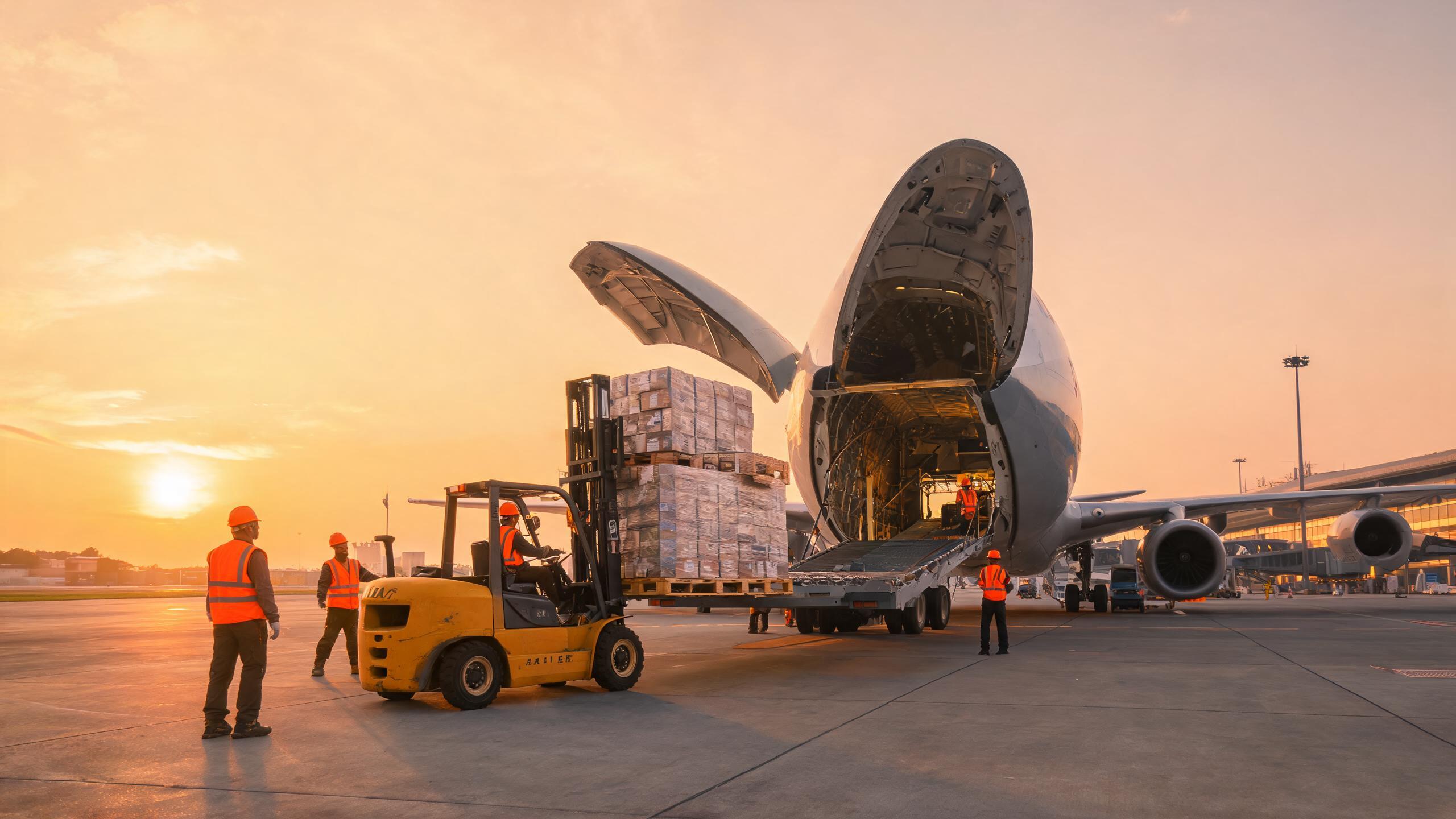
A practical breakdown of air freight rates from China to Europe, covering the key pricing components—fuel surcharges, weight/volume ratio, security fees, and peak season fluctuations—plus actionable strategies to reduce your total air cargo cost without compromising transit time.
FREIGHT COST ANALYSIS
- Air freight rates from China to Europe consist of 5–6 distinct surcharges on top of the base rate. Understanding each one lets you negotiate better.
- The chargeable weight is the larger of actual gross weight and volumetric weight (1:6 ratio for air freight). Optimizing packaging directly cuts your bill.
- Peak season (Oct–Dec) can add 30–50% to the base rate. Timing your shipments outside this window saves significant cost.
- Consolidation and route selection (direct vs. transshipment) are the two most effective levers for reducing per-kg cost.
Why Air Freight Rates from China to Europe Vary So Much
If you have ever received two quotes for the same shipment—one from a forwarder at $4.20/kg and another at $5.80/kg—you know how confusing air freight pricing can be. The difference is rarely about "one company being cheaper." It is about how each quote breaks down the same set of cost components.
Air freight rates from China to Europe are not a single number. They are a composite of the base air freight rate, fuel surcharge, security surcharge, terminal handling charges, airway bill fee, and often a peak season surcharge. Each component moves independently based on market conditions, carrier capacity, and fuel prices.
This article breaks down every component that makes up the air freight cost China to Europe, then gives you five concrete ways to reduce your total bill. No fluff—just the numbers and strategies that matter for B2B buyers.
The 6 Core Components of Air Freight Cost China to Europe
Every air freight quote you receive should itemize these components. If a forwarder gives you a single "all-in" rate without a breakdown, ask for the detail. Here is what goes into the price:
| Component | Typical range (per kg) | What drives it |
|---|---|---|
| Base air freight rate | $1.80 – $4.50 | Route distance, carrier, space availability, contract volume |
| Fuel surcharge (FSC) | $0.60 – $1.20 | Global jet fuel price (updated monthly by IATA) |
| Security surcharge | $0.10 – $0.25 | Mandatory screening, varies by origin airport |
| Terminal handling charge (THC) | $0.15 – $0.35 | Ground handling at origin and destination airports |
| Airway bill fee (AWB) | $20 – $50 per shipment | Documentation, fixed per master airway bill |
| Peak season surcharge (PSS) | $0.30 – $1.50 | Oct–Dec, Chinese New Year, or capacity crunches |
A typical air cargo rate China Europe for a standard shipment (100–500 kg, general cargo) in a non-peak month might be around $3.80–$4.20/kg all-in. During peak season, that same shipment can jump to $5.50–$6.00/kg.
Chargeable Weight: The Hidden Cost Multiplier
This is the single most misunderstood factor in air freight pricing. Airlines charge by chargeable weight, which is the greater of:
- Actual gross weight (total weight of cargo + packaging)
- Volumetric weight (length × width × height in cm ÷ 6,000)
For air freight, the standard divisor is 6,000. That means 1 cubic meter of cargo has a volumetric weight of 167 kg. If your cargo is light but bulky, you pay for the space it occupies, not its actual weight.
Example: A shipment of empty plastic containers weighs 80 kg but occupies 1.2 m³. Volumetric weight = 1.2 × 167 = 200 kg. You pay for 200 kg, not 80 kg.
This is why packaging optimization is one of the fastest ways to reduce air freight rates from China to Europe. Reduce the box size, remove unnecessary void fill, or switch to vacuum packaging—and your chargeable weight drops immediately.
Route and Carrier Selection: Direct vs. Transshipment
Not all routes from China to Europe cost the same. The three main routing options are:
| Route type | Transit time | Typical rate premium | Best for |
|---|---|---|---|
| Direct flight (PVG → FRA, CAN → AMS) | 2–3 days | Baseline (highest) | Urgent, high-value, or temperature-sensitive goods |
| One-stop (via DXB, IST, or HKG) | 3–5 days | 10–20% lower than direct | General cargo with moderate urgency |
| Consolidated / shared space | 5–7 days | 20–30% lower than direct | Non-urgent, low-density, or budget-sensitive shipments |
If your shipment is not time-critical, choosing a one-stop or consolidated service can reduce your air freight cost China to Europe by 20–30%. The trade-off is 2–4 extra days in transit.
5 Actionable Ways to Reduce Air Freight Rates from China to Europe
1. Optimize Packaging to Reduce Volumetric Weight
As explained above, chargeable weight is the bigger of actual vs. volumetric weight. Measure your current packaging and see if you can reduce the box dimensions by even 10%. For a shipment of 200 kg chargeable weight, a 10% reduction saves 20 kg × $4.00/kg = $80 per shipment.
Common improvements: use custom-fit boxes instead of standard ones, remove excess padding, use vacuum packing for soft goods, and consider pallet optimization.
2. Ship Outside Peak Seasons
Peak season surcharges (PSS) typically apply from October to December and again during the two weeks before Chinese New Year (January/February). During these periods, base rates also rise due to capacity shortages.
If your supply chain allows, shift your air freight shipments to January–March (post-CNY lull) or July–September. The difference can be 30–50% on the total rate.
3. Use Consolidation Services
Instead of booking a full pallet or direct flight, combine your cargo with other shipments going to the same destination. Consolidators buy bulk space from airlines and pass the savings to you. For shipments under 500 kg, consolidation is almost always cheaper than direct booking.
Typical savings: 15–25% compared to direct air freight rates for the same weight class.
4. Negotiate with Multiple Forwarders
Forwarders have different contracts with airlines. A forwarder that moves 500 tons per month on the China–Europe lane will get better rates than one moving 50 tons. Ask at least three forwarders for a detailed breakdown of air cargo rates China Europe, including all surcharges.
Do not just compare the "all-in" number. Compare each component. A forwarder with a lower base rate but higher fuel surcharge may not be cheaper overall.
5. Choose the Right Incoterm
If you are the buyer (importer), consider switching from CIF (cost, insurance, freight) to FOB (free on board) and arranging the air freight yourself. This gives you direct control over the forwarder selection and route choice. Many suppliers mark up freight costs by 10–20% when they handle it.
If you are the seller (exporter), offering DDP (delivered duty paid) with a consolidated air service can be a competitive advantage while still controlling costs.
Frequently Asked Questions
What is the current average air freight rate from China to Europe?
As of mid-2024, typical all-in rates for general cargo (100–500 kg) range from $3.80 to $5.50 per kg, depending on route, season, and carrier. Rates are lower for heavier shipments (1,000+ kg) and higher for urgent or oversized cargo.
Why is air freight from China to Europe so expensive right now?
Several factors: high jet fuel prices, reduced passenger belly capacity (post-COVID recovery is still uneven), and geopolitical disruptions (Red Sea crisis pushing some cargo from sea to air). These add $0.50–$1.00/kg compared to pre-pandemic averages.
How can I get a real-time air freight quote?
Contact a freight forwarder with your shipment details: origin city, destination airport, weight, dimensions, commodity type, and desired transit time. Most forwarders can provide a quote within 2–4 hours. For the most accurate rate, provide the exact packaging dimensions and weight.
Is air freight cheaper than express courier (DHL, FedEx, UPS)?
For shipments over 100 kg, air freight via a forwarder is typically 30–50% cheaper than express courier services. Express is better for small parcels (under 50 kg) where speed and door-to-door tracking are critical.
Final Thoughts
Understanding the components behind air freight rates from China to Europe is the first step to controlling your logistics costs. The rate you see on a quote is not fixed—it is a combination of base rate, surcharges, and chargeable weight calculations that you can influence.
Start by auditing your packaging, timing your shipments outside peak seasons, and comparing quotes from multiple forwarders. These three actions alone can reduce your air freight cost China to Europe by 15–30% without changing your supply chain.
If you need a tailored quote or want to discuss your specific shipment profile, contact our logistics team. We work with vetted forwarders on the China–Europe lane and can help you find the right balance of cost and transit time.