
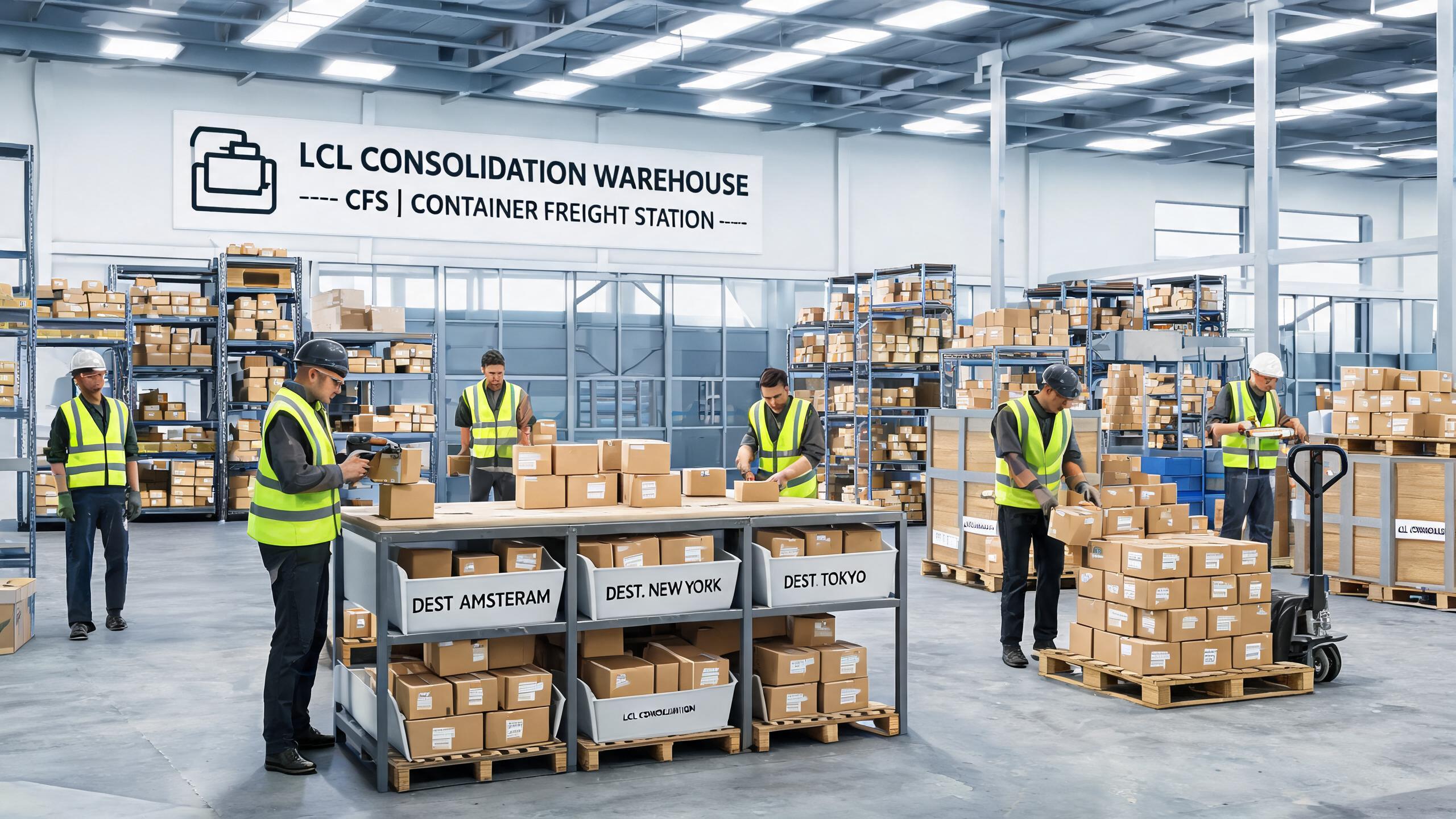
A practical guide to choosing between LCL and FCL shipping from China. We compare cost per CBM, break-even volumes, transit times, damage risk, and W/M billing — based on Meicheng's actual LCL consolidation (twice-weekly North America, weekly Europe) and weekly FCL services from Shanghai, Ningbo, Shenzhen, and Qingdao.
BUYER GUIDE — OCEAN FREIGHT
LCL vs FCL: The Decision Every China Importer Faces
Every importer sourcing from China hits the same fork in the road: should this shipment go as LCL (less than container load) consolidation, or should you book a full container (FCL)? The answer is rarely about container size alone. It depends on your cargo volume, your timeline, your product's fragility, and how the freight forwarder actually bills you.
This guide walks through the real decision criteria — cost per cubic meter, break-even volume, transit time differences, damage risk, and weight-or-measure (W/M) billing — using Meicheng's actual LCL and FCL service schedules as the reference point. If you are comparing lcl vs fcl shipping for your next order from Shenzhen, Yiwu, or Ningbo, these are the numbers that matter.
- LCL makes sense below roughly 15 CBM; above that, a 20' GP FCL usually costs less per unit of cargo.
- LCL is billed on weight-or-measure (W/M) — you pay for whichever is greater, so dense cargo changes the math.
- FCL gives you control over the container; LCL means your goods share space with other shippers' cargo.
- Meicheng runs twice-weekly LCL consolidation to North America and weekly LCL to Europe, with weekly FCL from Shanghai, Ningbo, Shenzhen, and Qingdao.
- Transit time for LCL is typically 3–7 days longer than FCL on the same route due to consolidation and deconsolidation.
How LCL Billing Works: Cost per CBM and W/M
LCL freight is quoted per cubic meter (CBM) or per 1,000 kg, whichever is greater. This is called weight-or-measure billing, commonly written as "W/M." The freight forwarder calculates your chargeable volume two ways:
- By volume: your cargo's total cubic meters (length × width × height of each carton, summed).
- By weight: your cargo's gross weight in tons (1 ton = 1,000 kg).
You are billed on the larger of the two. A pallet of light plastic toys might measure 2 CBM but weigh only 300 kg — you pay for 2 CBM. A pallet of steel fittings might measure 1.5 CBM but weigh 1,800 kg — you pay for 1.8 CBM (the weight).
This is the single most misunderstood part of lcl vs fcl shipping. Importers who only look at the per-CBM rate and ignore their cargo density often get surprised at invoice time. Before you compare LCL against FCL, calculate your chargeable volume using W/M rules, not just physical CBM.
Container Types and What They Actually Hold
FCL rates are quoted per container, not per CBM. The three standard dry containers you will be quoted are:
| Container Type | Internal Volume (approx.) | Usable Volume (realistic) | Max Payload (approx.) |
|---|---|---|---|
| 20' GP (General Purpose) | 33 CBM | 26–28 CBM | 28,000 kg |
| 40' GP | 67 CBM | 56–58 CBM | 26,500 kg |
| 40' HC (High Cube) | 76 CBM | 64–68 CBM | 26,500 kg |
The "usable volume" is lower than the theoretical number because cartons do not pack perfectly — you lose space to pallets, dunnage, and irregular box shapes. A good rule of thumb: plan on 26–28 CBM for a 20' GP and 56–58 CBM for a 40' GP. The 40' HC adds about 10 CBM of vertical space, which matters if your cargo is light and voluminous (e.g., poly bags, pillows, empty containers).
Break-Even Volume: When FCL Beats LCL
The break-even point is the cargo volume at which the total FCL cost equals the total LCL cost. Below that volume, LCL is cheaper; above it, FCL wins.
As a general benchmark for shipments from China to North America or Europe:
- Below 10–12 CBM: LCL is almost always cheaper. You are paying for a fraction of a container.
- 12–18 CBM: The crossover zone. Compare actual quotes — the FCL rate plus origin and destination charges can be close to LCL per-CBM costs.
- Above 18–20 CBM: FCL is typically more economical. You are paying for most of a container anyway; the FCL rate removes the per-CBM markup and the consolidation handling fees.
Why does FCL win at higher volumes? LCL rates include multiple layers of handling: origin consolidation, destination deconsolidation, and the forwarder's margin per CBM. FCL is a single door-to-port move with one set of charges. At 20+ CBM, the LCL per-CBM cost multiplied by your volume usually exceeds the flat FCL rate for a 20' GP.
Transit Time Differences: LCL vs FCL
FCL is faster, but not by as much as many importers assume. The difference comes from two steps that LCL adds:
- Origin consolidation: Your cargo waits at the forwarder's warehouse (CFS) until the consolidation container is full or the cutoff date arrives.
- Destination deconsolidation: At the port of arrival, the container is opened at the CFS, your cargo is sorted out, and it is released separately. This adds 2–4 days at destination.
In practice, on a China-to-North America route, FCL ocean transit might be 18–22 days, while LCL adds 3–7 days for consolidation and deconsolidation. On China-to-Europe, the same pattern holds. If your product is time-sensitive — seasonal goods, promotional items, or restocks for a fast-moving SKU — the FCL premium may be worth it for the schedule certainty alone.
Meicheng's actual schedules reflect this trade-off:
- LCL consolidation: Twice-weekly departures to North America, weekly to Europe, from Shenzhen, Yiwu, and Ningbo.
- FCL: Weekly departures from Shanghai, Ningbo, Shenzhen, and Qingdao.
The twice-weekly North America LCL cutoffs mean your cargo waits a maximum of 3–4 days at origin before sailing. The weekly Europe cutoff means up to 6–7 days of waiting. If you miss a cutoff, you wait for the next one — so plan your factory's production finish date around the cutoff, not the sailing date.
Damage Risk: The Hidden Cost of LCL
LCL cargo is handled more times than FCL cargo. It is loaded onto a truck at the factory, unloaded at the origin CFS, stacked into a consolidation container with other shippers' cargo, unloaded at the destination CFS, and re-loaded onto your local truck. Each handling step is a chance for damage.
FCL cargo, by contrast, is loaded once at the factory (or at a warehouse you control) and sealed. It is not opened until it reaches your destination. If your product is fragile, has irregular dimensions, or requires specific stacking orientation, FCL gives you control over loading. LCL means your cartons sit next to cargo you have never seen — and the consolidator's stacking priorities are speed and space, not your product's fragility.
Mitigation if you must ship LCL:
- Use strong export-grade cartons (double-wall if the product is heavy).
- Palletize whenever possible — pallets protect the bottom layer and allow forklift handling instead of manual throwing.
- Mark cartons clearly with "FRAGILE" and "THIS SIDE UP" in both English and Chinese.
- Consider shrink-wrapping pallets to keep cartons from shifting during transit.
That said, LCL damage is not inevitable. A competent consolidator with a clean warehouse and proper stacking discipline moves millions of CBM per year without incident. The risk is simply higher than FCL, and you should price that risk into your decision.
When Weekly LCL Cutoffs from Shenzhen, Yiwu, and Ningbo Make Sense
Meicheng's LCL consolidation runs from three major sourcing hubs — Shenzhen, Yiwu, and Ningbo — with twice-weekly departures to North America and weekly departures to Europe. When does this make sense for you?
Shenzhen is the right origin if your factory is in Guangdong — the Pearl River Delta manufacturing belt. Electronics, hardware, home appliances, and consumer goods all move through Shenzhen's ports. The twice-weekly North America cutoff means you can finish production mid-week and still catch a sailing that week.
Yiwu is the world's largest small-commodity market. If you are sourcing small consumer goods, accessories, or promotional items from Yiwu's markets, shipping LCL from Yiwu avoids the inland trucking cost to Ningbo or Shanghai. The weekly Europe cutoff aligns with the buying cycles of European importers who shop Yiwu for seasonal goods.
Ningbo is a deep-water port with strong capacity on both North America and Europe lanes. It is the natural choice for cargo from Zhejiang province factories — Ningbo, Hangzhou, Wenzhou, and surrounding areas. If your supplier is in Zhejiang, trucking to Ningbo is shorter and cheaper than to Shanghai.
The weekly cutoff structure matters for your planning. If you know your production will finish on a Friday, and the Europe LCL cutoff is Thursday, you have two options: pay for expedited trucking to make the cutoff, or wait a full week for the next departure. The twice-weekly North America schedule gives you more flexibility — a missed cutoff costs you 3–4 days, not 7.
FCL from Shanghai, Ningbo, Shenzhen, Qingdao: When to Book a Full Container
Meicheng also offers weekly FCL services from four ports: Shanghai, Ningbo, Shenzhen, and Qingdao. The port choice matters for both cost and transit time:
- Shanghai is China's largest port and the default choice for cargo from the Yangtze River Delta — Jiangsu, Zhejiang, and Shanghai itself. It has the most frequent sailings on both transpacific and Europe routes.
- Ningbo is increasingly preferred for Zhejiang cargo. It is less congested than Shanghai, and ocean rates are often slightly lower.
- Shenzhen (including Yantian and Shekou) serves the Pearl River Delta. It is the fastest origin for Guangdong factories.
- Qingdao serves northern China — Shandong, Hebei, Beijing, and Tianjin. If your supplier is in the north, trucking to Qingdao is far cheaper than to Shanghai or Ningbo.
FCL makes sense when:
- Your cargo exceeds roughly 18–20 CBM (the break-even zone).
- Your product is fragile or high-value, and you want control over loading.
- You need the fastest possible transit time with no consolidation delay.
- You are shipping a full 20' GP or 40' GP of a single product line.
- Your cargo is heavy — with W/M billing, dense cargo can make LCL more expensive than FCL even at lower volumes.
Practical Decision Framework: LCL vs FCL
Here is a simple checklist to run through before you request quotes:
| Decision Factor | Choose LCL | Choose FCL |
|---|---|---|
| Cargo volume | Below 12–15 CBM | Above 18–20 CBM |
| Time sensitivity | Can tolerate 3–7 extra days | Need fastest transit |
| Product fragility | Durable, standard cartons | Fragile, irregular, high-value |
| Cargo density | Light, voluminous cargo | Heavy, dense cargo |
| Inventory urgency | Regular restock, flexible timing | Seasonal launch, firm deadline |
| Budget structure | Pay per CBM, lower cash outlay | Pay flat container rate, lower per-unit cost at volume |
Common Mistakes Importers Make
Mistake 1: Comparing LCL per-CBM rate to FCL total cost without adding origin charges. The FCL quote should include the full origin cost — trucking, customs clearance, and port handling — not just the ocean freight line item.
Mistake 2: Ignoring W/M billing. If your cargo is dense, your chargeable volume may be higher than your physical CBM. Always calculate both and use the larger number when comparing LCL vs FCL.
Mistake 3: Assuming FCL is always faster. The ocean transit is similar; the difference is the consolidation buffer. If you miss an FCL sailing, you also wait for the next one. The real advantage of FCL is fewer handling steps, not necessarily a faster sailing.
Mistake 4: Not planning around the cutoff. The cutoff date is the deadline for your cargo to arrive at the CFS or port. Your factory's production finish date must account for trucking time to the origin warehouse. A "weekly departure" means nothing if you miss the cutoff.
Frequently Asked Questions
Q: What is the break-even volume for LCL vs FCL from China?
A: Generally 15–18 CBM. Below that, LCL is usually cheaper; above that, FCL per-unit cost wins. The exact number depends on the route, season, and current ocean rates — request both quotes at your actual volume.
Q: How is LCL billed — by volume or weight?
A: By whichever is greater (W/M). Your chargeable volume is the larger of your cargo's CBM or its gross weight in tons. Dense cargo can make LCL surprisingly expensive.
Q: How much longer does LCL take than FCL?
A: Typically 3–7 days longer on China–North America and China–Europe routes, due to origin consolidation and destination deconsolidation.
Q: Is LCL riskier for damage?
A: Yes, because your cargo is handled more times and shares the container with other shippers' cargo. Use strong cartons, palletize, and mark fragile items clearly.
Q: What is the difference between 40' GP and 40' HC?
A: The 40' HC (high cube) is about 9 CBM larger in volume — 76 CBM vs 67 CBM — and is the better choice for light, voluminous cargo that needs vertical space.
Q: How often does Meicheng ship LCL to North America and Europe?
A: Twice-weekly LCL consolidation to North America and weekly to Europe, from Shenzhen, Yiwu, and Ningbo. FCL sails weekly from Shanghai, Ningbo, Shenzhen, and Qingdao.
Final Recommendation
There is no universal "best" option in the fcl vs lcl shipment decision — only the right choice for your cargo's volume, density, timeline, and fragility. Run the W/M calculation first. Then get both quotes at your actual volume. Then factor in the transit time difference and the damage risk.
If you are below 12 CBM, LCL is the obvious choice — just plan around the cutoff and pack for shared-container handling. If you are above 20 CBM, FCL is almost certainly cheaper and safer. In the 12–20 CBM zone, the decision comes down to your product and your timeline.
For a specific quote on your next shipment — whether LCL consolidation from Shenzhen, Yiwu, or Ningbo, or FCL from Shanghai, Ningbo, Shenzhen, or Qingdao — contact Meicheng with your cargo details: dimensions, weight, and destination port. The right answer starts with the right numbers.