
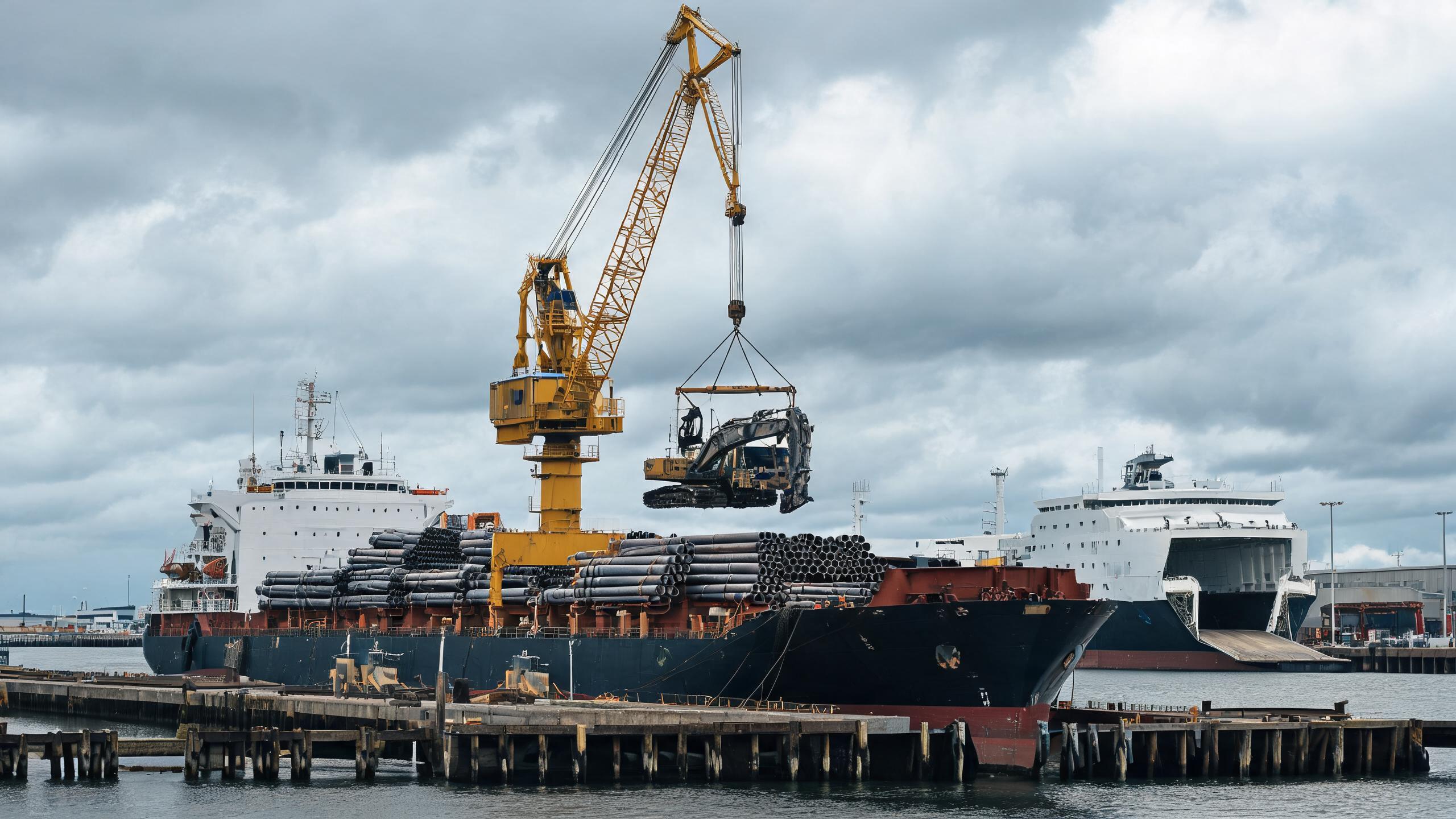
A practical guide for UK importers on shipping from China to UK. Covers Meicheng's weekly FCL and LCL departures from Shenzhen, Yiwu, and Ningbo to Felixstowe, Hamburg, and Rotterdam with 28–35 day transit, LCL consolidation, bonded CFS devanning, UK/EU import entry, door delivery across UK, DE, NL, BE, FR, PL, and CBM calculation. Explains when direct UK ports beat via-Europe routing.
FREIGHT BUYER GUIDE
Sea Freight from China to UK: Weekly FCL and LCL Departures, Transit Times, and Routing Choices
If you import from China to the UK, the two questions that matter most are: how long does shipping take, and which port should the cargo go through — direct to Felixstowe, or via a European hub like Hamburg or Rotterdam?
The answer depends on cargo volume, origin city in China, and whether your final destination is in the UK or mainland Europe. This guide covers Meicheng's actual service structure: weekly FCL and LCL departures, consolidation points, transit windows, bonded devanning, and the practical logic for choosing direct UK ports versus via-Europe routing.
- Weekly FCL and LCL departures from Shenzhen, Yiwu, and Ningbo to Felixstowe, Hamburg, and Rotterdam.
- Transit time: 28–35 days depending on origin, destination port, and routing.
- LCL consolidation available from all three origins; bonded CFS devanning at destination.
- UK/EU import entry handled; door delivery via partner agents in UK, DE, NL, BE, FR, PL.
- Direct UK ports suit UK-only cargo; via-Europe routing suits split UK/EU distribution or when frequency is tighter.
What "Shipping from China to UK" Actually Involves
Sea freight from China to UK is not a single service. It breaks down into:
- FCL (Full Container Load): You book a full 20ft or 40ft container. The container is sealed at origin and opened at destination. Best for cargo above roughly 15–18 CBM.
- LCL (Less than Container Load): Your cargo shares a container with other shippers' goods. You pay only for the space you use. Best for cargo below roughly 15 CBM.
Meicheng runs both, weekly, from three major Chinese sourcing hubs: Shenzhen, Yiwu, and Ningbo.
Weekly Departures: Origins and Destinations
FCL Departures
For FCL, you get a dedicated container. Meicheng offers weekly departures from:
- Shenzhen — the main manufacturing and electronics hub in South China
- Yiwu — the world's largest small-commodity wholesale market
- Ningbo — a major deep-water port with strong manufacturing hinterland in Zhejiang
Each origin has direct sailing options to the three destination ports below.
LCL Departures and Consolidation
For LCL, your cargo is consolidated with other shipments at the origin warehouse. Meicheng consolidates from Shenzhen, Yiwu, and Ningbo on a weekly schedule. This is particularly useful for buyers who purchase from multiple suppliers in one region and want a single consolidated shipment.
The consolidation point matters: if your suppliers are spread across Guangdong, the Shenzhen consolidation point is the most practical. If you source from Zhejiang or Jiangsu, Ningbo or Yiwu is closer.
Destination Ports
| Destination Port | Country | Typical Use |
|---|---|---|
| Felixstowe | UK | Direct UK entry; largest container port in the UK |
| Hamburg | Germany | Main EU hub; strong for Germany and Central Europe |
| Rotterdam | Netherlands | Europe's largest port; excellent for Benelux and inland distribution |
China to UK Shipping Time: 28–35 Days
The china to uk shipping time from departure to arrival is 28–35 days. The variance depends on:
- Origin city: Shenzhen to Felixstowe tends to run at the shorter end; Yiwu or Ningbo may add a few days depending on the mother vessel schedule.
- Destination port: Hamburg and Rotterdam are typically reached in the same 28–35 day window, but final delivery to inland points adds transit time.
- Routing: Direct sailings to Felixstowe are faster for UK-only cargo. Via-Europe routing adds a feeder leg or overland leg into the UK.
A realistic planning assumption: book your stock 6–8 weeks ahead of your target availability date. This covers the ocean transit, customs clearance, and door delivery.
Bonded CFS Devanning: What It Means for LCL
For LCL shipments, your cargo arrives at a Container Freight Station (CFS) at the destination port. This is where the container is opened and individual consignments are separated.
Meicheng uses bonded CFS devanning. "Bonded" means the facility operates under customs supervision. Your cargo can be devanned, stored, and prepared for customs clearance without paying duties until the goods are formally entered. This gives you flexibility:
- You can inspect the cargo before clearing it.
- You can split a single consolidated shipment into multiple entries.
- You can hold goods in bond if you are waiting for documentation or payment terms.
For UK importers, bonded devanning is especially useful when you import mixed SKUs and need to verify the packing list before submitting the customs declaration.
UK/EU Import Entry and Door Delivery
Once your cargo is devanned, Meicheng handles the UK or EU import entry. This includes:
- Customs declaration and duty calculation
- VAT handling (where applicable)
- Compliance with the relevant import regulations
After clearance, door delivery is arranged through partner agents in:
- UK
- Germany (DE)
- Netherlands (NL)
- Belgium (BE)
- France (FR)
- Poland (PL)
This is a key advantage of using a freight forwarder with a European agent network: one booking covers the entire chain from your supplier's factory in China to your warehouse door in Europe.
CBM Calculation: How to Size Your LCL Shipment
CBM (Cubic Meter) is the unit used to charge LCL freight. It is calculated as:
Length (m) × Width (m) × Height (m) = CBM per carton
Then multiply by the number of cartons. For example:
- Carton size: 0.6 m × 0.4 m × 0.4 m = 0.096 CBM
- 200 cartons = 19.2 CBM
Important: Chargeable Weight
LCL carriers charge on the greater of actual weight or volumetric weight. The standard air/sea conversion is:
1 CBM = 1,000 kg (for sea freight LCL)
So if your cargo is 10 CBM but weighs 12,000 kg, you are charged on 12 CBM (the higher of the two). Conversely, if it is 10 CBM and weighs 6,000 kg, you are charged on 10 CBM.
| Shipment Size | Recommended Mode | Why |
|---|---|---|
| Under 5 CBM | LCL | FCL would be wasteful; LCL keeps cost proportional to volume |
| 5–15 CBM | LCL or small FCL (20ft) | Compare quotes; sometimes a 20ft FCL is cheaper than LCL at this range |
| 15–25 CBM | 20ft FCL | FCL becomes cost-efficient; avoids LCL handling fees |
| 25–58 CBM | 40ft FCL / 40ft HQ | Full container utilization; lowest per-CBM cost |
| Above 58 CBM | Multiple FCLs or project cargo | Requires a tailored booking |
Direct UK Ports vs. Via-Europe Routing: When Each Makes Sense
This is the most common routing decision UK importers face. Here is the practical logic.
Choose Direct to Felixstowe When:
- Your final destination is in the UK only. Direct routing avoids the extra feeder leg or overland crossing from Europe.
- You need the shortest china to uk shipping time. A direct sailing to Felixstowe removes the need for a second vessel or a truck across the Channel.
- Your cargo is time-sensitive. Retail stock, seasonal goods, or promotional items benefit from the shorter, simpler chain.
- You want a single customs entry in the UK. Direct routing means the cargo clears UK customs at Felixstowe, with no EU transit complications.
Choose Via-Europe (Hamburg or Rotterdam) When:
- You have split distribution between the UK and mainland Europe. If part of your order goes to a UK warehouse and part to Germany or France, routing via Rotterdam or Hamburg lets you clear and distribute from one hub.
- You need more frequent sailings or better schedule reliability. Hamburg and Rotterdam are served by more mother vessels than Felixstowe. If your origin port has limited direct UK sailings, a Europe hub may give you a faster overall transit.
- You are sourcing from a Chinese port with better connectivity to Europe than to the UK. Some origins in China have direct services to Rotterdam but only transshipment options to Felixstowe. In that case, via-Europe can be faster.
- You want bonded storage flexibility in the EU. Cargo can be held in a bonded facility in Rotterdam or Hamburg and released into the UK or EU as demand requires.
| Factor | Direct to Felixstowe | Via Hamburg / Rotterdam |
|---|---|---|
| Transit time | Shorter for UK-only cargo | Adds 2–5 days for UK delivery |
| Cost | Lower for UK-only destinations | May be lower if mother vessel frequency is better |
| Customs | Single UK entry | EU entry + UK entry if crossing the Channel |
| Distribution | UK only | UK + EU from one hub |
| Schedule flexibility | Depends on direct service frequency | Usually more sailing options |
Practical Steps for Your First Booking
- Calculate your CBM and weight. This determines whether you need FCL or LCL.
- Confirm your origin. Shenzhen, Yiwu, or Ningbo — pick the one closest to your suppliers.
- Decide your destination port. UK-only cargo: Felixstowe. Split UK/EU: Hamburg or Rotterdam.
- Ask for the sailing schedule. Weekly departures mean you can plan production to hit a specific cut-off date.
- Check the transit window. Plan for 28–35 days from departure to arrival, then add customs clearance and door delivery time.
- Confirm the delivery address. Meicheng's partner agents cover UK, DE, NL, BE, FR, PL — make sure your final warehouse is within the service area.
FAQ
Q: What is the fastest shipping from China to UK? A: Air freight is faster but significantly more expensive. For sea freight, direct routing to Felixstowe with a 28–35 day transit is the standard option. For urgent small parcels, express courier services are an alternative.
Q: How is LCL freight charged? A: LCL is charged per CBM, with a minimum chargeable volume (typically 1 CBM). The chargeable weight is the greater of actual weight or volumetric weight (1 CBM = 1,000 kg for sea freight).
Q: Can I ship LCL if my cargo is less than 1 CBM? A: Yes, but you will likely be charged the minimum LCL rate (usually 1 CBM). It may be more economical to consolidate with other purchases or consider a courier service for very small shipments.
Q: Do you handle customs clearance in the UK? A: Yes. Meicheng handles UK/EU import entry as part of the service. This includes the customs declaration and coordination with the destination agent.
Q: What is bonded CFS devanning? A: It means your LCL cargo is devanned at a customs-supervised facility. You can inspect and prepare the cargo before formal customs entry, and you can hold goods in bond without paying duties until they are entered.
Q: How far in advance should I book? A: For sea freight, booking 1–2 weeks before your cargo is ready at the origin warehouse is typical. For peak season (August–October), book earlier to secure space.
Conclusion
Shipping from China to UK is a well-established lane with weekly departures and reliable transit times. The key decisions are: FCL vs. LCL, which origin port, and direct UK vs. via-Europe routing. Meicheng's service structure — weekly FCL and LCL from Shenzhen, Yiwu, and Ningbo to Felixstowe, Hamburg, and Rotterdam, with bonded CFS devanning, UK/EU import entry, and door delivery across six European countries — covers the full range of scenarios a UK importer is likely to face.
For a specific quote or sailing schedule, contact Meicheng with your cargo details: origin city, CBM, weight, and destination address. The right routing depends on your exact numbers, and those are best assessed on a per-shipment basis.