
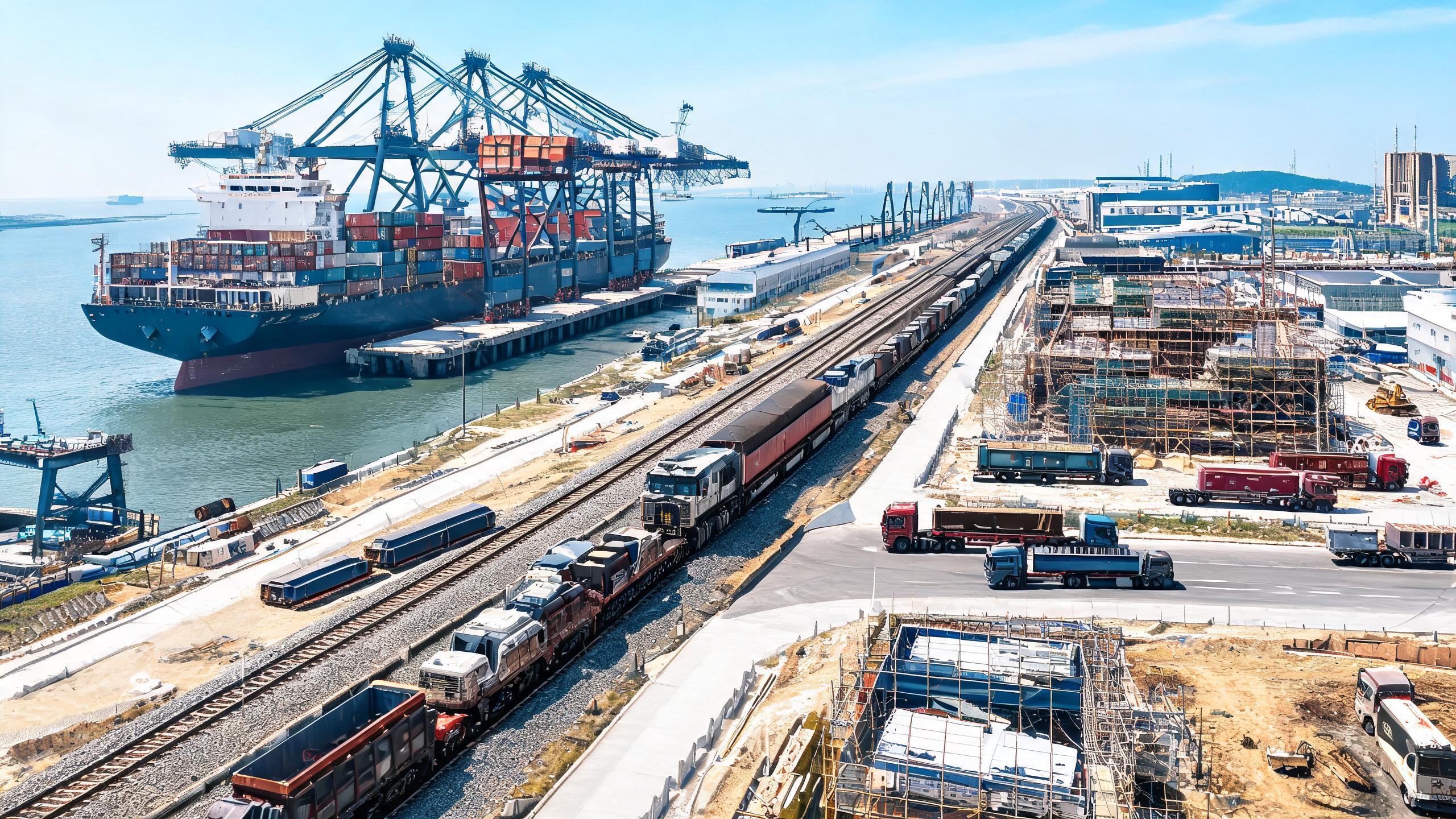
A practical guide for EPC contractors and project owners sourcing from China. Learn how multi-modal routing, critical path scheduling, and on-site supervision reduce risk, control cost, and keep heavy industrial projects on schedule.
PROJECT CARGO LOGISTICS CHINA
For an EPC contractor, the cargo is not the business—the project is. A delayed turbine, a cracked heat exchanger, or a shipment stuck at a transshipment port for three weeks does not just cost freight. It shifts the critical path, triggers liquidated damages, and strains the relationship with the client. This is why EPC logistics China is a discipline distinct from standard freight forwarding. It requires three things working in concert: multi-modal route planning, critical path scheduling, and on-site delivery supervision.
- Multi-modal planning is about risk allocation across transport legs, not just the lowest ocean rate.
- Critical path scheduling links the freight timeline to the construction schedule—not to the factory's ready date.
- On-site supervision at the Chinese factory prevents the most common cause of project delay: cargo that is ready but not shippable.
Why EPC Logistics China Is Different from Standard Freight
Standard freight forwarding moves cargo from A to B. EPC turnkey project transport China moves a complete scope—often hundreds of packages, from a single 120-ton reactor to boxes of bolts—from multiple Chinese suppliers to one project site, in a sequence that matches the installation plan. The difference is not the size of the cargo. It is the interdependence.
In a typical project cargo logistics China operation, you are managing:
- Oversized and heavy-lift items (reactors, columns, transformers) requiring special equipment and route surveys.
- Breakbulk and conventional cargo that cannot fit in a standard container.
- Containerized cargo that must arrive in a specific order for foundation works, mechanical installation, and commissioning.
- Customs and compliance documentation for both export from China and import at the destination country.
Each of these has a different lead time, a different risk profile, and a different cost structure. Treating them as one shipment is a common mistake. Treating them as independent shipments is equally wrong. The logistics provider must manage them as a single program with a single schedule.
Multi-Modal Planning: Matching the Route to the Cargo
There is no single "best" route from China to a project site. The right route depends on the cargo dimensions, the destination infrastructure, and the project timeline. A good EPC logistics China provider will present options, not just a quote.
| Mode | Best Suited For | Key Considerations |
|---|---|---|
| FCL (Full Container Load) | Standard equipment, components, materials | Most predictable transit time; requires containerable dimensions |
| Breakbulk / Conventional | Oversized items, heavy machinery, project cargo | Requires chartering or berth booking; port infrastructure at discharge must be verified |
| RORO (Roll-on/Roll-off) | Wheeled equipment, vehicles, mobile plants | Fast loading/unloading; limited to self-propelled or towable cargo |
| Rail (China–Europe / China–Central Asia) | Time-sensitive cargo to inland destinations | More predictable than ocean for some corridors; weight and dimension limits apply |
| Air Freight | Critical spares, urgent items, high-value small cargo | High cost per kg; rarely used for heavy project cargo except in emergencies |
The planning process should include a route survey for oversized cargo. Questions to answer before booking: Is the discharge port capable of handling the vessel's crane or do we need a floating crane? Are there bridge or road weight limits on the final leg from port to site? Is there a jetty at the site, or do we need to plan for lightering? These are not hypothetical questions. They determine whether the cargo arrives in one piece and on time.
Common Multi-Modal Combinations
Most turnkey project transport China programs use a combination of modes. A typical example for a power plant project in Southeast Asia:
- Leg 1: Factory to Chinese port by heavy-lift truck or barge (inland waterway).
- Leg 2: Ocean freight by breakbulk vessel from Shanghai or Tianjin to the destination port.
- Leg 3: Discharge and final-mile delivery by multi-axle trailer, with police escort if required.
Each leg has a different risk profile. The inland leg in China is often underestimated—permits for oversized loads, bridge assessments, and weather windows can add days. A competent EPC logistics China partner will flag these early, not after the cargo is already on the truck.
Critical Path Scheduling: Linking Freight to Construction
The most common scheduling error in project cargo logistics China is planning the freight around the factory's production schedule instead of the project's installation schedule. The factory says the equipment will be ready in Week 12. The freight forwarder books a vessel for Week 14. But the project site needs the foundation bolts in Week 8 and the main vessel in Week 20. If the bolts travel with the main vessel, the foundation work stops.
Critical path scheduling reverses this logic. It starts with the construction schedule and works backward:
- Identify the installation sequence at the project site (foundation → structural steel → equipment setting → piping → commissioning).
- Determine the required arrival date for each package or package group.
- Subtract the transit time for each leg, including buffer for customs clearance and port congestion.
- Work backward to the required departure date from China.
- Communicate this date to the factory as the binding shipment date—not the other way around.
Practical tip: Build a buffer of 7–10 days into the arrival date at the discharge port for every critical item. Vessels get delayed, ports get congested, and customs authorities are not always predictable. A buffer at the port is cheaper than a buffer at the construction site.
This approach requires the logistics provider to have visibility of the project schedule, not just the cargo list. It is a collaborative exercise. The EPC contractor shares the installation plan; the logistics team translates it into a shipping schedule with milestones, deadlines, and early-warning indicators.
What Should Be on the Schedule
- Factory ready date (confirmed in writing)
- Inland transport booking date
- Port cut-off date at the Chinese load port
- Vessel departure and estimated arrival dates
- Customs clearance window at destination
- Final-mile delivery date to site
- Installation date at site (the anchor point)
Each of these is a checkpoint. If any checkpoint slips, the logistics provider must flag it immediately and propose a mitigation—changing the vessel, splitting the shipment, or using an alternative route.
On-Site Delivery Supervision: The Layer That Prevents Delays
Many EPC logistics China programs fail not because the freight forwarder cannot move cargo, but because nobody supervises the cargo at the factory before it ships. The equipment is ready, but the export packing is wrong. The crates are too heavy for the forklift at the port. The lifting lugs are not marked. The customs documentation does not match the commercial invoice. These are all preventable—but only if someone is physically present at the factory during packing and loading.
On-site supervision in China serves three functions:
- Quality control of export packing: Verifying that the packing specification matches the transport mode. Breakbulk cargo needs different protection than containerized cargo. Long sea voyages in tropical climates require moisture protection that is different from short-haul shipments.
- Verification of cargo readiness: Checking that the cargo is actually complete, that spare parts are included, and that the dimensions and weights match the shipping documents. Discrepancies found at the factory are easy to fix. Discrepancies found at the port cause delays and demurrage.
- Documentation accuracy: Ensuring that the packing list, commercial invoice, and bill of lading are consistent. A single mismatch can stop customs clearance at the destination port for days.
What a Good Supervision Report Includes
| Checkpoint | What Is Verified |
|---|---|
| Packing condition | Crating quality, bracing, moisture protection, marking |
| Dimensions & weight | Actual vs. declared; impact on trucking and vessel loading |
| Lifting points | Marked and accessible; capacity matches the rigging plan |
| Documentation | Packing list, invoice, COO, inspection certificates |
| Loading supervision | Proper lifting, lashing, and securing on the truck or barge |
This is not a value-added service. It is a risk-control measure. The cost of sending a supervisor to the factory for two days is a fraction of the cost of one day of vessel demurrage or one week of project delay.
Choosing an EPC Logistics Partner in China
Not every freight forwarder can handle EPC turnkey project transport China. The selection criteria should be based on demonstrated capability, not on marketing language. Ask for:
- Case references for projects of similar cargo type and destination region. Ask for the specific challenges and how they were resolved.
- In-house capabilities: Does the provider have its own offices in China, or does it subcontract to a local agent? For project cargo, direct control matters.
- Heavy-lift expertise: Can the team produce a lifting and lashing plan? Do they have experience with abnormal loads and route surveys?
- Destination network: Do they have a partner or office at the discharge port? Final-mile delivery is where projects often fail.
- Communication protocol: Who is the single point of contact? How often will you receive status updates? What is the escalation process when a checkpoint slips?
Project cargo logistics China is not a commodity service. The provider's ability to plan, schedule, and supervise directly affects your project's bottom line. Choose accordingly.
Frequently Asked Questions
How far in advance should we engage a project cargo logistics provider?
Ideally at the bidding stage, and no later than 8–12 weeks before the first cargo is ready for shipment. Early engagement allows time for route surveys, vessel booking, and permit applications—especially for oversized cargo.
What is the biggest cost driver in EPC logistics China?
For oversized cargo, the vessel charter and the heavy-lift equipment at discharge are typically the largest cost items. For containerized cargo, the inland trucking in China and the final-mile delivery at destination often exceed the ocean freight cost.
Can we use a standard freight forwarder for our EPC project?
You can, but the risk is higher. Standard forwarders are optimized for moving containers efficiently. Project cargo requires route surveys, schedule integration, and on-site supervision—capabilities that are not part of a standard forwarding operation.
How do you handle customs clearance for project cargo?
For China export, the key is ensuring the documentation matches the cargo exactly. For destination import, we recommend engaging a customs broker at the discharge port early, especially for countries with complex import regimes for used equipment or temporary imports.
Final Thoughts
EPC turnkey project transport China is a coordination problem as much as a transportation problem. The logistics provider must understand the project schedule, plan the route with risk in mind, and verify the cargo before it leaves the factory. When these three elements are in place, the freight becomes a reliable part of the project plan—not a source of uncertainty.
If you are planning a project with Chinese suppliers and need a logistics partner who can manage multi-modal routing, critical path scheduling, and on-site supervision, contact us to discuss your cargo list and project timeline. We will provide a detailed logistics plan, not just a quotation.