
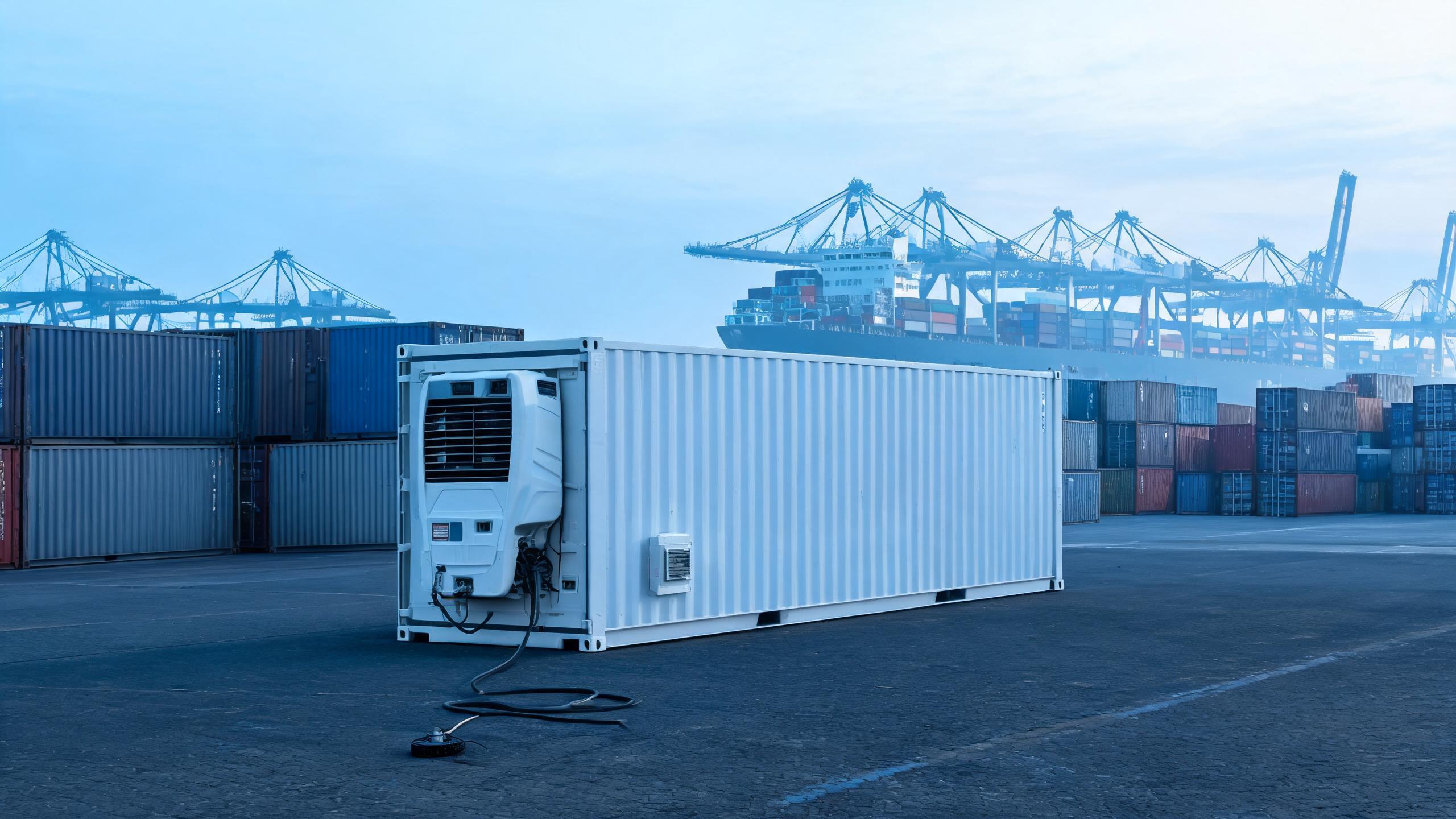
A practical guide to reefer container shipping from China covering 20' and 40' reefer containers, temperature-controlled rail for Central Asia, cold chain for pharma and food, bonded temperature-controlled storage in Shenzhen, Shanghai, and Ningbo, setting temperature and ventilation, terminal power and monitoring, and weekly FCL sailings with COSCO, Maersk, MSC, and CMA CGM space contracts.
BUYER GUIDE — REEFER LOGISTICS FROM CHINA
Reefer Container Shipping from China: When You Need Temperature-Controlled Containers, Cold Chain for Pharma & Food, and What to Check Before You Book
If you are buying perishable food, pharmaceuticals, or any cargo that must stay within a strict temperature range, the ocean freight is not the hardest part. The hardest part is the chain of custody: the reefer container, the terminal power supply, the monitoring, the bonded storage at origin, and the carrier's sailing schedule. One gap in that chain and your shipment arrives with a temperature excursion — which for pharma can mean a rejected batch, and for food can mean a spoiled container.
This guide covers what you actually need to check when shipping temperature-controlled cargo from China: when a 20' or 40' reefer is required, how temperature-controlled rail containers work for Central Asia routes, how bonded temperature-controlled storage works in Shenzhen, Shanghai, and Ningbo, and how to secure reliable weekly FCL sailings with major carriers.
- Reefer container shipping from China requires checking three things before booking: the container's temperature range, the terminal's power and monitoring capability, and the carrier's weekly sailing frequency.
- For Central Asia routes, temperature-controlled rail containers are a viable alternative to ocean freight — but only if the rail operator provides continuous power and monitoring.
- Bonded temperature-controlled storage (2–25°C) in Shenzhen, Shanghai, and Ningbo lets you consolidate cargo without paying import duties until the goods actually ship.
- Meicheng works with COSCO, Maersk, MSC, and CMA CGM on reefer-capable weekly FCL sailings, with space contracts that protect your booking during peak season.
When Do You Actually Need a Reefer Container?
A reefer container is not just a box with a cooling unit. It is a sealed, insulated environment with a refrigeration system that can hold a set temperature — typically between -25°C and +30°C — for the entire voyage. You need one when your cargo has a defined temperature tolerance and cannot survive outside that range.
Common cargo types that require reefer container shipping:
- Pharmaceuticals: vaccines, insulin, biologics, clinical trial materials — usually 2–8°C or 15–25°C
- Food products: fresh fruit, vegetables, meat, seafood, dairy, chocolate, frozen goods — typically -18°C to +4°C
- Chemicals: certain raw materials that degrade at high temperatures
- Cosmetics and personal care: emulsions and creams that separate when exposed to heat
The choice between a 20' and 40' reefer depends on volume and weight. A 20' reefer typically holds about 26–28 CBM (cubic meters) of usable space, while a 40' reefer holds roughly 58–60 CBM. If your cargo is heavy and dense (like frozen meat), a 20' may be more economical. If it is light and bulky (like packaged food), a 40' is usually the better cost per unit.
| Container Type | Usable Volume | Typical Temperature Range | Best For |
|---|---|---|---|
| 20' Reefer | ~26–28 CBM | -25°C to +30°C | Dense, heavy cargo; smaller shipments |
| 40' Reefer | ~58–60 CBM | -25°C to +30°C | Light, bulky cargo; larger volumes |
| 40' High Cube Reefer | ~66–68 CBM | -25°C to +30°C | Maximum volume for light cargo |
Setting Temperature and Ventilation: What the Shipper Must Specify
A common mistake in reefer container shipping is assuming the carrier will "figure out" the right settings. They will not. The shipper must specify the temperature set point and, for certain cargo, the ventilation rate.
Temperature Set Point
This is the temperature the reefer unit maintains. It should match the cargo's required transport temperature, not the storage temperature. For example, some pharmaceuticals are stored at 2–8°C in a warehouse but shipped at 5°C to allow for temperature fluctuations during loading and unloading. Specify the set point in your shipping instructions.
Ventilation
Fresh fruit and vegetables respire — they take in oxygen and release carbon dioxide and heat. Without ventilation, they spoil. The reefer unit can provide fresh air exchange at a rate measured in cubic meters per hour (CMH). Typical settings:
- Closed ventilation (0 CMH): for frozen goods, pharmaceuticals, and any cargo that must not be exposed to outside air
- Low ventilation (10–20 CMH): for most fresh produce
- High ventilation (20–40 CMH): for cargo with high respiration rates, like bananas or avocados
If you are unsure about the ventilation requirement, ask your freight forwarder to confirm with the carrier. Getting this wrong is one of the most common causes of cargo damage in reefer container shipping.
Terminal Power and Monitoring: The Critical Link
A reefer container runs on its own power while on the vessel, but at the terminal — before loading and after discharge — it must be plugged into the terminal's reefer power points. This is where shipments fail.
Before you book reefer container shipping from China, check:
-
Does the terminal have sufficient reefer power points? Major Chinese ports like Shenzhen (Yantian, Shekou), Shanghai (Yangshan, Waigaoqiao), and Ningbo (Beilun, Chuanshan) have dedicated reefer racks with power supply. But during peak season, these can fill up. Your freight forwarder should confirm availability before your container arrives.
-
Is there continuous monitoring? A reefer container should have its temperature logged from the moment it is plugged in at origin until it is unplugged at destination. Ask for the temperature record (often called the "reefer report" or "temperature log") at discharge. This is your proof that the cold chain was maintained.
-
What happens if the power fails? Most modern terminals have backup generators, but you should know the protocol. If there is a power outage, the reefer unit will stop cooling, and the temperature will drift. The monitoring system should alert the terminal operator immediately.
Meicheng's operational team checks terminal reefer availability and power status before each booking, and we request the temperature log at discharge for every reefer shipment we handle. This is not a value-add — it is a basic requirement for protecting your cargo.
Temperature-Controlled Rail Containers for Central Asia Routes
If your destination is in Central Asia — Kazakhstan, Uzbekistan, Kyrgyzstan, Tajikistan — ocean freight is not always the fastest option. Rail from China to Central Asia takes roughly 10–15 days, compared to 30–40 days via ocean to a port like Bandar Abbas or Poti, followed by overland trucking.
Temperature-controlled rail containers are available on these routes. They work like reefer containers but are designed for rail wagons, with a diesel-powered refrigeration unit that runs for the entire journey. Key considerations:
- Power supply: Rail containers have their own generator, so they do not depend on the locomotive for power. Confirm the generator's fuel capacity covers the full transit time.
- Monitoring: Ask for GPS and temperature tracking during transit. Some rail operators provide real-time monitoring; others only provide a log at destination.
- Border crossings: Central Asia routes cross multiple borders (China–Kazakhstan, Kazakhstan–Uzbekistan, etc.). Each crossing can add 1–3 days of waiting time. Ensure the reefer unit's battery and fuel can handle these delays.
For pharma shipments to Central Asia, rail is often preferred over ocean because the transit time is shorter and the temperature is easier to control. But the route must be planned carefully, and the rail operator must have a proven track record with reefer containers.
Bonded Temperature-Controlled Storage in Shenzhen, Shanghai, and Ningbo
If you are consolidating cargo from multiple suppliers in China, or if your cargo arrives at the port before your vessel departs, you need a place to store it that maintains the cold chain. Bonded temperature-controlled warehouses offer two advantages:
-
No import duties until the goods ship: Bonded warehouses are considered "outside" the customs territory. You do not pay import duties or VAT until the goods are formally entered into the destination country. This is a cash-flow advantage.
-
Temperature-controlled storage (2–25°C): The warehouse maintains a controlled environment, so your cargo stays within its required temperature range while waiting for the vessel.
Meicheng uses bonded temperature-controlled storage facilities in Shenzhen, Shanghai, and Ningbo, with a temperature range of 2–25°C. This covers most pharma and food requirements. If you need colder storage (e.g., -20°C for frozen goods), we can arrange that as well, but it is typically in a separate freezer facility, not the bonded warehouse.
When to Use Bonded Storage
- Consolidation: You have multiple suppliers in different Chinese cities, and you want to consolidate the cargo into one container before shipping.
- Schedule gaps: Your cargo is ready before the next available vessel. Instead of shipping it early and paying for storage at the destination, you store it in a bonded facility at origin.
- Quality inspection: You need to inspect or sample the cargo before it ships. Bonded warehouses allow this without clearing customs.
Weekly FCL Sailings with COSCO, Maersk, MSC, and CMA CGM: Space Contracts Matter
Reefer containers are not always available on every vessel. Carriers allocate a limited number of reefer slots per sailing, and during peak season (typically August–October for fruit, and year-round for pharma), these slots fill up fast.
This is where a space contract makes a difference. A space contract is an agreement between you (or your freight forwarder) and the carrier that guarantees a certain number of reefer slots on specific sailings. It protects you from being bumped when demand exceeds supply.
Meicheng holds space contracts with four major carriers — COSCO, Maersk, MSC, and CMA CGM — for reefer-capable weekly FCL sailings from major Chinese ports. What this means in practice:
- Guaranteed space: Your reefer container is booked on a specific vessel, and the carrier is contractually obligated to honor that booking.
- Priority during peak season: When reefer slots are scarce, contract holders get priority over spot bookings.
- Rate stability: A space contract locks in the rate for the contract period, protecting you from spot market volatility.
| Carrier | Typical Routes from China | Reefer Capacity | Notes |
|---|---|---|---|
| COSCO | North America, Europe, Mediterranean | High — large reefer fleet | Strong on transpacific and Asia–Europe |
| Maersk | Global | Very high — largest reefer fleet | Good monitoring tools; remote container management |
| MSC | Global | High | Competitive rates; frequent sailings |
| CMA CGM | Europe, Africa, Indian Ocean | Medium-high | Strong on Africa and Indian Ocean routes |
The right carrier depends on your destination, your cargo type, and your budget. A freight forwarder with space contracts across multiple carriers can compare options and book the one that best fits your schedule and requirements.
How to Prepare a Reefer Shipment from China: A Step-by-Step Checklist
- Define your cargo's temperature range and ventilation requirement.
- Confirm the container type (20' or 40' reefer) based on volume and weight.
- Check the carrier's reefer capacity and sailing frequency for your destination.
- Confirm terminal reefer power availability at origin and destination.
- If consolidating, arrange bonded temperature-controlled storage.
During loading:
- Pre-cool the reefer container to the set point before loading (this takes 1–2 hours).
- Load the cargo quickly and close the doors immediately. Minimize the time the doors are open.
- Set the temperature and ventilation on the reefer unit's control panel.
- Record the container number, seal number, and temperature set point in your shipping documents.
During transit:
- Request GPS and temperature tracking if available from the carrier.
- Ask your freight forwarder to monitor the shipment and alert you if there is a deviation.
At destination:
- Check the temperature log (reefer report) before accepting the container.
- If there is a temperature excursion, document it and notify the carrier and your freight forwarder immediately.
FAQ: Reefer Container Shipping from China
Q: What is the difference between a reefer container and a temperature-controlled container? A: They are the same thing. "Reefer" is the industry term for a refrigerated container. A temperature-controlled container is the same equipment, described in more general terms.
Q: Can I ship pharmaceuticals in a 20' reefer with a 2–8°C temperature range? A: Yes, but you must also consider ventilation (pharma typically requires closed ventilation), terminal power availability, and the carrier's monitoring capability. For high-value pharma, you may also want to use a temperature data logger inside the container, independent of the reefer unit's own monitoring.
Q: How far in advance should I book a reefer container? A: For peak season (August–October), book 3–4 weeks in advance. For off-peak, 1–2 weeks is usually sufficient. If you have a space contract, you can book closer to the sailing date.
Q: What happens if the reefer container loses power during transit? A: The temperature will drift toward ambient. The reefer unit will restart when power is restored, but the temperature excursion may have already damaged the cargo. This is why continuous monitoring and a temperature log are essential.
Q: Can I use a reefer container for non-temperature-sensitive cargo? A: You can, but it is not cost-effective. Reefer containers are more expensive to book than dry containers. If your cargo does not need temperature control, use a standard dry container.
Final Thoughts: Reefer Shipping Is a Chain, Not a Single Service
The most important thing to understand about reefer container shipping from China is that it is a chain of services: container selection, temperature and ventilation settings, terminal power, monitoring, storage, and carrier booking. Each link must hold. If one link fails — the terminal runs out of reefer power points, or the carrier bumps your booking — the entire shipment is at risk.
This is why working with a freight forwarder that handles reefer shipments regularly matters. Meicheng's team manages the full chain: we confirm container availability, set the temperature and ventilation per your cargo's requirements, check terminal power and monitoring, arrange bonded storage if needed, and book weekly FCL sailings with COSCO, Maersk, MSC, or CMA CGM under space contracts.
If you are planning a reefer shipment from China — whether it is pharma, food, or any temperature-sensitive cargo — send us your cargo details, destination, and required temperature range. We will confirm the equipment, the sailing schedule, and the total cost before you commit.
READY TO SHIP?
Contact us with your cargo type, volume, temperature requirement, and destination port. We will come back with a confirmed reefer booking, including terminal power confirmation and monitoring details.