
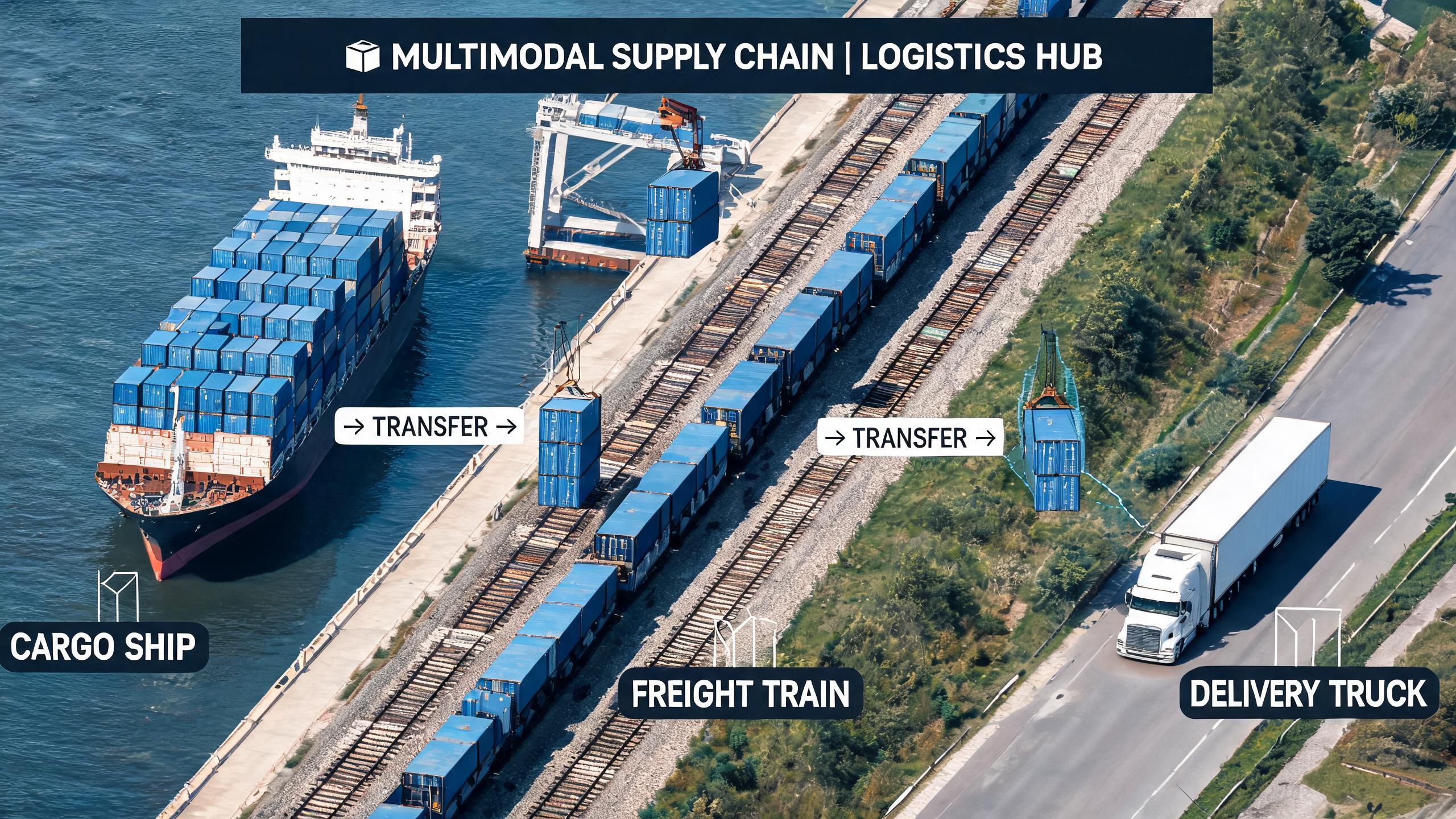
When your cargo moves from a factory in China to a warehouse in Europe via truck, rail, and sea, which document controls the shipment? This guide explains the difference between a multimodal transport document, a multimodal bill of lading, and a combined transport bill of lading, and what buyers should check before signing.
BUYER GUIDE — SHIPPING DOCUMENTS
You have confirmed the price, the Incoterms, and the delivery date. The factory in Chongqing says your goods will go by truck to a rail hub, then by train to a seaport, then by vessel to Hamburg. Your freight forwarder sends you a document called a "multimodal bill of lading."
Is that the same as an ocean bill of lading? Does it give you the same protection? Who is liable if the train is delayed or the truck shipment is damaged before it reaches the port?
These questions matter more now than ever. China-Europe rail freight has grown steadily, and many shipments from inland Chinese cities like Chengdu, Xi'an, and Chongqing combine road, rail, and sea legs. The document that covers the entire journey is not always the one you expect. This article explains the key differences between a multimodal transport document, a multimodal bill of lading, and a combined transport bill of lading — and what to check before you accept one.
- A multimodal transport document covers the entire journey — truck, rail, and sea — under a single contract with one responsible party.
- An ocean bill of lading only covers the sea leg. If your cargo moves by rail or truck before or after the vessel, that portion is outside its scope.
- The FIATA multimodal transport bill of lading (FBL) is the industry-standard document issued by freight forwarders acting as carriers for the whole route.
- Liability limits, claim deadlines, and "on board" evidence differ between a combined transport bill of lading and a pure ocean bill of lading. Read the terms before you accept.
What Is a Multimodal Transport Document?
A multimodal transport document is a single transport document that covers carriage of goods by at least two different modes of transport — for example, road + rail, rail + sea, or road + sea + rail. It is issued by a multimodal transport operator (MTO), who takes responsibility for the entire journey from the point of receipt to the point of delivery.
The key feature is not the number of modes. It is the single contract and single responsible party. You, as the buyer or shipper, deal with one entity for the whole route. That entity is responsible for the cargo even when the actual movement is performed by sub-contracted truckers, rail operators, and shipping lines.
In practice, this means:
- One document covers the door-to-door or port-to-door movement.
- One party issues the document and takes liability for loss or damage during the entire transit.
- You do not need to arrange separate contracts with each carrier.
Ocean Bill of Lading vs Multimodal Bill of Lading
An ocean bill of lading (OBL) is a transport document issued by a shipping line or its agent. It covers the carriage of goods on a vessel from one port to another. It serves three functions:
- It is a receipt for the goods.
- It is evidence of the contract of carriage.
- It is a document of title — the holder can take delivery of the goods at the destination port.
The critical limitation: an ocean bill of lading only covers the sea leg. If your cargo is trucked from the factory in Chengdu to a port in Shanghai, then shipped to Rotterdam, the ocean bill of lading does not cover the truck leg. That leg is governed by a separate contract — usually a road waybill — arranged by your freight forwarder.
A multimodal bill of lading, by contrast, covers the entire journey. It is issued when the carrier (or forwarder acting as carrier) takes responsibility for the cargo from the point of origin — often the factory door — to the final destination, regardless of how many modes are used in between.
| Feature | Ocean Bill of Lading | Multimodal Bill of Lading |
|---|---|---|
| Coverage | Port-to-port (sea leg only) | Door-to-port or door-to-door (all modes) |
| Issued by | Shipping line or its agent | Multimodal transport operator (MTO) or freight forwarder as carrier |
| Responsible party | The shipping line | The MTO / forwarder for the entire route |
| Document of title | Yes (negotiable if issued "to order") | Yes, if issued in negotiable form |
| Applicable rules | Hague-Visby Rules, Hamburg Rules, or national law | Depends on the document — often FIATA FBL terms or UNCTAD/ICC Rules for Multimodal Transport Documents |
| Typical use | Port-to-port sea shipments | Sea-rail, sea-truck, or rail-truck combinations |
Combined Transport Bill of Lading — What Does It Mean?
A combined transport bill of lading is a specific type of multimodal document. The term "combined transport" usually refers to carriage where at least one leg is by sea and another leg is by a different mode — for example, sea + rail or sea + truck.
In practice, the terms "combined transport bill of lading" and "multimodal bill of lading" are often used interchangeably. The difference is mostly historical. "Combined transport" became common in the 1960s and 1970s when containerization made it easy to move a container from a truck onto a vessel without unpacking. "Multimodal transport" is the broader, more modern term.
What matters for you as a buyer is not the name on the document. It is the scope of liability — whether the issuer takes responsibility for the entire journey or only part of it. Some documents are titled "combined transport bill of lading" but contain clauses that limit the issuer's liability to the sea leg only. Read the terms, not just the title.
The FIATA Multimodal Transport Bill of Lading (FBL)
The FIATA multimodal transport bill of lading — commonly called the FBL — is a standard document developed by the International Federation of Freight Forwarders Associations (FIATA). It is widely used by freight forwarders who act as multimodal transport operators.
Why does the FBL matter? Because it is a recognized, standardized document with published terms. When a forwarder issues an FBL, they are declaring themselves as the carrier for the entire route — not just an agent arranging the transport. This is a significant legal commitment.
Key features of the FIATA FBL:
- It is negotiable — it can be used as a document of title if issued "to order."
- It covers the entire multimodal journey.
- The forwarder is liable as a carrier, not merely as an intermediary.
- It is governed by the FIATA FBL terms and conditions, which incorporate the UNCTAD/ICC Rules for Multimodal Transport Documents.
For shipments from China that combine sea, rail, and truck legs, the FIATA FBL is often the most practical document. It gives the buyer a single point of contact and a single liable party, which simplifies claims if something goes wrong.
"Ask your forwarder: 'Are you issuing this document as a carrier or as an agent?' The answer determines who you can claim against if your cargo is delayed or damaged."
Sea-Rail-Truck Shipments from China: Which Document Applies?
Consider a typical shipment from an inland Chinese city to Europe:
- Truck leg: Factory in Chongqing → rail hub in Xi'an (approx. 700 km).
- Rail leg: Xi'an → a Chinese coastal port, or directly via China-Europe rail to a hub like Duisburg.
- Sea leg: Chinese port → European port (e.g., Hamburg, Rotterdam).
- Final truck leg: European port → buyer's warehouse.
Each leg could be operated by a different company. The trucker in China is not the same as the rail operator, which is not the same as the shipping line. Without a multimodal transport document, you would need separate contracts for each leg — and if cargo is damaged on the rail leg, you would need to identify which carrier was responsible and claim against them directly.
With a multimodal transport document — especially a FIATA FBL — you have one document, one issuer, and one liable party for the whole route. If the cargo is damaged on the rail leg, you claim against the forwarder who issued the FBL, not against the rail operator.
What to Check Before You Accept a Multimodal Transport Document
Not all multimodal documents are equal. Before you accept one from your forwarder, check the following:
| Checkpoint | What to look for | Why it matters |
|---|---|---|
| Issuer's role | Does the document say "as carrier" or "as agent"? | If "as agent," the forwarder is not liable for the whole journey. |
| Scope of carriage | Does it cover from the point of receipt to the final destination? | Some documents only cover port-to-port, even if titled "multimodal." |
| Liability limits | What is the maximum liability per kilogram or per package? | Liability limits vary by mode — sea limits are often lower than road or rail limits. |
| On-board notation | Is there a "shipped on board" notation with a date? | This is evidence that the goods were loaded on the vessel — important for letters of credit. |
| Negotiability | Is it issued "to order" and negotiable? | If you need to transfer title, the document must be negotiable. |
| Governing rules | Which rules apply — FIATA FBL terms, UNCTAD/ICC, or national law? | Different rules give different levels of protection. |
Common Mistakes Buyers Make
Mistake 1: Assuming an ocean bill of lading covers the whole journey. It does not. If your shipment includes a rail or truck leg, ask for a multimodal transport document that explicitly covers those legs.
Mistake 2: Accepting a "combined transport bill of lading" without reading the liability clause. The title alone does not tell you who is liable for which leg. Some combined transport bills limit liability to the sea leg only.
Mistake 3: Not checking whether the forwarder is acting as a carrier. If the document says "as agent," the forwarder only arranged the transport. Your claim would need to go to the actual carrier responsible for the damage — which may be difficult to identify.
Mistake 4: Ignoring liability limits. A multimodal transport document may apply different liability limits for different legs. For example, if damage occurs on the sea leg, the limit may be based on the Hague-Visby Rules (around 2 SDR per kilogram). If it occurs on the road leg, the limit may be higher (under CMR, around 8.33 SDR per kilogram). The document should state which limit applies.
Frequently Asked Questions
Is a multimodal bill of lading a document of title?
Yes, if it is issued in negotiable form — typically "to order." This means the holder of the original document can take delivery of the goods at the destination. The FIATA FBL is negotiable when issued in this form.
Can a freight forwarder issue a multimodal bill of lading?
Yes, if the forwarder acts as a multimodal transport operator (MTO) and takes responsibility for the entire journey. The FIATA FBL is specifically designed for this purpose. If the forwarder only acts as an agent, they cannot issue a multimodal bill of lading — only a forwarder's cargo receipt (FCR), which is not a document of title.
What is the difference between a combined transport bill of lading and a multimodal bill of lading?
In practice, the terms are often used interchangeably. "Combined transport" historically refers to sea + another mode, while "multimodal transport" is the broader term covering any combination of two or more modes. What matters is the scope of liability stated in the document, not the title.
Which document should I request for a sea-rail-truck shipment from China?
Ask for a multimodal transport document — preferably a FIATA FBL — issued by your forwarder as carrier. This gives you a single contract, a single liable party, and a document of title if issued in negotiable form. Confirm in writing that the document covers the entire route from the point of receipt to the final destination.
What happens if my cargo is damaged on the rail leg and I only have an ocean bill of lading?
Your ocean bill of lading does not cover the rail leg. You would need to claim against the rail carrier or the party who arranged the rail transport — typically your forwarder. This is more complicated and may involve different liability rules. A multimodal transport document avoids this problem by giving you one party to claim against.
Final Recommendation
For any shipment from China that involves more than one mode of transport — especially the growing sea-rail-truck routes from inland cities — request a multimodal transport document, ideally a FIATA multimodal transport bill of lading, issued by your forwarder as carrier.
Before you accept the document, confirm in writing:
- The issuer is acting as carrier for the entire route.
- The document covers from the point of receipt to the final destination.
- The liability limits are acceptable for your cargo value.
- The document is negotiable if you need it for letter of credit purposes.
If you are unsure whether the document your forwarder offers gives you adequate protection, ask them to explain the scope of liability in writing. A reputable forwarder will be able to do so without hesitation. If they cannot — or if they suggest an ocean bill of lading is sufficient for a multimodal shipment — consider whether they have the experience to handle your cargo.
For shipments where your cargo value exceeds the standard liability limits, discuss additional insurance coverage with your forwarder or broker. The document determines who is liable, but insurance determines whether you are fully compensated.