
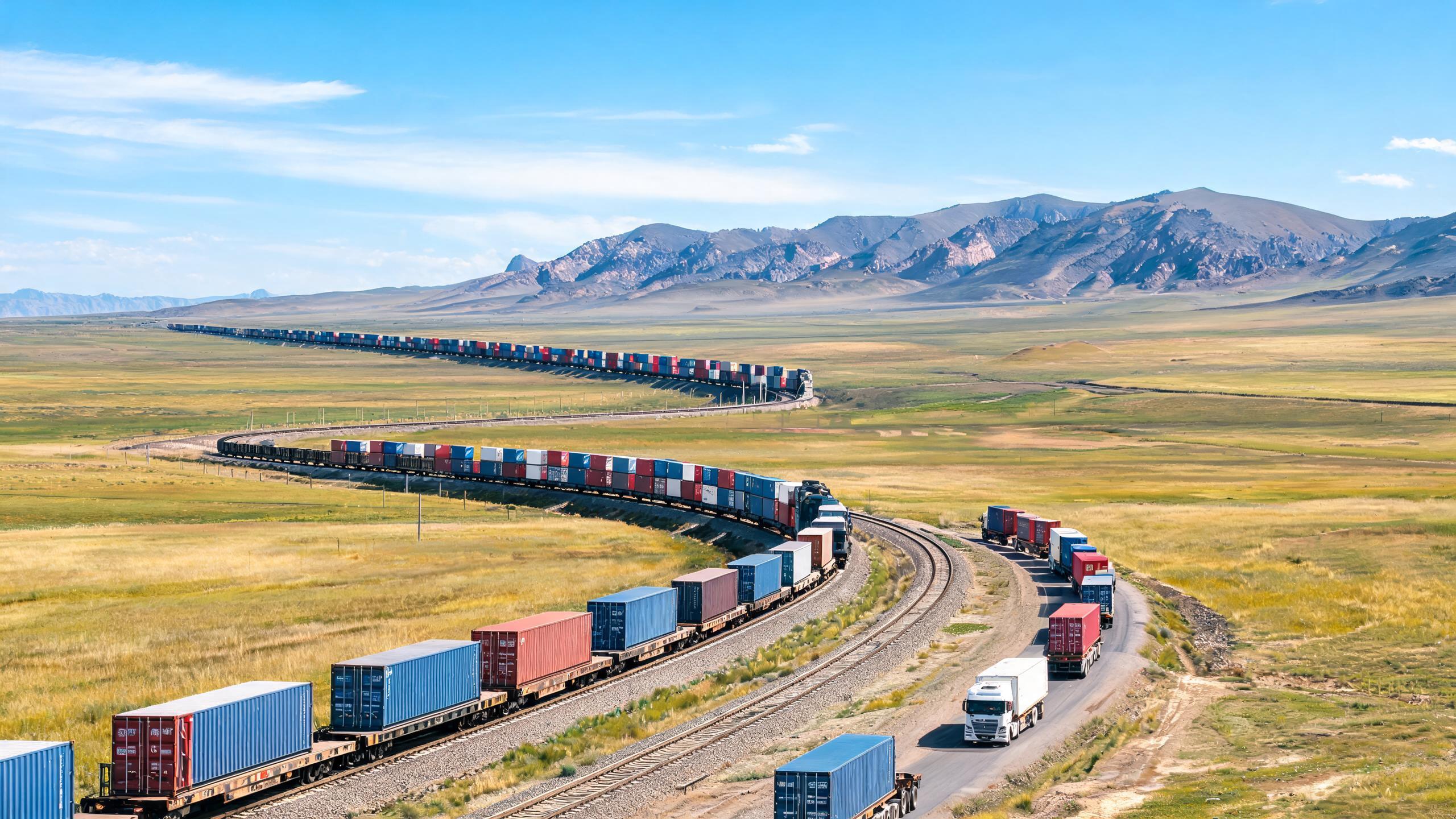
A practical guide for B2B buyers on China–Central Asia multimodal transport. Learn how rail and truck services combine under TIR transit to move cargo to Kazakhstan, Uzbekistan, and Russia — covering route options, transit times, cost drivers, customs handling, and how to evaluate a freight partner.
BUYER GUIDE · MULTIMODAL FREIGHT
If you ship from China to Kazakhstan, Uzbekistan, or Russia, you have probably faced the same decision: rail is cheaper but slower and tied to station schedules; truck is faster but hits customs friction at every border. What most buyers do not realize is that you do not have to choose one. A combined rail-and-truck service, moving under a single TIR transit document, gives you a middle path — one that many China–Central Asia logistics providers now run as a standard product.
This article explains how that service actually works, what it costs in time and money, and what to check before you book.
- Multimodal China–Central Asia transport combines rail for the long haul and truck for the final leg — cutting door-to-door time versus pure rail.
- TIR transit lets one customs document cover multiple border crossings, reducing stops and deposit requirements at each frontier.
- Typical door-to-door transit: 12–18 days to Almaty, 15–22 days to Tashkent, and 18–28 days to Moscow, depending on routing and border handling.
- Cost per cubic meter or per ton sits between full rail and full truck — the exact figure depends on cargo type, weight, and current capacity.
Why multimodal instead of single-mode rail or truck?
Pure rail from China to Central Asia is reliable for bulk and containerized cargo, but it has two structural limits. First, you are tied to station-to-station schedules: if your factory is not near the departure station and your buyer is not near the arrival station, you pay for two truck runs anyway. Second, rail transit times are longer — typically 20–30 days to Almaty — and the last-mile delivery can add another week.
Pure truck is faster on paper, but every border crossing is a risk point. A single trailer moving China → Kazakhstan → Uzbekistan crosses at least two international borders. Without a transit regime, customs clearance and deposits are handled separately at each one, which means more paperwork, more waiting, and more chances for delay.
Multimodal transport China to Central Asia solves this by splitting the journey at the point where each mode is strongest:
- Rail for the trunk haul — the long, stable section inside China and across the Kazakhstan border, where rail capacity is abundant and cost per ton is low.
- Truck for the flexible legs — pickup at the factory, delivery to the buyer's door, and the final run from a hub like Almaty or Tashkent to the destination city.
The two legs are connected under one contract and one transit document, so you deal with a single freight forwarder instead of coordinating three separate carriers.
How TIR transit fits into the route
TIR (Transports Internationaux Routiers) is a UN customs transit system. The key benefit for your shipment is simple: one customs document covers the entire journey across multiple countries. Instead of paying customs deposits and clearing formalities at each border, the cargo moves under a TIR carnet, with customs checks done at the origin and destination.
For a China–Central Asia route, this matters because the cargo typically crosses:
- China exit (Khorgos or Alashankou)
- Kazakhstan entry and exit (if continuing to Uzbekistan or Russia)
- Uzbekistan entry, or Russia entry
With TIR, the truck does not stop for full clearance at each of those points. The seal stays intact, the carnet travels with the goods, and the guarantee covers the duties in transit. The result is fewer stops, shorter border waiting, and lower cash tied up in deposits.
One clarification buyers often ask about: TIR applies to the truck portion of the journey. When your cargo moves by rail inside China, it is carried under a rail waybill. The multimodal service switches to TIR truck at the point where the rail leg ends — usually at a hub near the Kazakhstan border or inside Kazakhstan — and the truck then carries the cargo under TIR to the final destination.
Typical routes and transit times
The exact route depends on your origin city in China and your destination. Here are the common patterns we see in China Central Asia rail transport and combined services:
| Destination | Typical routing | Door-to-door transit | Best suited for |
|---|---|---|---|
| Almaty, Kazakhstan | Rail to Khorgos / Alashankou → TIR truck to Almaty | 12–18 days | Time-sensitive consumer goods, e-commerce, auto parts |
| Tashkent, Uzbekistan | Rail to Khorgos → truck via Kazakhstan to Tashkent | 15–22 days | Construction materials, textiles, machinery parts |
| Moscow, Russia | Rail to Dostyk / Altynkol → truck via Kazakhstan into Russia | 18–28 days | Industrial equipment, chemicals (non-hazardous), FMCG |
These are planning figures, not guarantees. Border congestion, seasonal demand, and weather all affect actual transit. A good freight partner will give you a range, not a single promise, and will update you when the cargo crosses each checkpoint.
Cost structure: what you actually pay for
Multimodal pricing is not one flat rate. It is built from several components, and understanding them helps you compare quotes fairly:
- Origin trucking — from your factory or warehouse to the rail loading station in China.
- Rail freight — the trunk haul, charged per container (20GP / 40GP / 40HQ) or per ton for LCL groupage.
- Transshipment — unloading from rail, transferring to truck at the hub. This includes handling and any short-term storage.
- TIR truck leg — the final road haul, charged per truck or per ton, including the TIR carnet cost.
- Customs clearance — export declaration in China and import clearance at destination. Some providers include this; others quote it separately.
- Documentation — waybills, certificates of origin, and any cargo-specific documents (e.g., Gost certificates for Russia).
As a rule of thumb, multimodal sits roughly 10–20% above pure rail and 15–30% below dedicated truck on the same lane. The exact gap depends on current fuel prices, rail capacity, and how much of the journey is on the road. For cargo above a certain weight or volume, the savings versus air freight are substantial — often 50–70% — which is why many buyers choose this mode for mid-value, non-urgent goods.
What cargo suits this service best?
Not every shipment is a good fit. The service works best when:
- Your cargo fits a standard container or pallet — oversized or project cargo may need special equipment and a different routing.
- Your timeline is 2–4 weeks — if you need delivery in 5 days, this is not the mode; if you can wait 30+ days, pure rail may be cheaper.
- Your destination has a truck-accessible hub — Almaty, Tashkent, and Moscow all work well; remote locations add trucking time.
- You want door-to-door simplicity — one contract, one contact person, one set of documents.
Common cargo categories we handle on these lanes include auto parts, construction materials, home appliances, textiles, food ingredients, and general industrial goods. For hazardous materials or temperature-controlled cargo, confirm with your freight forwarder in advance — these require special equipment and documentation that affect both price and transit.
How to evaluate a multimodal freight partner
Because multimodal involves multiple carriers and border crossings, the quality of your freight forwarder matters more than the mode itself. Ask these questions before you book:
- Do you operate your own trucks, or do you subcontract? Both models work, but you want to know who is responsible if a truck breaks down mid-route.
- Which hubs do you use for the rail-to-truck transfer? Khorgos and Alashankou are the main gateways; the choice affects both cost and transit.
- Is the TIR carnet included in your quote? Some providers list it as a separate charge; make sure you see it line by line.
- How do you handle customs at destination? Do you have a local agent in Almaty, Tashkent, or Moscow, or do you hand off to a partner? Ask for the name of the agent.
- What is your tracking frequency? You want updates at each checkpoint — rail departure, border crossing, transshipment, and final delivery — not just a "shipment in transit" status.
- What happens if the cargo is delayed at the border? A clear process for communication and cost-sharing is worth more than a promise of on-time delivery.
A reliable provider will give you specific answers to these questions, not vague assurances. If a forwarder cannot name their hub, their customs agent, or their tracking system, treat that as a warning sign.
Documentation checklist
To avoid delays at origin, prepare these documents before the cargo reaches the rail station:
- Commercial invoice and packing list
- Bill of lading or rail waybill (issued by the carrier)
- TIR carnet (for the truck leg)
- Certificate of origin (form A or non-preferential, depending on destination)
- Customs declaration (export)
- Any destination-specific certificates (e.g., EAC / Gost for Russia, sanitary permits for food products)
Your freight forwarder should provide a checklist tailored to your cargo type and destination. If they do not, ask for one — missing paperwork is the single most common cause of border delays.
When to choose multimodal over other modes
The decision is ultimately about balancing three variables: cost, time, and risk.
| Mode | Typical transit (to Almaty) | Relative cost | Best when |
|---|---|---|---|
| Air freight | 3–7 days | Highest | Urgent, high-value, low-weight cargo |
| Dedicated truck | 8–14 days | High | Full truckloads, door-to-door speed |
| Multimodal (rail + TIR truck) | 12–18 days | Medium | Balanced cost and speed, partial loads, door-to-door |
| Pure rail | 20–30 days | Lowest | Large volumes, flexible timeline, station-to-station |
If your cargo is time-sensitive but not urgent, and you want a single point of responsibility from factory to door, multimodal is often the right call. If you are shipping full container loads on a predictable schedule, pure rail may save you money. If you need speed above all, air freight is the only option.
Final advice for buyers
Multimodal China–Central Asia transport is not a magic solution — it is a practical compromise that many importers use to get goods to Kazakhstan, Uzbekistan, and Russia faster than rail and cheaper than truck. The key is to understand the route, the cost components, and the questions to ask your freight partner.
Before you book, get quotes from at least two providers. Compare them on the same lane, with the same cargo weight and dimensions, and ask each to break down the cost by leg. That comparison will tell you more about the market than any article can.
If you are planning a shipment and want a route-specific quote, send us your cargo details — origin city, destination, weight, dimensions, and preferred transit time — and we will come back with a line-by-line breakdown.