
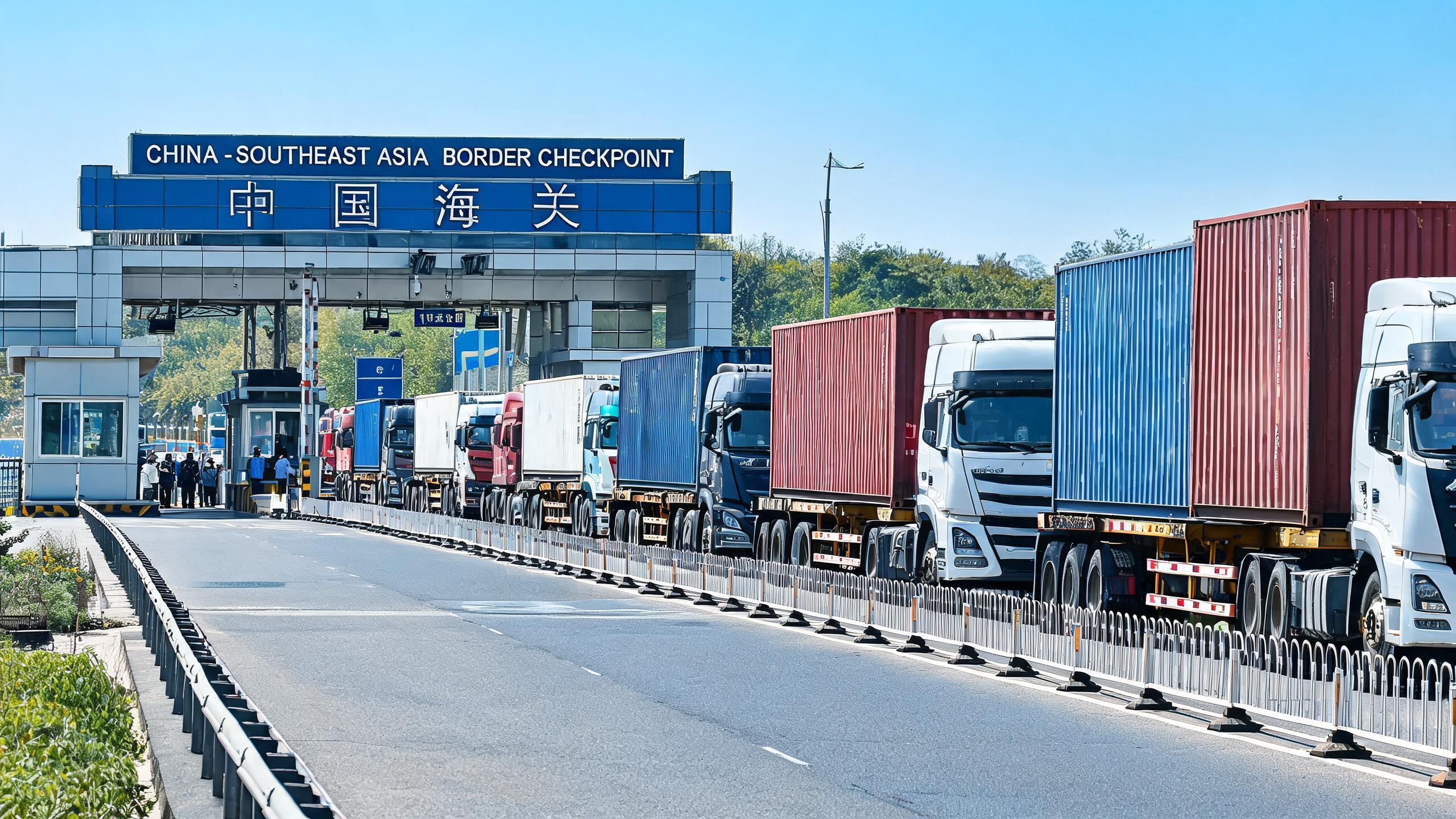
A practical guide for international buyers on cross-border trucking from China to Southeast Asia, Central Asia, and Europe. Understand the key routes, TIR transit benefits, multimodal options, and how to choose the right logistics partner for your freight.
LOGISTICS STRATEGY
• Cross-border trucking from China offers transit times of 5–12 days to most of Southeast Asia, versus 20–30+ days by sea.
• TIR (Transports Internationaux Routiers) customs transit system reduces border delays and eliminates repeated inspections across multiple countries.
• Multimodal transport (truck + rail or truck + sea) balances cost and speed for long-distance routes to Central Asia and Europe.
• Regional coverage includes all of mainland Southeast Asia (Vietnam, Thailand, Laos, Myanmar, Cambodia, Malaysia), plus Central Asia and the EU via the New Eurasian Land Bridge.
Why Cross-Border Trucking from China?
For intra-Asia trade, road freight offers a unique combination of speed, flexibility, and door-to-door service that other modes struggle to match.- Speed: A truck from Shenzhen to Hanoi takes 3–5 days. To Bangkok, 7–10 days. To Singapore, 12–14 days. Compare this to 7–14 days for sea freight from Shanghai to Singapore, plus inland haulage.
- Flexibility: Trucks can handle less-than-truckload (LTL) and full-truckload (FTL) shipments. You can ship 2 cubic meters or 20. You are not tied to container minimums.
- Door-to-Door: The same truck—or a coordinated fleet—picks up from your supplier’s factory in Guangdong or Yunnan and delivers to your warehouse in Vientiane, Phnom Penh, or Almaty. No port-side transloading.
- Lower Risk of Damage: Fewer handling points compared to sea-air or multimodal container moves.
Major Trucking Routes from China
SOUTHEAST ASIA CORRIDORS
The most active china to southeast asia trucking routes are anchored by China’s southern borders.| Route | Key Border Crossings | Typical Transit (Door-Door) | Common Cargo |
|---|---|---|---|
| China → Vietnam | Youyi Guan (Pingxiang/Huu Nghi), Mong Cai, Lao Cai | 3–5 days | Electronics, machinery, garments, consumer goods |
| China → Laos → Thailand | Mohan (Boten), then Vientiane or Nong Khai | 7–10 days | Construction materials, food ingredients, auto parts |
| China → Myanmar | Ruili (Muse), Daluo (Tachilek) | 5–8 days | Agricultural machinery, textiles, chemicals |
| China → Cambodia | Via Vietnam (Moc Bai/Bavet) or via Laos | 10–14 days | Furniture, electronics, FMCG |
| China → Malaysia / Singapore | Via Thailand (Sadao or Bukit Kayu Hitam) | 12–16 days | High-value electronics, perishables, machinery |
CENTRAL ASIA & THE CAUCASUS
For buyers in Kazakhstan, Uzbekistan, Kyrgyzstan, and beyond, the shortest land route from China is through the Khorgos or Alashankou border crossings into Kazakhstan.- China → Kazakhstan: 5–7 days from Urumqi or Xi’an to Almaty.
- China → Uzbekistan: 10–14 days via Kazakhstan, crossing at Gisht Kuprik or Yallama.
- China → Caucasus: 15–20 days, crossing Kazakhstan, Uzbekistan, Turkmenistan, and Iran or Azerbaijan.
EUROPE VIA THE NEW EURASIAN LAND BRIDGE
Trucking from China to Europe is a niche but growing option for time-sensitive, high-value goods. The route typically runs through Kazakhstan, Russia, Belarus, and into Poland or Germany. Transit time is 18–25 days, significantly faster than sea (35–45 days) but more expensive. Multimodal transport china solutions often combine rail for the long-haul section (e.g., Xi’an to Duisburg) with trucking for first- and last-mile pickup and delivery.What Is TIR Transit and Why Does It Matter?
TIR (Transports Internationaux Routiers) is a UN customs transit system that allows goods to move across international borders under a single customs document, with a financial guarantee covering duties and taxes at risk.For a shipment from China to Thailand, a TIR truck can cross the China-Laos border and the Laos-Thailand border with one sealed customs document, without being opened for inspection at each crossing. This saves 1–3 days per border.China officially joined the TIR Convention in 2016, and the system is now operational on several key corridors. The benefits for cross border trucking china are clear:
- Reduced border delays: No need to unload and re-inspect cargo at each border.
- Lower administrative costs: One guarantee replaces multiple national bonds.
- Improved security: TIR seals are tamper-evident, reducing theft risk.
- Predictable transit times: Less time waiting at borders means more reliable delivery schedules.
Multimodal Transport: Combining Truck, Rail, and Sea
For many buyers, the best solution is not a single mode but a well-orchestrated combination. Multimodal transport china refers to moving goods under a single contract using two or more modes of transport.Common Multimodal Combinations
| Combination | Best For | Example Route | Transit Time |
|---|---|---|---|
| Truck + Rail | Long-distance, high-volume to Central Asia / Europe | Factory in Shenzhen → Truck to Xi’an rail hub → Rail to Duisburg → Truck to final destination | 18–25 days |
| Truck + Sea (Ro-Ro or Container) | Island nations (Indonesia, Philippines) or deep-sea destinations | Truck to Shanghai port → Sea to Jakarta → Truck to warehouse | 15–25 days |
| Truck + Air | Urgent, high-value, small-volume shipments | Truck to Guangzhou airport → Air to Singapore → Truck to final delivery | 3–5 days |
Regional Coverage: What Buyers Need to Know
SOUTHEAST ASIA
The ASEAN region is the most mature market for cross border trucking china. The China-ASEAN Free Trade Area (CAFTA) has reduced tariffs, and the ASEAN Highway Network (AHN) provides a physical road infrastructure connecting all member states. The most popular lanes are:- Kunming → Bangkok via the R3A highway (through Laos and Thailand).
- Nanning → Hanoi → Ho Chi Minh City via the Nanning-Hanoi Expressway.
- Kunming → Vientiane via the newly completed Vientiane-Boten Expressway (Laos-China Railway parallel road).
CENTRAL ASIA
Kazakhstan is the primary gateway. From there, goods can be trucked to Uzbekistan, Kyrgyzstan, Tajikistan, and Turkmenistan. The region is heavily dependent on road transport because rail infrastructure, while extensive, is slower and less flexible for door-to-door delivery. TIR is widely used here.EUROPE
Trucking direct from China to Europe is feasible but expensive (approximately $8,000–$12,000 per FTL, depending on route and weight). Most buyers use rail-truck multimodal for the cost-speed balance. The New Eurasian Land Bridge (NELB) is the backbone, with rail transit times of 12–18 days to Poland/Germany, plus trucking for first/last mile.How to Choose a Cross-Border Trucking Partner
Not all logistics providers are equal. When evaluating a partner for cross border trucking china or multimodal transport china, ask these questions:- Do they have their own fleet or rely on sub-contractors? Owned fleet usually means better control over schedules and cargo security.
- Are they TIR-certified? If yes, ask for their TIR carnet issuance history.
- What is their track record at the specific border crossings you need? A provider who knows the Youyi Guan crossing well will save you days compared to one who uses it infrequently.
- Do they offer real-time tracking? GPS tracking with a customer portal is standard for good providers.
- What is their insurance coverage? Minimum should be cargo insurance covering the full invoice value, plus third-party liability.
- Can they handle customs clearance? Many providers offer customs brokerage as part of the service. Confirm that they have licensed brokers in the destination country.
Common Pitfalls to Avoid
- Underestimating transit times: Border delays, especially during holidays (Chinese New Year, Songkran, Ramadan), can add 2–5 days. Always build in a buffer.
- Ignoring weight and volume restrictions: Each country has different axle-load limits. A truck loaded to Chinese standards may be overweight in Laos or Thailand, leading to fines or offloading.
- Assuming all goods are eligible: Some products (hazardous materials, certain chemicals, food items) require special permits or are restricted on certain routes. Confirm eligibility before booking.
- Not verifying the final-mile provider: If your partner sub-contracts the last leg, ensure they have the same quality and security standards.
Frequently Asked Questions
What is the difference between cross-border trucking and multimodal transport?
Cross-border trucking uses road transport for the entire journey. Multimodal transport uses two or more modes (e.g., truck + rail, truck + sea) under a single contract. Multimodal is typically used for longer distances where a single mode is inefficient.
How much does cross-border trucking from China to Southeast Asia cost?
Costs vary by route, weight, and volume. As a rough guide, a full truckload (FTL) from Shenzhen to Bangkok costs approximately $2,500–$4,000. Less-than-truckload (LTL) is priced per cubic meter or per kilogram. Always request a quote based on your specific shipment details.
Is TIR available for all routes from China?
No. TIR is most active on routes to Central Asia and Europe. For Southeast Asia, it is available on the China-Laos-Thailand corridor but is not yet universal. Check with your logistics provider for the specific route.
Can I track my shipment in real-time?
Most professional cross-border trucking providers offer GPS tracking. You should receive a tracking link or portal access when the shipment is dispatched.
What documents are required for cross-border trucking from China?
Standard documents include: commercial invoice, packing list, bill of lading (or CMR for road), customs declaration, certificate of origin (if claiming FTA benefits), and any specific permits (e.g., for hazardous goods). Your logistics provider will advise on exact requirements.
Next Steps
If you are currently evaluating cross border trucking china options for your next shipment, start by mapping your supply chain: identify the pickup point, the destination, the cargo type, and the required transit time. Then, request quotes from logistics providers who specialize in your target corridor.
For a detailed discussion of your specific route and cargo requirements, please contact our logistics team. We can provide a tailored solution that balances cost, speed, and reliability.
This article is for informational purposes only. Specific transit times, costs, and regulatory requirements should be confirmed with a qualified logistics provider for your individual shipment.