
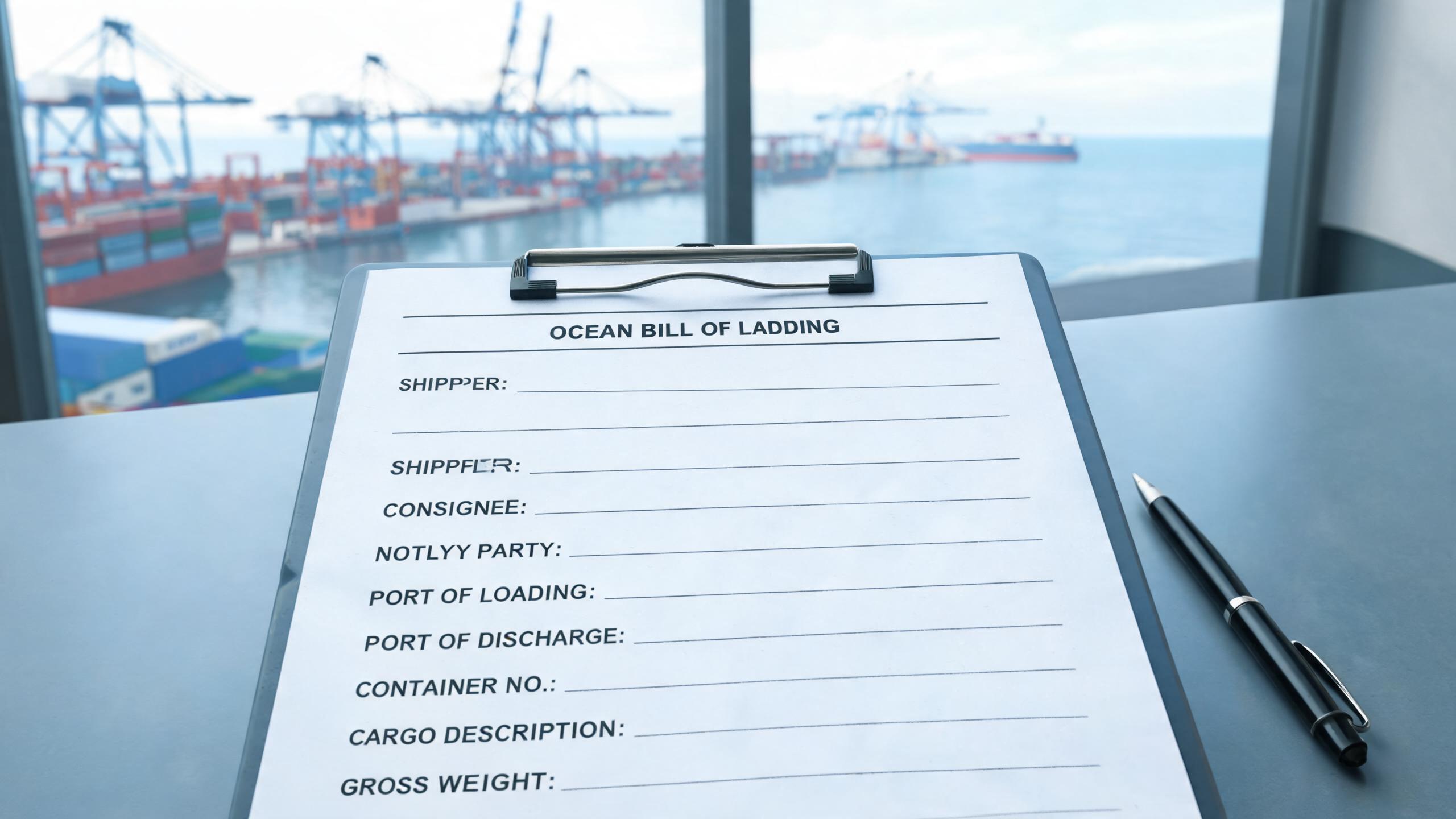
A practical guide to the bill of lading for importers sourcing from China. Learn the bill of lading meaning, the difference between a master bill of lading and a house bill, which type to use for FOB and CIF terms, and the five mistakes that cause delays, extra fees, or lost cargo claims.
BUYER GUIDE · OCEAN FREIGHT DOCUMENTATION
If you import from China, the bill of lading is the single most important document in your shipment. It is not just a receipt. It is the contract of carriage, the title to your goods, and the document you need to clear customs and take delivery. Get it wrong, and you can face demurrage charges, customs delays, or in the worst case, lose the right to your own cargo.
This guide explains the bill of lading meaning in plain terms, breaks down the types you will actually encounter when shipping from China, and covers the common mistakes importers make — so you can avoid them.
- The bill of lading serves three functions: receipt, contract, and document of title.
- For FOB shipments from China, the buyer (you) controls the carrier contract. For CIF, the seller does. This determines who issues the bill of lading.
- A master bill of lading is issued by the actual shipping line. A house bill is issued by a freight forwarder. Know which one you hold.
- Never let your supplier ship without your written shipping instructions. This causes most documentation errors.
- An original bill of lading is required to take delivery in most Chinese export trades. A telex release or seaway bill is faster but offers less control.
What Is a Bill of Lading? The Bill of Lading Meaning
A bill of lading (B/L) is a legal document issued by a carrier or its agent to a shipper. It confirms that the carrier has received the goods on board a vessel and promises to deliver them to the consignee at the destination port.
In international trade, the bill of lading meaning goes beyond a simple receipt. It performs three distinct functions:
- Receipt of goods — It confirms the carrier received the cargo in the stated quantity and condition.
- Contract of carriage — It sets out the terms under which the carrier transports the goods, including the route, vessel, freight charges, and liability limits.
- Document of title — It gives the holder the right to claim the goods at destination. Whoever holds a negotiable original bill of lading controls the cargo.
This third function is why the bill of lading matters so much in China trade. Your supplier ships the goods. You pay for them. But until you hold the original bill of lading, the goods are not legally yours at the destination. This is your main protection when trading with a new or unknown factory.
Key Parties on a Bill of Lading
Before we go into types, you need to know who appears on the document. Four parties matter:
| Party | Who It Is | Why It Matters |
|---|---|---|
| Shipper | Usually your supplier in China | Appears on the document as the party who hands over the goods. Some buyers prefer their own trading company as shipper for confidentiality. |
| Consignee | The party entitled to receive the goods | Determines whether the bill is negotiable or non-negotiable. "To order" means it can be endorsed. |
| Notify party | The party the carrier contacts on arrival | Usually the buyer or your customs broker. The carrier sends the arrival notice here. |
| Carrier | The shipping line or the freight forwarder | Determines whether you hold a master or a house bill of lading. |
Types of Bill of Lading You Will Meet When Shipping from China
Not all bills of lading are the same. The type you need depends on your incoterm, your payment terms, and who arranged the freight. Here are the ones that matter.
1. Master Bill of Lading (MBL) vs. House Bill of Lading (HBL)
This is the most common point of confusion for importers.
A master bill of lading is issued by the actual vessel operator — the shipping line itself, such as Maersk, MSC, COSCO, or CMA CGM. It covers the cargo from the port of loading to the port of discharge on that specific vessel.
A house bill of lading is issued by a freight forwarder or NVOCC (non-vessel operating common carrier). The forwarder consolidates cargo from multiple shippers into one container or one shipment and issues its own bill to each shipper. The forwarder then receives a master bill from the shipping line for the consolidated shipment.
When you book directly with a shipping line, you get a master bill. When you book through a forwarder, you usually get a house bill. Many importers from China book through forwarders, so they hold a house bill.
| Feature | Master Bill of Lading (MBL) | House Bill of Lading (HBL) |
|---|---|---|
| Issued by | Shipping line (Maersk, COSCO, etc.) | Freight forwarder / NVOCC |
| Coverage | Port to port on the named vessel | Door to port, or door to door, including inland haulage |
| Control | Direct contract with the carrier | Contract with the forwarder, who contracts with the carrier |
| Surrender at destination | Surrendered to the shipping line's agent | Surrendered to the forwarder's agent, who then releases against the MBL |
| Common use case | Full container load (FCL), direct booking | Less than container load (LCL) or FCL via forwarder |
Practical tip: If you hold a house bill, your cargo release at destination depends on the forwarder's agent, not the shipping line. Choose a forwarder with a reliable destination office or agent network. If your forwarder is weak at your destination port, you will feel it when trying to take delivery.
2. Negotiable (Original) Bill of Lading
A negotiable bill of lading is made out "to order" (e.g., "to order of shipper"). It can be endorsed and transferred. The holder of the original document has the right to claim the goods. This is the standard for letter of credit (L/C) transactions and for most open-account trades where the buyer pays before or at shipment.
Typically, three original bills are issued. The carrier releases the cargo against any one original. The other two become void. This is why you must keep all originals safe — a lost original can delay cargo release for weeks and may require a bank indemnity.
3. Non-Negotiable Bill of Lading / Seaway Bill
A seaway bill is a straight bill made out to a named consignee. It is not a document of title. The cargo is delivered directly to the named consignee without requiring the original document. This is faster and cheaper because there is no physical document to courier. But you lose control — the consignee can take delivery without presenting anything.
Use a seaway bill only when you fully trust the consignee, or when payment is already settled. For open-account trade with a new customer, avoid it.
4. Telex Release
A telex release is not a separate type of bill. It is a procedure. The shipper surrenders the original bill of lading at the origin, and the carrier sends an electronic message to the destination agent to release the cargo to the consignee without presenting originals.
Telex release is common for China exports when payment is completed and the buyer does not need the original for customs or L/C. It saves courier costs and avoids the risk of lost originals. But again, it only works when you do not need to retain title control.
5. Ocean Bill of Lading vs. Other Transport Documents
An ocean bill of lading covers sea freight only. For multimodal shipments (e.g., from a factory in Shenzhen to your warehouse in Chicago, including rail or truck legs), you may get a combined transport bill of lading. This covers the entire journey under one document. For air freight, the equivalent document is the air waybill (AWB), which is non-negotiable.
When your supplier quotes "sea freight only," you will receive an ocean bill of lading. When they quote "door to door," expect a combined transport document.
Which Bill of Lading Do You Need? Match It to Your Incoterm
Your incoterm determines who arranges and pays for the main carriage — and therefore who controls the bill of lading.
| Incoterm | Who Arranges Main Freight | Who Controls the B/L | Typical B/L Type |
|---|---|---|---|
| EXW (Ex Works) | Buyer | Buyer's forwarder | HBL or MBL, depending on booking |
| FOB (Free on Board) | Buyer | Buyer's forwarder | HBL or MBL, buyer's choice |
| CFR / CIF (Cost, Insurance, Freight) | Seller | Seller's forwarder | Usually HBL via seller's forwarder |
If you buy on FOB terms from China, you nominate the forwarder. That means you control the bill of lading. This is the safest arrangement for you, because the forwarder works on your instructions, not the supplier's.
If you buy on CIF terms, the seller arranges the freight. You will receive the bill of lading from the seller's forwarder. Make sure your name appears correctly as consignee or notify party. If the seller's forwarder is unknown to you, verify their credentials before the shipment sails.
Common Mistakes Importers Make with Bills of Lading
These are the errors we see repeatedly in China trade. Each one costs time or money.
Mistake 1: Inaccurate or Incomplete Consignee Information
A wrong consignee name, a misspelled company name, or a missing tax ID can stop cargo release at destination. Customs may reject the documentation, and the carrier will not release the goods until the bill is corrected. Correcting a bill of lading after the vessel sails costs money (amendment fees) and takes days.
Fix: Send your supplier and forwarder written shipping instructions with the exact consignee name, address, and notify party, exactly as they must appear. Ask for a draft bill of lading for approval before the vessel sails.
Mistake 2: Not Checking the Draft Bill of Lading
Many importers wait until the final bill is issued to check it. By then, the vessel has sailed, and corrections are expensive or impossible. A draft bill is issued before sailing. Review it line by line: shipper, consignee, notify party, description of goods, number of packages, gross weight, container number, seal number, port of loading, port of discharge.
Fix: Make it a rule: no sailing until you approve the draft. If your forwarder issues the draft late, push back. This is your cargo.
Mistake 3: Confusing the Master Bill with the House Bill
If you hold a house bill but think you have a master bill, you may go to the shipping line's office at destination to take delivery — and be turned away. The cargo is released against the house bill through the forwarder's agent, not the shipping line directly.
Fix: Know which document you hold. Ask your forwarder explicitly: "Is this an MBL or an HBL? Who is the destination agent?" If you need a master bill (for example, for a letter of credit that requires a shipped on board ocean bill of lading), book directly with a shipping line or instruct your forwarder to issue a master bill.
Mistake 4: Releasing the Original Bill Before Payment
The original bill of lading is your title to the goods. If you hand it over to the buyer before receiving payment, you have effectively given them the cargo. This is the root of many payment disputes in China trade.
Fix: If you are the seller, do not release originals until funds are confirmed. If you are the buyer, do not pay the full amount before you have verified the bill of lading is genuine and matches the shipment. For L/C transactions, the bank handles this exchange — use it when trading with new partners.
Mistake 5: Ignoring the "Shipped on Board" Date
The "shipped on board" date is the date the cargo was loaded onto the vessel. This is not the same as the date the bill was issued. For L/C transactions, the shipped on board date must fall within the latest shipment date stated in the credit. A mismatch is a discrepancy, and the bank can refuse to pay.
Fix: When your forwarder sends the draft, check the shipped on board date against your L/C terms. If it falls after the latest shipment date, you have a problem — negotiate with the buyer before the documents are presented to the bank.
How to Check a Bill of Lading Before You Accept It
Use this checklist when your forwarder sends the draft bill of lading:
- Shipper name and address match the supplier or your trading company.
- Consignee is exactly as instructed (especially "to order" wording for L/C).
- Notify party is correct and reachable.
- Description of goods matches the commercial invoice and packing list.
- Number of packages, gross weight, and measurement match the packing list.
- Container and seal numbers match the container you loaded (or the forwarder's container for LCL).
- Port of loading and port of discharge are correct.
- Shipped on board date is within your L/C shipment window.
- Freight prepaid or collect, as agreed in your incoterm.
- Number of originals issued (usually three) is stated.
If any field is wrong, ask for a corrected draft before sailing. Once the vessel sails, corrections are subject to carrier approval and fees.
What to Do If Your Original Bill of Lading Is Lost
Lost originals happen. If you lose an original bill of lading for a China shipment, act immediately:
- Notify the carrier or forwarder in writing.
- Request a replacement set. The carrier will usually require a letter of indemnity from the shipper and possibly a bank guarantee for the cargo value.
- If the cargo is already at destination, discuss a telex release or delivery against a bank indemnity. This is faster than reissuing originals.
This process takes time and costs money. Prevention is simpler: keep originals in a secure place, and consider using a telex release or seaway bill when your payment terms allow it.
Final Advice for Importers Shipping from China
The bill of lading is not paperwork to be signed and filed away. It is the legal instrument that controls your cargo. Treat it with the same care as your payment documents.
Three rules to remember:
- Control the document. On FOB terms, nominate your own forwarder and approve the draft before sailing.
- Know what you hold. Master bill or house bill — understand the difference and who releases your cargo at destination.
- Never release title before payment. The original bill of lading is your leverage. Use it.
If you are sourcing from China and need help with freight arrangements, documentation, or verifying a forwarder, contact us. We work with importers on shipping terms, bill of lading review, and cargo release procedures. Send us your draft bill of lading for a quick check before your next shipment sails.