
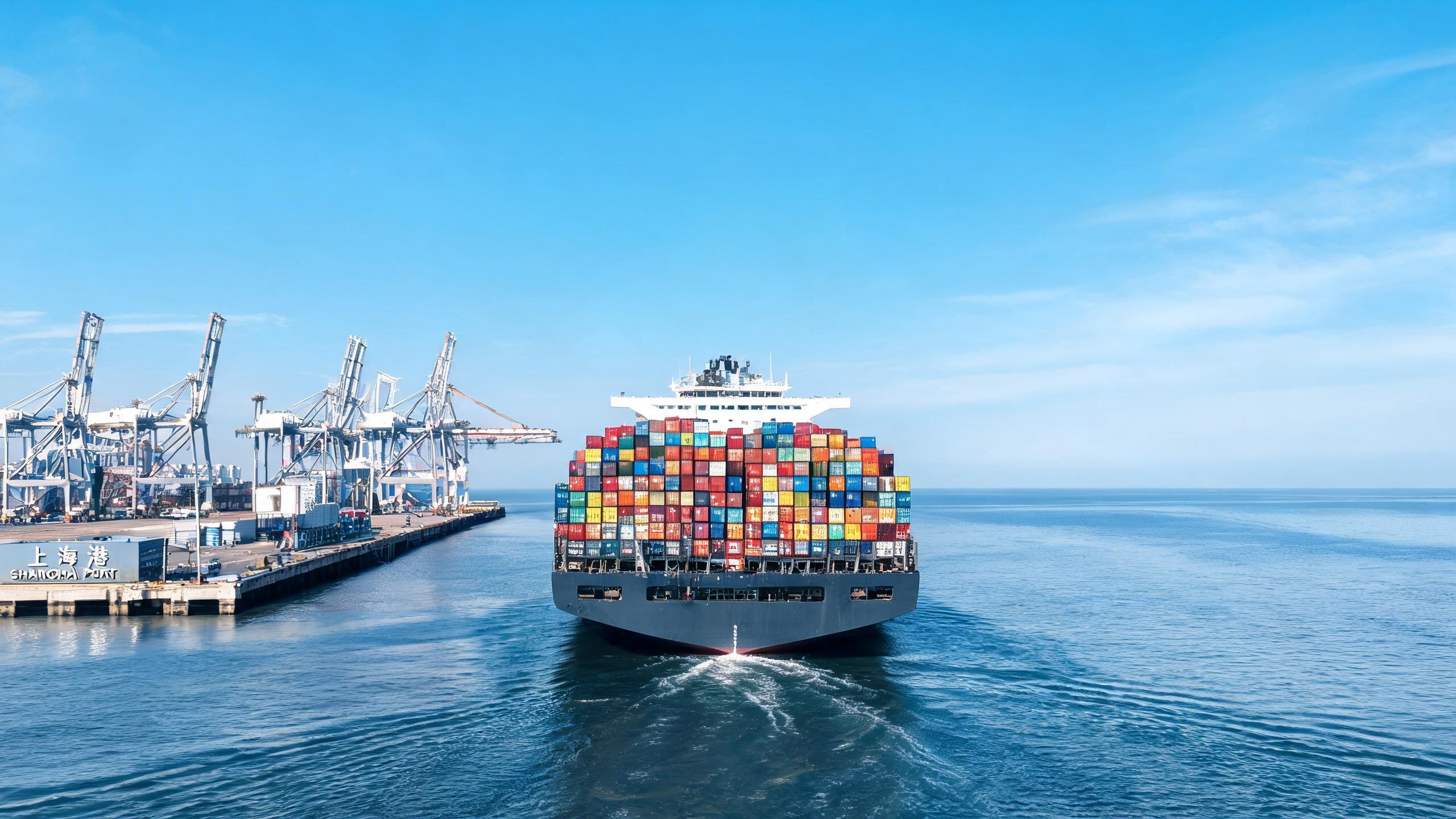
A practical buyer's guide to full container load shipping from China to Europe. Covers weekly sailing schedules to Hamburg and Rotterdam, container type selection (20GP, 40GP, 40HQ), the complete documentation checklist, transit times, and cost factors — written for importers who need to plan cargo movement with confidence.
FCL BUYER GUIDE
FCL Ocean Freight from China to Europe: Weekly Sailings, Container Types, and Documentation for Hamburg and Rotterdam
If you are importing full container loads from China into Northern Europe, the two ports you will hear most often are Hamburg and Rotterdam. Together they handle a large share of Asia–Europe container traffic, and most major carriers call at both on the same weekly service rotation.
This guide covers the practical side of FCL shipping from China to Europe: how weekly sailings work, which container type to book, what documentation you need, and what affects your total cost. It is written for importers who want to plan cargo movement without surprises.
- FCL China to Europe transit times typically range from 26 to 38 days depending on port pair and carrier route.
- 40HQ is the most commonly booked container for general cargo; 20GP suits dense, heavy goods.
- Hamburg and Rotterdam both receive multiple weekly sailings from major Chinese ports — you rarely wait more than a few days for the next vessel.
- Documentation errors, not transit time, are the most common cause of delays at destination.
What "FCL" Means in Practice
FCL (Full Container Load) means your cargo occupies an entire container. You are not sharing space with other shippers' goods, so your cargo is loaded once at origin, sealed, and unloaded only at your destination or at the consignee's warehouse.
FCL shipping from China to Europe is the standard choice when:
- Your cargo volume fills 15 CBM or more (roughly 60% of a 20GP).
- You need to protect goods from handling damage and pilferage.
- You want predictable, single-bill-of-lading logistics.
- Your cargo has a high value-to-volume ratio where per-unit freight cost matters less than security.
For smaller volumes, LCL (Less than Container Load) is an option, but per-CBM rates are higher and transit times are often longer because of consolidation and deconsolidation stops.
Weekly Sailings: How the Schedule Works
Ocean carriers operate on fixed weekly rotations. A typical Asia–North Europe service looks like this:
Shanghai → Ningbo → Yantian → Singapore → (Suez Canal) → Rotterdam → Hamburg → (return)
Each port gets one call per week per service. If your cargo misses the cut-off (the last time the carrier accepts containers for a specific vessel), it rolls to the next week's sailing.
For FCL China to Europe, most major ports of loading offer multiple weekly departures because several carriers operate overlapping services:
| Port of Loading | Typical Weekly Departures to North Europe | Notes |
|---|---|---|
| Shanghai | 5–8 | Highest frequency; most carriers call here |
| Ningbo | 4–6 | Often combined with Shanghai on the same rotation |
| Shenzhen (Yantian/Shekou) | 4–7 | Strong for South China manufacturers |
| Qingdao | 2–4 | Main port for Shandong province cargo |
| Tianjin (Xingang) | 2–3 | Serves Beijing/Tianjin/Hebei region |
Hamburg vs. Rotterdam: What's the Difference?
Both ports are first-call or second-call on most Asia–Europe loops. The difference in transit time is usually only 1 to 2 days between the two.
- Rotterdam is often the first European call after the Suez Canal. That means your cargo arrives 1–2 days earlier than it would in Hamburg on the same service. It also has excellent barge and rail connections to Germany, Belgium, and France.
- Hamburg is the largest German port and a natural gateway for cargo destined for Germany, Austria, Czech Republic, Poland, and Scandinavia. Its hinterland rail network is extensive.
Choose your discharge port based on final destination, not just transit time. If your warehouse is in southern Germany, Rotterdam + truck or barge may be faster and cheaper than Hamburg + truck. If your cargo is going to Berlin or Poland, Hamburg is usually the better choice.
Container Types: Which One to Book
For FCL shipments, you have four practical choices. Most cargo fits one of these standard sizes.
| Container Type | Internal Dimensions (approx.) | Max Payload (approx.) | Usable Volume | Best For |
|---|---|---|---|---|
| 20GP (20' Standard) | 5.90 × 2.35 × 2.39 m | 28,200 kg | ~28 CBM | Dense, heavy cargo: machinery, stone, steel, chemicals in drums |
| 40GP (40' Standard) | 12.03 × 2.35 × 2.39 m | 26,500 kg | ~58 CBM | Light, voluminous cargo: furniture, household goods, cartons |
| 40HQ (40' High Cube) | 12.03 × 2.35 × 2.69 m | 26,300 kg | ~68 CBM | Tall or bulky items: palletized goods, large appliances, racking |
| 45' High Cube (Pallet Wide) | 13.56 × 2.47 × 2.69 m | 25,800 kg | ~76 CBM | Euro-pallet optimized loads; limited availability |
How to Choose
Rule of thumb: If your cargo weighs more than 18–20 metric tons, book a 20GP. If it is light but bulky, book a 40GP or 40HQ.
The 40HQ is the most popular container for FCL China to Europe because it adds roughly 10 CBM over a standard 40GP for a small freight surcharge (usually only a few hundred USD). If your cargo is palletized, the extra height makes stacking and loading easier.
Important: Always check the carrier's max payload for the specific vessel. Older ships and some services have lower payload limits, and overweight containers incur surcharges or may be refused.
Documentation: The Complete Checklist
Documentation errors cause more delays than weather, port congestion, or customs issues combined. Here is what you need for a smooth FCL shipment from China to Europe.
1. Commercial Invoice
The carrier and customs use this to assess duties and verify cargo value. It must include:
- Shipper and consignee full legal names and addresses
- Detailed description of goods (not just "parts" — specify what kind)
- HS codes at 6-digit level minimum
- Unit values and total value in USD or EUR
- Incoterms and place of delivery
2. Packing List
Shows how the cargo is packed inside the container: number of cartons, pallets, gross/net weights, and dimensions per package. Customs may inspect the container against this document.
3. Bill of Lading (B/L)
The contract of carriage and the document of title. Three main types:
| Type | Use Case |
|---|---|
| Original B/L | Buyer needs original documents to take delivery; used with Letters of Credit |
| Seaway Bill | No original needed; cargo released automatically to named consignee |
| Telex Release | Carrier releases cargo electronically after payment; fastest option |
For regular buyers with open account terms, telex release or seaway bill is the most practical. For L/C transactions, original B/L is mandatory.
4. Certificate of Origin
Required for preferential duty rates under the EU's GSP scheme (for certain countries) or for the China–EU trade agreement. A EUR.1 or RCEP certificate may apply depending on your origin and the commodity. Check with your freight forwarder — this is not always required, but having it avoids surprises at customs clearance.
5. Other Documents (as applicable)
- Insurance certificate — if you bought marine cargo insurance (recommended for FCL)
- Inspection certificates — for regulated goods (food, electronics, chemicals)
- Fumigation certificate — if wooden pallets or crates are used (ISPM-15 compliant stamp required)
- Import licenses — for restricted goods in the destination country
Transit Times: What to Expect
Transit time is measured from vessel departure at origin port to vessel arrival at destination port. It does not include:
- Trucking to the origin port
- Customs clearance at origin
- Vessel waiting time at the Suez Canal
- Discharge and customs clearance at destination
- Inland transport after discharge
Typical FCL China to Europe transit times (main services, via Suez Canal):
| Port Pair | Typical Transit (days) |
|---|---|
| Shanghai → Rotterdam | 27–31 |
| Shanghai → Hamburg | 29–33 |
| Ningbo → Rotterdam | 28–32 |
| Shenzhen (Yantian) → Hamburg | 29–34 |
| Qingdao → Rotterdam | 30–35 |
Add 5–10 days for total door-to-door time, including origin trucking, customs, and final delivery. If your cargo is urgent, some carriers offer premium or expedited services with priority discharge, but expect to pay 20–40% more on the ocean freight rate.
Cost Factors: What Determines Your FCL Rate
Ocean freight rates for FCL China to Europe fluctuate weekly. The main variables:
- Port pair — Shanghai to Rotterdam is the most competitive lane; smaller ports cost more.
- Season — Peak season (August–October) rates can be 2–3× off-peak levels.
- Container type — 40HQ costs roughly 15–20% more than 40GP.
- Carrier — Premium carriers (Maersk, MSC, CMA CGM) charge more than smaller lines.
- Surcharges — BAF (bunker adjustment), PSS (peak season surcharge), and port congestion fees are added on top of the base rate.
Always ask for an all-in quote that includes ocean freight, origin charges (trucking, customs, THC), and destination charges. The base rate alone is misleading.
Choosing a Freight Forwarder
A good forwarder handles the booking, documentation, and coordination. Ask these questions before committing:
- Which carriers do you use on this lane? Can you share recent transit time performance?
- Do you offer weekly fixed departures or do you book per shipment?
- What is included in your all-in rate? Get a written breakdown.
- Who handles customs clearance at destination — you or your buyer?
- What is your process for shipment tracking and exception management?
For repeat shipments, a forwarder with fixed weekly consolidation on the China–Europe lane is more valuable than one with lower rates but inconsistent schedules.
Final Checklist Before You Book
- Confirm your cargo weight and volume — book the right container.
- Choose discharge port based on final destination, not just transit time.
- Ask for an all-in quote with surcharges itemized.
- Prepare commercial invoice and packing list before the vessel departs.
- Decide on B/L type (telex release recommended for open account).
- Verify whether a Certificate of Origin is needed for duty preference.
- Check if your goods require special certificates (fumigation, inspection, licenses).
- Buy marine cargo insurance — the carrier's liability is limited.
FCL shipping from China to Europe is a well-established, reliable process when you plan it correctly. The key is not the transit time — it is the documentation, the container choice, and the port selection. Get those three right, and your cargo moves without drama.
Need a quote for your next FCL shipment to Hamburg or Rotterdam? Contact us with your cargo details (commodity, weight, volume, and port of loading) and we will provide a detailed all-in rate within 24 hours.