
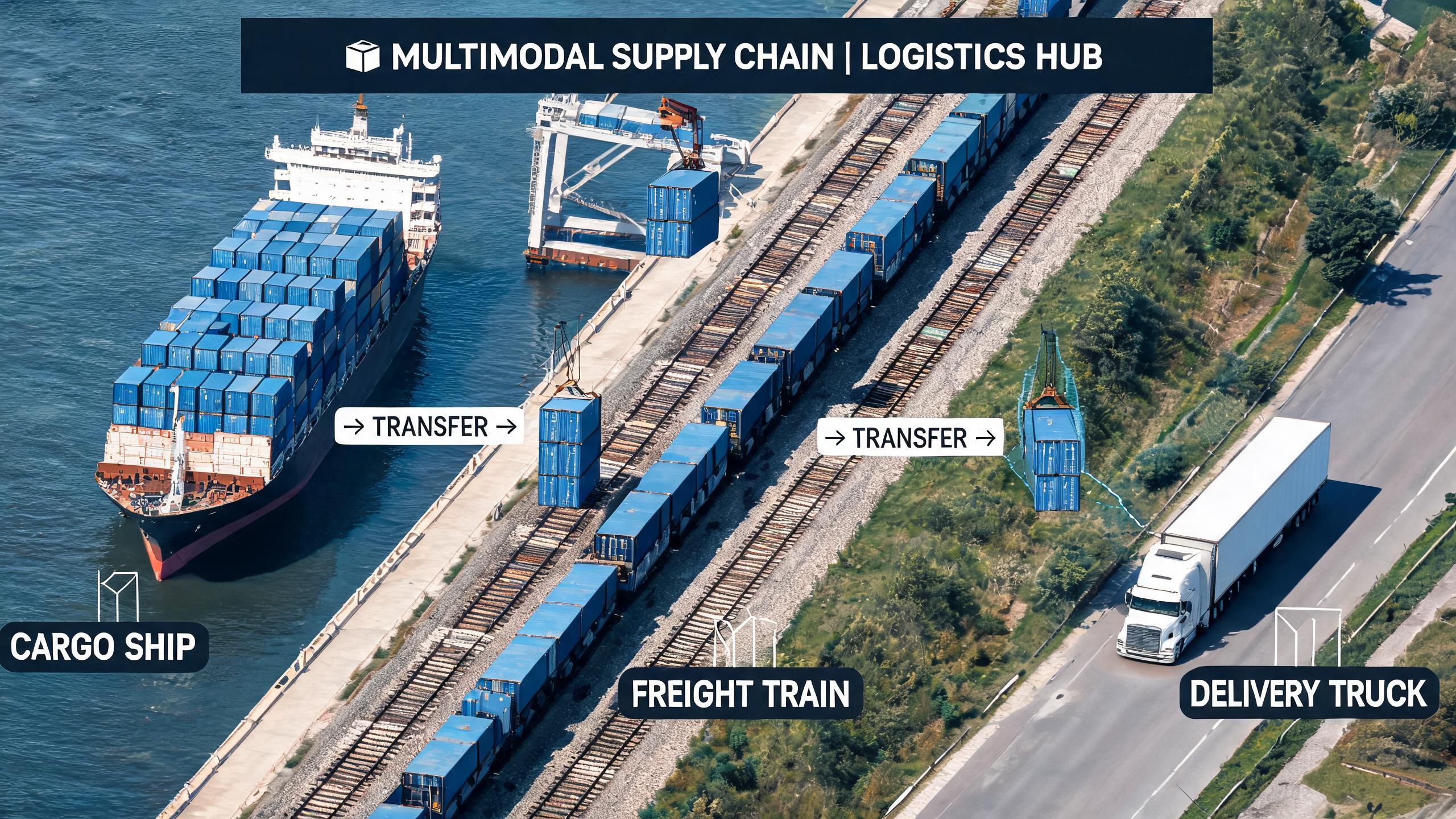
A practical guide for international buyers on how multimodal transport from China works—when to combine sea, rail, and road freight, how it compares to single-mode shipping, and what to check before booking.
BUYER GUIDE · FREIGHT & LOGISTICS
If you import from China regularly, you have probably faced the same dilemma: sea freight is cheap but slow, air freight is fast but expensive, and rail sits somewhere in between. What many buyers overlook is that you do not have to pick just one mode. Multimodal transport from China lets you combine sea, rail, and road freight in one shipment, using each mode where it makes sense.
This article explains how China sea rail road transport works, when it beats single-mode shipping, and what to verify before you book. No generic promises—just the practical details that affect your cost, transit time, and risk.
- Multimodal transport uses one contract and one bill of lading for a shipment that moves by two or more modes—typically sea + rail, or sea + road.
- It is usually 30–50% cheaper than air freight and 10–20 days faster than ocean-only, depending on the corridor.
- The main cost levers are the inland leg in China, the port pair, and the destination customs clearance.
- Not all freight forwarders handle multimodal well—check their network, equipment, and tracking capability before committing.
What multimodal transport from China actually means
Multimodal transport means your cargo moves under a single transport contract using at least two different modes. The forwarder issues one through bill of lading, takes responsibility for the whole journey, and coordinates the handovers between modes.
A typical China sea rail road transport setup looks like this:
- Road leg (origin): Truck picks up cargo from the factory in, say, Foshan or Qingdao and delivers it to a rail hub or port.
- Rail leg (China inland): Container moves by rail from the inland city to a coastal port—for example, from Chengdu or Chongqing to Shanghai or Shenzhen.
- Sea leg (main haul): Vessel carries the container from the Chinese port to the destination port, such as Hamburg, Los Angeles, or Rotterdam.
- Road leg (destination): Truck delivers from the destination port to the buyer's warehouse.
The key point: you deal with one forwarder, not three separate carriers. That single point of responsibility is what makes multimodal different from simply booking separate legs yourself.
Why buyers choose combined transport China
Cost and speed are the two obvious reasons, but there are others that matter just as much for B2B buyers.
1. Cost savings on the inland leg
If your factory is inland—Chengdu, Chongqing, Xi'an, Wuhan—trucking a container to a coastal port can cost more than the ocean freight itself. Rail is significantly cheaper for that inland move. On the Chengdu–Shanghai corridor, for example, rail can cut the inland transport cost by roughly 30–40% compared with road, while also reducing carbon emissions.
2. Faster than ocean-only, cheaper than air
For cargo from inland China to Europe, a pure sea route via Shanghai to Rotterdam might take 30–35 days door-to-door. A sea + rail combination that moves the container by rail to a port like Shenzhen and then by sea can shave several days off the total. It will not match air freight speed, but it will beat air freight cost by a wide margin—often 50% or more on heavy, bulky cargo.
3. More predictable scheduling
Rail operates on fixed schedules, unlike road, which is subject to traffic, weather, and driver shortages. When the inland leg runs on rail, you get a more reliable pickup window and fewer surprises at the port.
4. Reduced handling and paperwork
Because the container stays sealed from origin to destination, there is less handling than if you booked separate legs. One bill of lading also means one set of documents, one customs process at origin, and one point of contact for tracking.
When multimodal makes sense—and when it does not
Multimodal is not always the right answer. Here is a practical breakdown.
| Situation | Best option | Why |
|---|---|---|
| Factory near coastal port (e.g., Ningbo, Shenzhen) | Direct sea freight | Short inland leg means multimodal adds little value |
| Factory inland (e.g., Chengdu, Chongqing, Xi'an) | Sea + rail multimodal | Rail cuts inland cost and improves schedule reliability |
| Urgent, high-value, low-weight cargo | Air freight | Speed outweighs cost; multimodal too slow |
| Heavy, bulky, time-tolerant cargo | Direct sea freight | Lowest cost per cubic meter; multimodal adds unnecessary complexity |
| Mixed cargo with both urgent and standard items | Split shipment | Send urgent items by air, rest by sea or multimodal |
The rule of thumb: multimodal wins when the inland leg is long and the cargo is not urgent enough for air. If your factory is within 100 km of the port, direct sea freight is usually simpler and cheaper.
How China sea rail road transport is priced
Understanding how the cost is built helps you negotiate. A multimodal quote from China typically includes these components:
- Origin trucking: Factory to rail hub or port, charged per container or per ton.
- Rail freight (inland): Charged per container per route; rates vary by corridor and season.
- Port handling charges: Terminal handling, customs clearance, and documentation at the Chinese port.
- Ocean freight: The main sea leg, quoted per container (20ft or 40ft).
- Destination charges: Port handling, customs clearance, and delivery to your warehouse.
Ask your forwarder for a split quote—each leg itemized—rather than one lump sum. That way you can see where the cost sits and compare options more easily.
What to check before booking multimodal transport
Not every forwarder can execute multimodal well. Before you commit, verify the following:
1. Network and corridor experience
Ask which specific corridors they handle regularly. A forwarder who moves 50 containers a month on the Chengdu–Europe rail corridor will handle your shipment better than one who books it once a quarter. Request recent transit time records for the exact route you plan to use.
2. Equipment and container availability
Rail and sea require different container specifications in some cases. Confirm the forwarder has access to the right container type (dry van, high cube, reefer) at your origin city, and that they can guarantee equipment during peak seasons like September–October.
3. Tracking and visibility
Multimodal involves multiple handovers, which is where cargo gets lost or delayed. Ask whether they provide a single tracking number that covers all legs, or whether you have to track each leg separately. A single point of visibility is a strong sign of a well-managed operation.
4. Customs and documentation responsibility
Clarify who handles export customs in China and import customs at destination. With a through bill of lading, the forwarder usually manages origin customs, but destination clearance may be handled by your customs broker. Confirm this in writing before shipping.
5. Incoterms alignment
Multimodal works with most Incoterms, but the division of responsibility changes. Under FOB, the buyer controls the main carriage; under CIF or DAP, the seller does. Make sure the Incoterm matches who is actually coordinating the multimodal legs.
Common mistakes buyers make
These are the errors we see most often in combined transport China bookings:
- Assuming multimodal is always cheaper. It is cheaper than air, but not always cheaper than direct sea. Compare both before deciding.
- Ignoring the destination inland leg. A cheap sea leg to Rotterdam means nothing if your warehouse is in Warsaw and the trucking cost is high. Include the full door-to-door cost.
- Not booking equipment early. During peak seasons, rail capacity and containers get booked out weeks in advance. Late bookings mean delays.
- Choosing the cheapest quote without checking the network. A low price from a forwarder with no rail experience often ends up costing more in delays and damage.
How to request a multimodal quote
To get an accurate quote, give your forwarder these details:
- Origin city and exact factory address
- Destination city and warehouse address
- Container type and quantity (e.g., 2 × 40HQ)
- Cargo description, weight, and dimensions
- Preferred transit time window
- Incoterm you intend to use
The more specific you are, the more accurate the quote. A vague "ship from China to Germany" request will get you a generic price that does not reflect your actual route.
Frequently asked questions
Is multimodal transport from China reliable?
Yes, when handled by a forwarder with corridor experience. The main risk is handover delays between modes, which is why you should verify tracking capability and ask for recent transit time records.
Can I use multimodal for LCL (less than container load) shipments?
Yes, but it is less common. LCL multimodal requires consolidation at the rail hub or port, which adds handling. For small volumes, direct sea LCL or air freight may be more practical.
How much faster is multimodal compared to direct sea?
It depends on the corridor. For inland China to Europe, multimodal can save roughly 5–15 days compared to a route that trucks the container to the port first and then ships by sea. The exact saving depends on the inland rail distance and port congestion.
Does multimodal cost more than direct sea?
Not necessarily. The inland rail leg is often cheaper than trucking, so the total door-to-door cost can be lower even though the ocean leg is the same. Compare the full door-to-door quote, not just the ocean freight line.
Final recommendation
Multimodal transport from China is a practical middle ground between air and sea. It works best when your factory is inland, your cargo is not urgent enough for air, and you want better cost control than a pure truck-to-port route.
Before you book, get a split quote, verify the forwarder's corridor experience, and confirm tracking and customs responsibilities in writing. The right multimodal setup can cut your inland transport cost and give you a more predictable schedule—without the air freight bill.
If you are evaluating options for your next shipment, ask your forwarder for a door-to-door multimodal quote with itemized legs. That single document will tell you more about the true cost than any generic rate sheet.