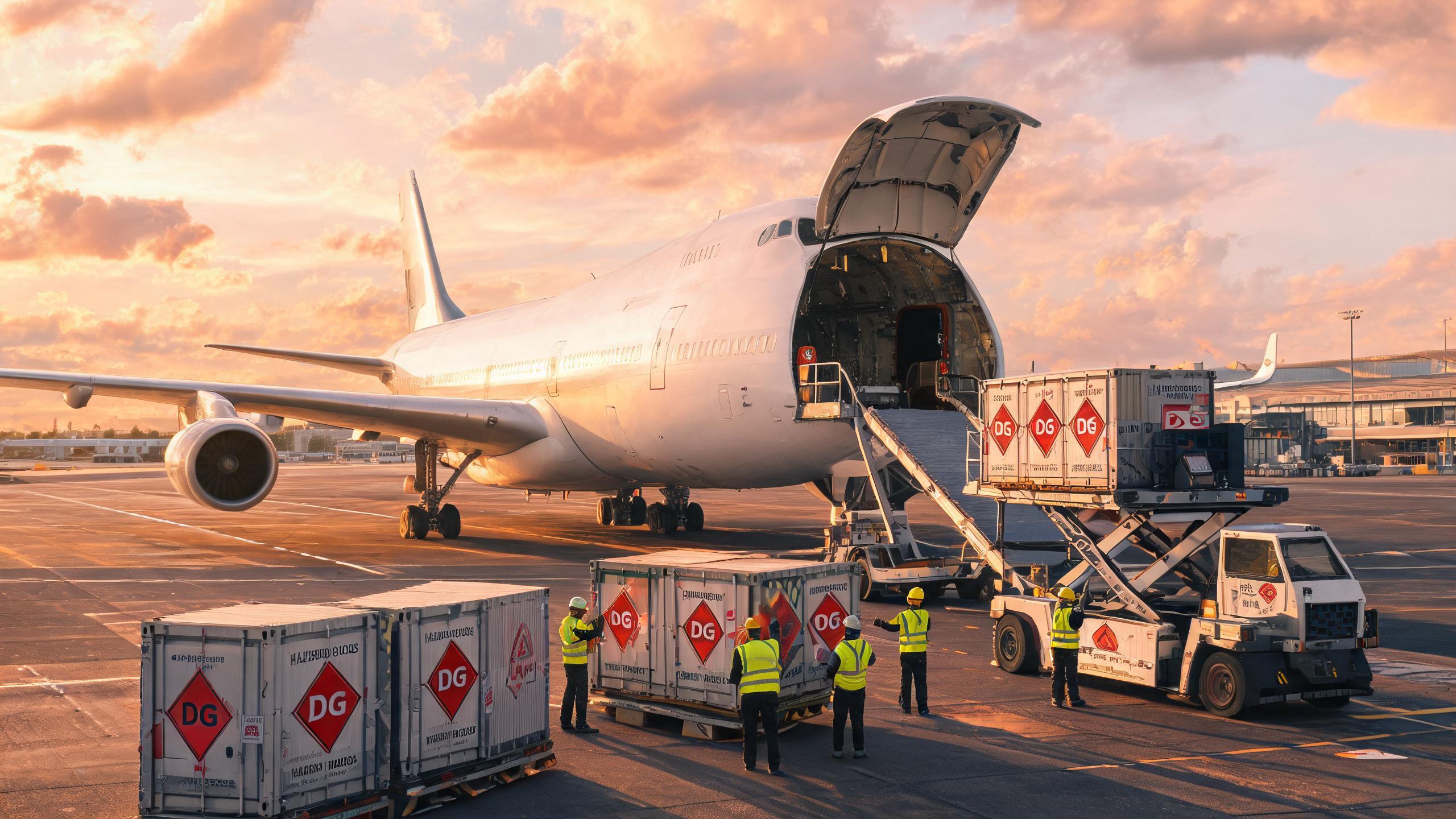
Shipping dangerous goods (DG) by air from China is a high-stakes operation. Lithium batteries, chemicals, and other classified hazardous materials require strict IATA DGR compliance, specialized packaging, and often a dedicated DG charter flight. This guide explains the regulatory framework, why chartering a full aircraft is sometimes the safest option, and how to evaluate a DG air freight partner in China.
BUYER GUIDE — DG AIR FREIGHT CHINA
If you are sourcing lithium batteries, industrial chemicals, or other classified hazardous materials from China, you already know that booking them on a regular passenger flight is rarely an option. Airlines impose strict quantity limits, many refuse certain UN numbers entirely, and the documentation requirements leave no room for error. For large volumes or high-risk goods, the practical answer is often a chartered air cargo for dangerous goods — a dedicated aircraft moving only your cargo under a controlled, fully compliant operation.
This guide covers the regulatory baseline you need to understand, when a DG charter flight makes commercial sense, and how to vet a freight forwarder in China before you commit cargo to them.
- IATA DGR is the operating standard for all air shipments of dangerous goods; compliance is non-negotiable and carrier-specific.
- Lithium batteries are among the most tightly restricted DG — state of charge, packaging, and labelling rules change frequently.
- A DG charter flight is justified when volume is high, the cargo is forbidden on passenger aircraft (CAO only), or schedule certainty matters more than cost.
- Your forwarder must hold valid DG training certificates and have direct airline or charter broker relationships — ask for proof.
What Counts as Dangerous Goods in Air Cargo
The International Air Transport Association (IATA) publishes the Dangerous Goods Regulations (DGR), which is the global reference for shipping hazardous materials by air. Under the DGR, dangerous goods are classified into nine classes, from explosives (Class 1) to miscellaneous dangerous goods (Class 9), which includes lithium batteries, dry ice, and asbestos.
For most buyers sourcing from China, the relevant classes are:
- Class 3 — Flammable liquids: paints, adhesives, solvents, some cleaning agents.
- Class 8 — Corrosives: acids, alkalis, battery electrolytes.
- Class 9 — Miscellaneous: lithium-ion and lithium-metal batteries, battery-powered devices, dry ice, and genetically modified organisms.
Each class has specific packing instructions (PI), labelling requirements, and quantity limits. The DGR also assigns each substance a UN number and a Packing Group (I, II, or III) based on the level of danger it presents. Getting these classifications wrong is not a paperwork issue — it is a safety and legal issue that can ground a flight or trigger heavy penalties.
Lithium Battery Shipping: The Most Common DG Challenge from China
Lithium batteries are everywhere in China's export mix — from power banks and e-bike batteries to EV battery packs and medical device power supplies. They are also the most frequently audited DG category. The IATA DGR has a dedicated section (Packing Instruction 965–970) covering lithium-ion and lithium-metal batteries, and the rules have tightened in recent years.
Key points to understand when shipping lithium batteries from China:
| Parameter | Requirement (typical) |
|---|---|
| State of charge (SoC) | Generally ≤30% for lithium-ion cells and batteries shipped by air |
| Packaging | UN 38.3 tested packaging; inner packaging must fully enclose the battery |
| Marking | Lithium battery mark with UN number, contact phone, and handling label |
| Shipper's Declaration | Required for fully regulated lithium batteries (PI 965 Section IA/IB) |
| Airline approval | Many airlines require pre-approval for lithium battery shipments |
One of the most common mistakes we see from new buyers is assuming that "small batteries" are exempt. The DGR has an excepted quantity provision, but it only applies to very small cells (typically below 20 Wh for lithium-ion) and still requires specific packaging and marks. If in doubt, treat the shipment as fully regulated and get a competent DG specialist to review it.
The cost of a rejected shipment — demurrage, storage, re-consolidation, and the risk of losing the cargo — almost always exceeds the cost of getting the DG paperwork right the first time.
Why a DG Charter Flight Is Often the Right Call
A DG charter flight means you lease an entire aircraft (or a substantial portion of its payload) exclusively for your cargo. This is fundamentally different from booking space on a scheduled freighter, where your DG boxes sit alongside other shippers' freight and must conform to the general loading rules.
Chartering makes commercial sense in several scenarios:
- Volume: When you have enough cargo to fill a significant share of the aircraft, the per-kilo rate of a charter can actually be lower than scheduled DG rates, which often carry heavy surcharges.
- CAO-only restrictions: Some dangerous goods are forbidden on passenger aircraft and may only travel on all-cargo flights. A charter guarantees you are on a freighter.
- Schedule certainty: Scheduled cargo flights with DG acceptance can face rollovers and delays. A charter gives you a fixed departure time.
- Segregation control: Some DG classes cannot be loaded next to each other. On a dedicated charter, you control the loading plan.
Chartering also simplifies the approval chain. Instead of negotiating with multiple airlines that each have their own DG acceptance policy, you work with one charter broker and one operating carrier. That single point of accountability is valuable when the cargo is time-sensitive or high-value.
How a DG Charter Operation Works from China
Here is the typical sequence for a dangerous goods air cargo China operation, from booking to takeoff:
- Pre-booking assessment: Your forwarder reviews the DG classification, UN numbers, quantities, and packaging to confirm the cargo is eligible for air transport and which aircraft type is suitable.
- Charter broker engagement: The broker sources an available freighter — common types include B747F, B777F, and IL-76 — and negotiates the rate, positioning, and departure window.
- DG documentation: The shipper's declaration, MSDS/SDS, and the air waybill are prepared. For lithium batteries, the UN 38.3 test summary must be attached.
- Ground handling: Cargo is delivered to the origin airport (typically PVG, CAN, or SZX for DG), inspected, and loaded under the supervision of a certified DG handling agent.
- Flight execution: The aircraft departs on the agreed schedule, and the buyer receives tracking updates until arrival.
Lead times for a DG charter from China are typically 5 to 10 days from confirmation to departure, depending on aircraft availability and the origin airport. Positioning an empty aircraft from another region adds time and cost, so flexibility on departure airport can significantly reduce the rate.
How to Evaluate a DG Air Freight Partner in China
Not all freight forwarders are equipped to handle dangerous goods, even if they say they are. Before you book, ask for these specific items:
- IATA DGR training certificates: Every person involved in accepting, handling, or preparing DG must hold a current certificate. Ask for copies and check the expiry dates.
- Airline approvals: The forwarder should have pre-approved DG agreements with the airlines or charter carriers they use. If they cannot name the carrier, that is a red flag.
- UN 38.3 test reports: For lithium batteries, the forwarder should be able to verify that the battery model has passed UN 38.3 testing. This is the manufacturer's responsibility, but a good forwarder will check it.
- Warehouse capability: DG cargo often needs segregated storage before loading. Ask whether the forwarder operates its own DG warehouse at the origin airport or uses a certified third-party facility.
- Incident history: A straightforward question — "How many DG shipments have you handled in the last 12 months, and have you had any rejections?" — will tell you a lot about their actual experience.
Cost Drivers for DG Charter Flights
Pricing for a chartered air cargo dangerous goods operation is not a simple per-kilo rate. The main cost drivers are:
| Cost Factor | Impact |
|---|---|
| Aircraft type and payload | Larger aircraft have higher fixed costs but lower per-kilo rates at full payload |
| Origin and destination airports | Positioning fees apply if the aircraft must fly empty to the origin |
| DG class and quantity | High-risk classes (e.g., Class 1 or 2) may require special handling or be refused entirely |
| Seasonality | Peak season (Sept–Dec) sees tighter aircraft availability and higher rates |
| Fuel surcharges | Passed through separately and indexed to global fuel prices |
As a rule of thumb, a DG charter from China to Europe or North America starts to make economic sense when the shipment weight exceeds 15–20 tonnes. Below that, you may be better off booking space on a scheduled freighter with a DG-accepting carrier. However, if your cargo is CAO-only or extremely time-sensitive, a charter can still be justified at lower weights.
Common Mistakes to Avoid
Based on our experience working with buyers, these are the recurring errors that cause delays and cost overruns:
- Incorrect SoC documentation: For lithium batteries, the state of charge must be declared and verifiable. Some airlines now physically check a sample.
- Missing UN 38.3 summary: The test summary must be attached to the air waybill. Without it, the cargo will not be accepted.
- Using non-compliant packaging: The outer packaging must meet UN performance standards and bear the UN specification mark. Reused or damaged packaging is a common rejection reason.
- Assuming all airlines accept all DG: Each carrier publishes its own "Conditions of Carriage" for dangerous goods. Some refuse certain UN numbers outright.
- Leaving DG booking to the last minute: DG acceptance requires more lead time than general cargo. Book at least 7–10 days ahead for scheduled flights, and longer for charters.
Frequently Asked Questions
Q: Can I ship lithium batteries as "excepted" or "small" quantities to save cost?
A: Possibly, but only if the cells meet the strict size thresholds in the DGR and the packaging complies with the excepted quantity provisions. Many buyers discover their batteries are too large and must be shipped as fully regulated DG. Have a DG specialist review the spec sheet before you plan the shipment.
Q: What is the difference between CAO and passenger aircraft restrictions?
A: "Cargo Aircraft Only" (CAO) means the item is forbidden on passenger aircraft and may only be transported on an all-cargo flight. A DG charter flight is by definition an all-cargo operation, so CAO restrictions are automatically satisfied.
Q: How far in advance should I book a DG charter from China?
A: For a standard DG charter, start the process 2–3 weeks before your desired departure date. This allows time for aircraft positioning, DG documentation review, and any airline-specific approvals. Last-minute charters are possible but will cost more.
Q: Who is legally responsible if the DG documentation is wrong?
A: The shipper (or the shipper's agent) is primarily responsible under IATA DGR and national aviation law. If your forwarder prepares the documentation on your behalf, they share responsibility, but the ultimate liability rests with the shipper. This is why it is critical to use a forwarder with real DG expertise.
Next Steps
Shipping dangerous goods by air from China is a controlled, document-heavy process — but it is entirely manageable with the right partner. The key is to start early, verify your forwarder's DG credentials, and be precise about your cargo's UN number, packing group, and packaging compliance.
If you are preparing a dangerous goods air cargo China shipment and need a compliance review or a charter quote, contact us with your cargo details — UN number, quantity, weight, and destination. We will assess the feasibility and provide a clear cost breakdown before you commit.