
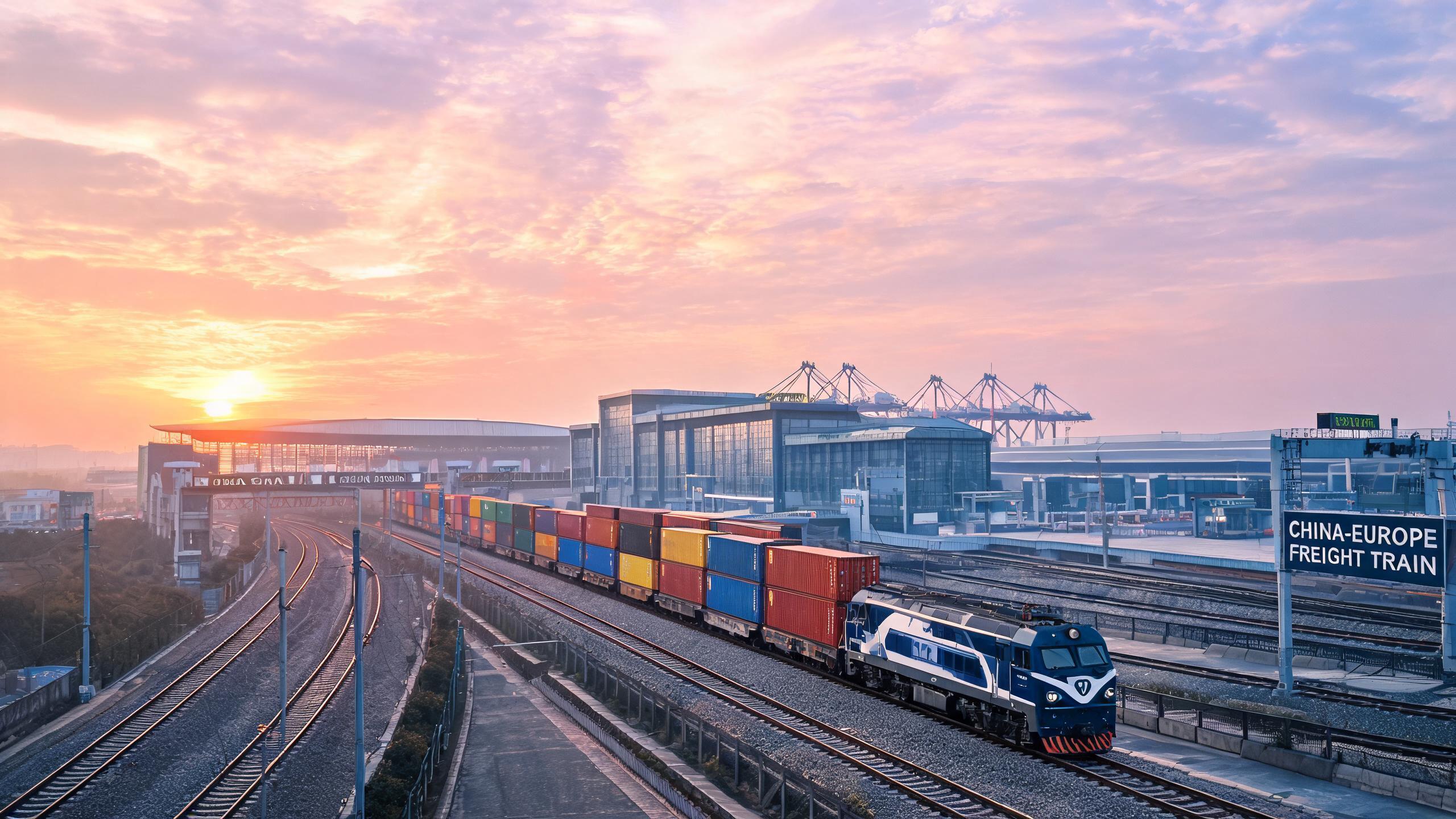
Discover everything you need to know about rail shipping from China to Europe. This guide covers the main routes, typical transit times, cost advantages, and practical considerations for B2B importers looking for a reliable alternative to air and sea freight.
INTERNATIONAL FREIGHT GUIDE
Why Rail Freight from China to Europe Is Growing Fast
For B2B buyers moving goods between China and Europe, the choice between ocean and air has long been a trade-off: sea is cheap but slow (30–45 days), air is fast but expensive (often 5–10× the cost). Rail from China to Europe fills that gap with a middle ground that many importers now consider the default for medium-value, time-sensitive cargo.
Since the first direct China-Europe freight train service launched in 2011, the network has expanded to cover dozens of departure cities in China and arrival hubs across Europe. In 2023 alone, over 17,000 China-Europe freight trains operated, carrying more than 1.9 million TEUs of goods. The route is no longer a niche option — it is a mature, scheduled service used by industries from automotive parts to electronics to fashion.
- Rail transit time: 12–20 days door-to-door, compared to 30–45 days by sea.
- Cost: 30–50% of air freight, and roughly 1.5–2× the cost of sea freight.
- Best suited for: goods with a high value-to-weight ratio, moderate urgency, or inventory replenishment needs.
- Main routes: Western (via Kazakhstan/Russia/Belarus/Poland) and Southern (via Kazakhstan/Azerbaijan/Georgia/Turkey).
- Customs clearance: requires proper documentation at both EU and China borders; some routes have additional transit country customs.
Main Rail Routes from China to Europe
There are two primary corridors for rail shipping from China to Europe. The choice between them depends on origin city, destination, cargo type, and current geopolitical considerations.
1. The Western Route (Main Line)
This is the most established and heavily used corridor. Trains depart from major Chinese hubs such as Xi'an, Chengdu, Chongqing, Zhengzhou, and Yiwu, cross into Kazakhstan at the Alashankou or Khorgos border, then travel through Kazakhstan, Russia, Belarus, and into Poland at the Malaszewicze terminal. From Poland, cargo is distributed to Germany, the Netherlands, France, Italy, and other European countries.
- Transit time (block train): 12–16 days from China to Poland.
- Frequency: Multiple departures per week from major hubs.
- Advantages: Mature infrastructure, frequent schedules, well-established customs procedures.
- Considerations: Crosses Russia and Belarus, which may affect insurance premiums or sanctions compliance for certain goods.
2. The Southern (Middle) Corridor
This route bypasses Russia and Belarus entirely. It departs from China (usually via the same western Chinese hubs), crosses Kazakhstan, then turns south through Azerbaijan, Georgia, and Turkey, before entering Europe via Bulgaria or Romania. It is also known as the Trans-Caspian International Transport Route (TITR).
- Transit time: 18–25 days door-to-door (longer due to multiple border crossings and a Caspian Sea ferry leg).
- Frequency: Less frequent than the Western route, but growing.
- Advantages: Avoids Russia and Belarus; preferred for cargo destined for Southern Europe or Turkey.
- Considerations: More border crossings = higher risk of delays; limited capacity on the Caspian ferry.
| Route | Departure Hubs (China) | Entry Point to EU | Typical Transit Time (block train) | Best For |
|---|---|---|---|---|
| Western (Main) | Xi'an, Chengdu, Chongqing, Zhengzhou, Yiwu | Malaszewicze, Poland | 12–16 days | Central / Northern Europe, high-frequency shipments |
| Southern (Middle) | Xi'an, Chengdu, Chongqing | Bulgaria / Romania | 18–25 days | Southern Europe, Turkey, goods requiring Russia/Belarus avoidance |
Transit Times: What to Expect for Rail from China to Europe
When you book rail freight from China to Europe, the transit time quoted by your logistics provider typically includes three segments:
- Pre-carriage: 1–3 days from your supplier's factory to the rail terminal in China (by truck).
- Main rail leg: 12–16 days (Western route) or 18–25 days (Southern route) from departure to arrival at the European hub terminal.
- Distribution: 1–5 days from the hub terminal to your final destination (by truck or short-sea).
Total door-to-door transit time is typically 14–20 days for the Western route and 20–28 days for the Southern route. These are averages; actual times depend on customs clearance speed at borders, weather, and terminal congestion.
"Rail is the sweet spot for restocking inventory between sea and air. If your sea shipment is delayed by a week, rail can cover the gap."
Cost Comparison: Rail vs. Sea vs. Air
Pricing for rail freight from China to Europe fluctuates with fuel costs, capacity, and demand. As a general benchmark:
| Mode | Typical Cost per CBM (China to Germany) | Transit Time (door-to-door) | Best for Cargo Value |
|---|---|---|---|
| Sea (LCL) | $100–$250 | 30–45 days | Low-value, high-volume, non-urgent |
| Rail | $400–$900 | 14–20 days | Medium-value, time-sensitive, inventory fill |
| Air | $2,500–$5,000 | 3–7 days | High-value, urgent, small volume |
Note: Rail rates are typically quoted per container (20' or 40') or per CBM for LCL. The cost advantage over air is substantial — often 60–70% less — while the time savings over sea are 50–60%.
What Types of Goods Move Best by Rail?
Not every product is ideal for rail freight from China to Europe. The best candidates share these characteristics:
- Value-to-weight ratio: Electronics, machinery parts, auto components, fashion items, home appliances, medical devices.
- Moderate urgency: Inventory replenishment, seasonal goods, or items that missed the ocean sailing window.
- Not too bulky: Heavy machinery or raw materials (steel, minerals) are usually cheaper by sea.
- Not too temperature-sensitive: Some rail containers offer temperature control, but it is less common and more expensive than sea.
Hazardous goods, lithium batteries (unless specially packed), and perishable food items require special handling and may be restricted on certain routes.
Documentation and Customs Clearance
Rail shipping from China to Europe requires a set of documents similar to sea freight, with some additions:
- Bill of Lading (CIM/SMGS consignment note): The rail equivalent of the ocean bill of lading. For the Western route, a combined CIM/SMGS note is often used to simplify border crossings.
- Commercial invoice and packing list: Standard for all modes.
- Certificate of origin: May be required for preferential tariff treatment under EU-China trade agreements or for goods subject to anti-dumping duties.
- Customs declaration: Filed at the Chinese departure terminal and again at the EU entry point (usually Poland or Bulgaria).
- Transit documents: For the Southern route, additional documentation for Azerbaijan, Georgia, and Turkey.
Customs clearance at the EU border is typically handled by the freight forwarder's agent at the entry terminal. Delays most often occur when the commercial invoice or HS code classification is incorrect. Work with a forwarder experienced in rail customs procedures.
Risks and How to Mitigate Them
No shipping mode is risk-free. Here are the most common issues B2B buyers face with rail freight from China to Europe, and how to address them:
Border Delays
Customs inspections at the China-Kazakhstan border or the Poland-Belarus border can add 1–3 days. Mitigation: Use a forwarder with a dedicated customs broker at these borders. Book on a "block train" (dedicated full train) rather than a single wagon, as block trains receive priority.
Geopolitical Risk
The Western route crosses Russia and Belarus. Sanctions on certain goods (e.g., dual-use technology, electronics) may apply. Mitigation: Confirm your cargo's HS code is not restricted. For sensitive goods, consider the Southern route.
Capacity Shortages
During peak seasons (September–November), rail capacity can be tight. Mitigation: Book 3–4 weeks in advance. Lock in rates with a long-term contract if you ship regularly.
Damage and Insurance
Rail containers experience less vibration than sea containers, but damage can still occur during loading/unloading or truck transfers. Mitigation: Purchase cargo insurance. Standard rail quotes often exclude insurance.
How to Choose a Rail Freight Provider
When evaluating providers for rail shipping from China to Europe, ask these questions:
- Which routes do you operate? Not all forwarders have contracts on both the Western and Southern corridors.
- What is your departure frequency? Weekly? Twice a week? Daily? Frequency affects your ability to meet tight deadlines.
- Do you offer door-to-door service? Some forwarders only handle the rail leg; you need to arrange trucking on both ends separately.
- What is your customs clearance process? Do you have in-house customs brokers at the EU entry terminal?
- What is your track record for on-time delivery? Ask for a recent performance report (e.g., percentage of shipments arriving within 2 days of the estimated date).
- Do you provide real-time tracking? Many rail operators now offer GPS tracking on containers.
Frequently Asked Questions
Is rail freight from China to Europe reliable?
Yes. The Western route has been operating for over a decade with scheduled services. On-time performance is typically 85–95% within a 2-day window, though geopolitical events can cause occasional disruptions.
Can I ship LCL (less than container load) by rail?
Yes. Many forwarders offer LCL rail services, though the minimum volume is usually 1–2 CBM. LCL rail is more expensive per CBM than full container load (FCL), but still cheaper than air.
What is the maximum weight per container?
Standard 20' containers: 20–22 tons. 40' containers: 26–28 tons. Exceeding these limits may require special permits or may not be accepted by rail operators.
Do I need to pay VAT at the border?
For shipments entering the EU, VAT is typically deferred or paid at the final destination, not at the border. Your forwarder can advise on the specific procedure for your country.
Conclusion: Is Rail Right for Your Supply Chain?
Rail freight from China to Europe is not a replacement for sea or air — it is a third option that fills a specific niche. If you are shipping medium-value goods that need to arrive in 2–3 weeks rather than 5–6 weeks, and you want to avoid the high cost of air freight, rail is likely the right choice.
For B2B buyers managing multiple product lines, a hybrid approach often works best: use sea for bulk, low-value items; rail for mid-range, time-sensitive goods; and air for urgent, high-value shipments. The key is to build rail into your supply chain planning, not as an emergency backup, but as a scheduled service you can rely on.
If you are evaluating rail shipping for your next order, contact a logistics provider with direct experience on the route you need. Ask for a recent transit time report, a full cost breakdown including customs and trucking, and a clear explanation of the documentation required. With the right partner, rail from China to Europe can become a competitive advantage in your supply chain.