
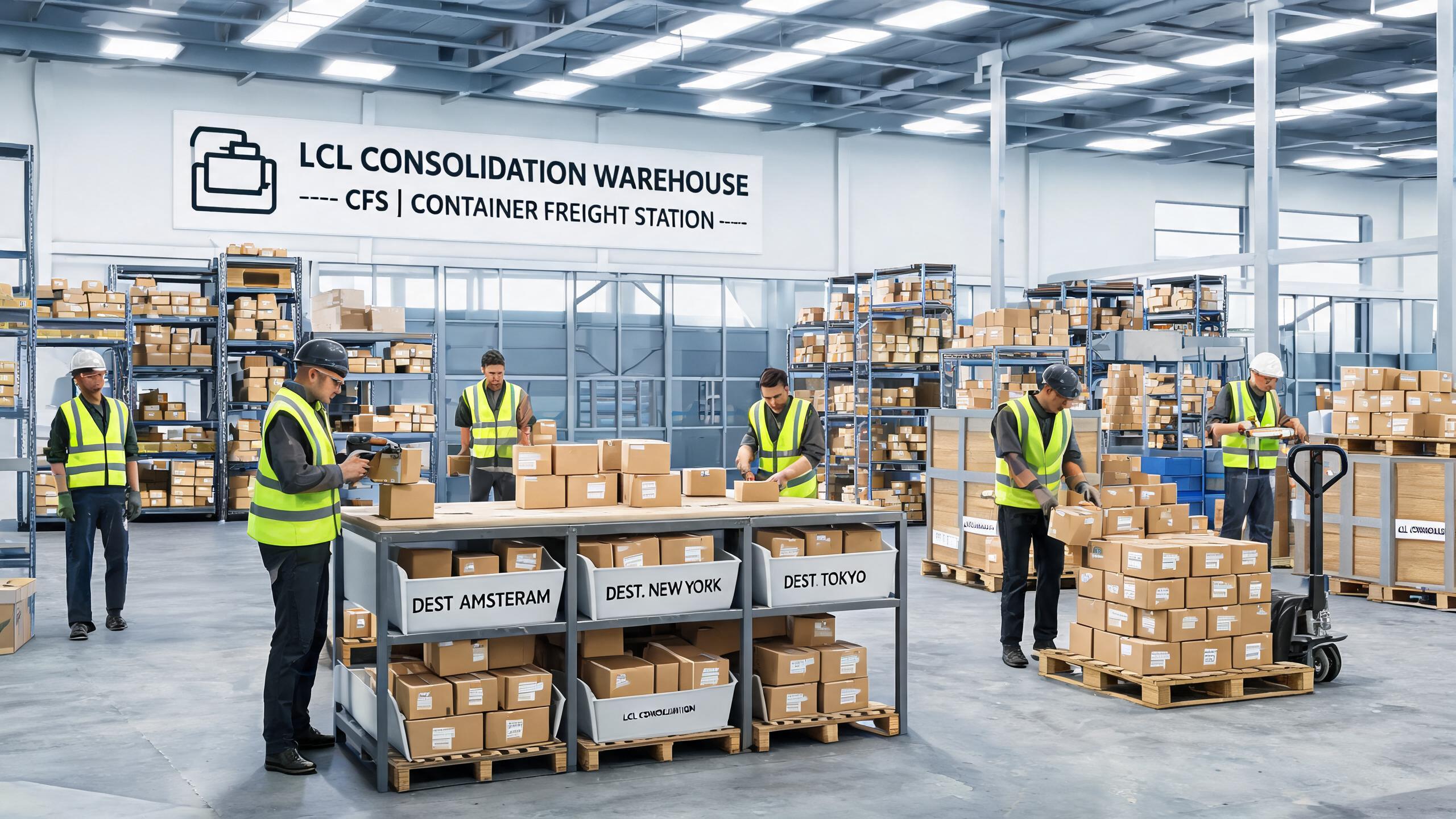
A practical guide for European importers using LCL shipping from China to Europe. Learn how weekly consolidation sailings work, how to calculate chargeable CBM, and what door-to-door delivery options are available — with clear steps to get an accurate quote.
FREIGHT BUYER GUIDE
If you are importing less than a full container from China to Europe, LCL consolidation is often the only economical option. But LCL freight is not as straightforward as FCL. You pay for space, not weight alone. You share a container with other shippers. And the final cost depends on how your cargo is measured, which port it lands at, and whether you need help beyond the destination port.
This guide covers the three things European buyers ask us about most: how weekly LCL sailings work, how CBM is calculated for lcl china to europe shipments, and what door-to-door options actually include.
- LCL rates are based on chargeable volume (CBM), not gross weight — a 200 kg pallet can cost more than a 500 kg pallet if it takes up more space.
- Weekly consolidation sailings from major Chinese ports to Europe are standard, but transit time varies by 5–10 days depending on the destination port and whether transshipment is needed.
- Door-to-door LCL shipping from China to Europe typically includes origin handling, ocean freight, destination customs clearance, and final delivery — but confirm what is excluded before you book.
Why LCL consolidation makes sense for Europe-bound cargo
A standard 20-foot container holds roughly 28 CBM of cargo. If your shipment is under 15 CBM, paying for a full container means paying for empty space. LCL consolidation lets you share that space with other shippers and pay only for the volume you use.
For European importers, LCL is common for:
- First trial orders before committing to full container volumes
- Spare parts, accessories, or after-sales stock
- Products with seasonal demand that do not justify a full container
- Mixed SKUs that need to arrive together but are ordered in small quantities
The trade-off is handling. Your cargo is loaded into a shared container, unloaded at the destination port, and separated from other shippers' goods. That adds a layer of handling that FCL does not have. Choose a forwarder with a reliable consolidation network to minimize the risk of damage or delay.
Weekly sailings: what to expect on LCL China to Europe routes
Most major forwarders operate weekly LCL consolidation sailings from Chinese hub ports — Shenzhen, Shanghai, Ningbo, Qingdao, and Guangzhou are the most common origins. A weekly sailing means your cargo can be cut off and loaded every week, rather than waiting for a full container to be booked.
Typical transit times for lcl shipping from china to europe are:
| Destination region | Typical transit time | Common entry ports |
|---|---|---|
| North Europe (Hamburg, Rotterdam, Antwerp) | 28–35 days | Hamburg, Rotterdam, Antwerp |
| Mediterranean (Genoa, Barcelona, Valencia) | 30–38 days | Genoa, Barcelona, Valencia |
| UK (Felixstowe, Southampton) | 30–38 days | Felixstowe, Southampton |
| Eastern Europe (via North Europe ports) | 35–45 days | Koper, Gdansk, Constanta |
Note
Transit times are estimates. They vary by carrier, season, port congestion, and whether the route is direct or requires transshipment. Ask your forwarder for the current schedule before you commit to a delivery date.
How CBM is calculated for LCL shipments
CBM stands for cubic meter — the volume of your cargo. For LCL consolidation Europe shipments, the freight forwarder calculates the chargeable volume based on the outer dimensions of each package or pallet.
The formula is simple:
CBM = Length (m) × Width (m) × Height (m)
For multiple packages, add the CBM of each package together. For example:
- 10 cartons, each 60 cm × 40 cm × 50 cm
- Each carton: 0.6 × 0.4 × 0.5 = 0.12 CBM
- Total: 10 × 0.12 = 1.2 CBM
That is your total volume. But here is where LCL gets tricky: the chargeable weight.
Chargeable weight: volume vs. actual weight
LCL carriers compare your cargo's actual weight against its volumetric weight. The higher of the two becomes the chargeable weight.
The standard volumetric divisor for ocean freight is 1:1000 — meaning 1 CBM is considered equal to 1000 kg.
| Scenario | Actual weight | Volume | Volumetric weight (CBM × 1000) | Chargeable weight |
|---|---|---|---|---|
| Dense cargo (e.g., metal parts) | 800 kg | 0.5 CBM | 500 kg | 800 kg (actual) |
| Light cargo (e.g., plastic goods) | 300 kg | 1.2 CBM | 1200 kg | 1200 kg (volumetric) |
Some forwarders also apply a minimum chargeable volume — often 1 CBM. If your shipment is 0.6 CBM, you may still be billed for 1 CBM. Confirm this with your forwarder before booking.
Door-to-door delivery options for LCL from China to Europe
Door-to-door LCL shipping from China to Europe means your cargo is picked up at the supplier's factory in China, consolidated, shipped, cleared through customs in Europe, and delivered to your warehouse or doorstep.
But "door-to-door" is a broad term. What is included depends on the Incoterm and the service level you choose.
Common Incoterms for LCL door-to-door
| Incoterm | Who handles origin | Who handles ocean freight | Who handles destination |
|---|---|---|---|
| EXW (Ex Works) | Buyer (or buyer's forwarder) | Buyer | Buyer |
| FOB (Free on Board) | Seller | Buyer | Buyer |
| DDP (Delivered Duty Paid) | Seller | Seller | Seller (including duty and taxes) |
| DAP (Delivered at Place) | Seller | Seller | Seller (excluding duty and taxes) |
For European buyers, DDP is often the most convenient option because the forwarder handles everything — including import duty and VAT. However, DDP requires the seller (or their forwarder) to have a local VAT registration or a reliable partner in the destination country. Not all forwarders offer DDP to all European countries. Confirm availability before you plan around it.
What door-to-door typically includes
A full door-to-door LCL service usually covers:
- Origin pickup from the supplier's factory in China
- Export customs declaration and documentation
- LCL consolidation and ocean freight
- Destination customs clearance
- Final delivery to your address
What it usually does not include:
- Import duty and VAT (unless DDP)
- Storage fees if cargo is not collected on time
- Delivery to remote areas (may incur additional charges)
- Insurance (recommended, but often optional)
How to get an accurate LCL quote
LCL pricing varies by origin port, destination port, cargo dimensions, weight, and current carrier rates. To get a reliable quote for lcl shipping from china to europe, prepare the following information:
- Number of packages and their outer dimensions (length × width × height in cm)
- Total actual weight in kg
- Commodity description and HS code (for customs and duty estimation)
- Origin city in China (for pickup or delivery to the consolidation warehouse)
- Destination city in Europe (for door delivery or port pickup)
- Preferred Incoterm (EXW, FOB, DAP, or DDP)
- Target arrival date, if you have one
The more precise your cargo details, the fewer surprises you will see on the final invoice. A forwarder who quotes on estimated dimensions may adjust the charge later when the actual measurements are taken at the consolidation warehouse.
Common mistakes buyers make with LCL
1. Underestimating the chargeable volume
Palletized cargo takes up more space than loose cartons. If your supplier ships on pallets, the pallet height and footprint count toward CBM. Always measure the palletized dimensions, not the carton dimensions.2. Ignoring the minimum chargeable volume
Many forwarders apply a 1 CBM minimum. If your shipment is 0.8 CBM, you may be billed for 1 CBM. This is standard practice, but it should be disclosed upfront.3. Assuming door-to-door includes duty and taxes
Unless you explicitly book DDP, import duty and VAT are your responsibility. A DAP quote includes delivery but not duty. A DDP quote includes both — and typically costs more because the forwarder assumes the risk and administrative burden.4. Not planning for destination handling time
LCL cargo must be deconsolidated at the destination port before it can be cleared and delivered. This adds 2–4 days compared to FCL. If your production line is waiting on parts, factor this into your lead time.Frequently asked questions
How often do LCL sailings from China to Europe depart?
Most major forwarders offer weekly consolidation sailings from Chinese hub ports. However, not every destination port receives a weekly direct sailing. Some smaller ports may only have bi-weekly or monthly services, which extends the overall transit time.What is the minimum shipment size for LCL?
There is no strict minimum, but forwarders typically apply a 1 CBM minimum charge. Shipments below 1 CBM are still accepted, but you pay for 1 CBM.Can I track my LCL shipment?
Yes. Most forwarders provide a tracking number and a portal where you can see the status of your cargo — from pickup to delivery. Ask for tracking details when your cargo is booked.Is LCL more expensive than FCL per CBM?
Yes. LCL rates per CBM are higher than FCL rates per CBM because the forwarder must cover the cost of consolidation, deconsolidation, and the risk of sharing space. LCL is economical only when your total volume is below the break-even point — usually around 15–18 CBM for a 20-foot container.Final advice for European buyers
LCL consolidation is a practical, cost-effective way to move smaller shipments from China to Europe — provided you understand how the pricing works. Measure your cargo correctly, confirm the minimum chargeable volume, and be explicit about what your door-to-door quote includes and excludes.
If you are planning a shipment and want a clear, itemized quote for lcl china to europe, send us your cargo details — dimensions, weight, commodity, and destination. We will come back with a breakdown you can compare line by line.